Choose a domain renewal budget: fund a defined window, not a launch offer
A useful domain renewal budget answers two questions: what are we proposing to retain, and what funding needs evidence before approval? A registration offer alone answers neither. This guide proposes a funding-window worksheet using sources accessed on October 14, 2026. It is a planning aid, not a current quote, financial advice or permission to spend, change renewal settings or let a domain lapse.
Boletolibre editorial team
Published
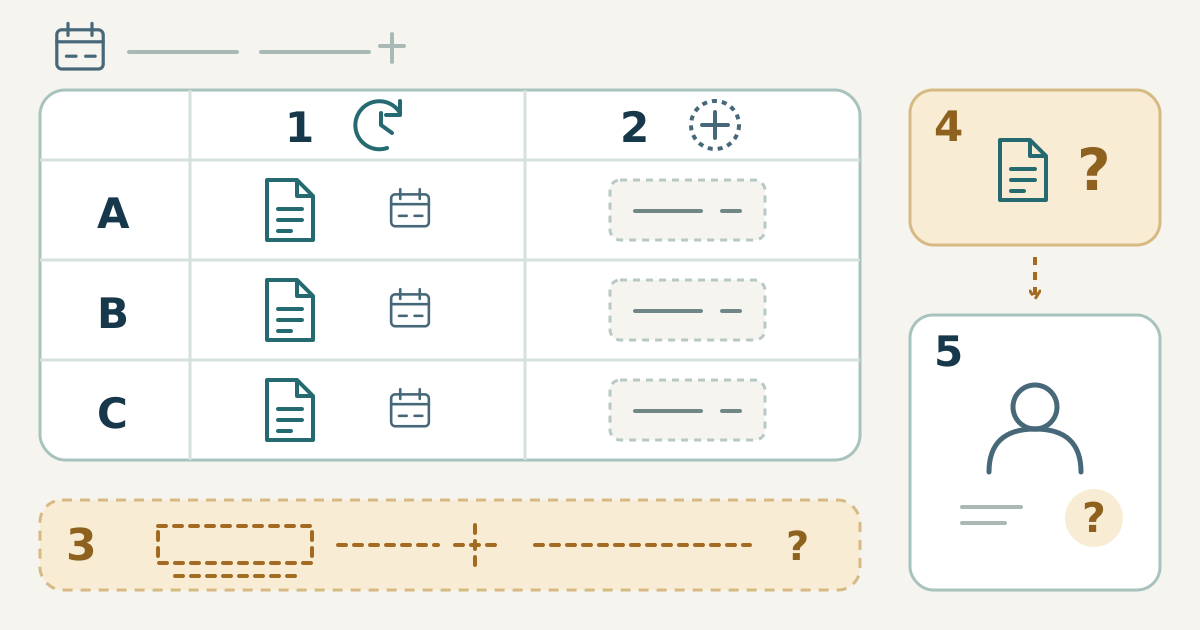
Start with the decision the approver needs
Choose an explicit budget window and one reporting currency. List only the domains proposed for retention in that window, with their business purpose and the person entitled to approve that decision. A previous event redirect may still matter even when no new event uses its name. The worksheet records that judgment; it does not make it for you.
Distinguish the registration expiry date, the proposed payment date and the date funding must be available. Record the evidence for each instead of assuming they coincide. If retention, term or payment timing is unresolved, keep the row visible as unresolved. Leaving it out of a subtotal must not silently authorize non-renewal.
Copy this blank funding card first
Cover record: budget window ____, reporting currency ____, preparation/review date ____, retention approver ____, quote reviewer ____ and funding approver ____. Duplicate the following two-column row card for each domain. Keep private account and payment details out of the shared document.
| Field per domain | Your entry and evidence |
|---|---|
| Identity and scope | Domain reference/purpose ____; proposed retention and authorized decision ____. |
| Timing | Expiry evidence ____; payment/funding date and source ____. |
| Applicable term | Renewal period ____; minimum term ____; account/product/premium applicability ____. |
| Renewal amount | Applicable quote ____; explicit currency ____; source/date ____; quote-review owner ____. |
| Optional scope | Separately quoted services ____; inclusion decision and owner ____. |
| Open charges | Tax/FX/premium/term questions ____; missing evidence and owner ____. |
| Window subtotal | Confirmed charge due in this window ____; unresolved row excluded and labelled ____. |
| Approval receipt | Quote recheck date ____; funding decision ____; held condition and next owner ____. |
Do not turn a label into an applicable quote
The Network Solutions page read on October 14 separates registration, renewal and minimum-term labels in its displayed A-extension table. It also distinguishes its standard schedule from premium-domain pricing. That is a useful example of questions to separate, not a recommendation. Other alphabet tabs, collapsed FAQs, account eligibility, checkout and tax terms were not inspected. The visible dollar symbol did not independently establish the currency.[1]
For your real row, obtain the renewal terms applicable to that exact domain and account. Match currency, covered period, payment timing and included scope before comparing amounts. Do not divide an ambiguous minimum term into an invented annual price or assume a launch offer continues. A multi-year option needs its own confirmed eligibility and matched periods; this guide establishes no savings or future-price guarantee.
Use disclosures to find evidence, not to set prices
For the gTLD scope of ICANN’s Expired Registration Recovery Policy, Sections 4.1–4.1.2 require reasonable availability of renewal, different post-expiration renewal and restoration fees at registration. Website display and agreement links are specified; registrars providing no registrar services through a website must at least include fees in their agreements. Reseller websites are also covered. These are disclosure duties, not ICANN-set retail rates or universal ccTLD terms.[2]
Sections 4.2–4.2.3 address notification-method descriptions on registrar websites if used, in agreements or linked pages, and on reseller websites. A described notice channel is not proof of delivery, your billing date or renewal authority. The policy version is February 21, 2024; implementation was allowed from August 21, 2024 and required by August 21, 2025. Keep those policy dates distinct from the October 14, 2026 source access. Already-expired cases require separate applicable renewal/restoration review.[2]
Fictional Cedar Lantern Club: three rows, one currency
Everything in this example is invented: Cedar Lantern Club, Domain A/B/C, purposes, dates, amounts and story approvals. They are not registrations or provider quotes. Assume USD reporting, January–December 2027, intended retention and a one-year renewal for each row. No payment or settings change occurs.
| Fictional row and funding date | Assumed USD renewal / optional charge |
|---|---|
| A: main identity; March 1, 2027 | 12.00 / 0.00 |
| B: previous-event redirect; June 1, 2027 | 18.00 / 6.00; optional service included only in the story |
| C: chapter identity; October 1, 2027 | 30.00 / 0.00 |
Fictional renewal subtotal: USD 12.00 + 18.00 + 30.00 = USD 60.00. Separate optional scope: USD 6.00. The known fictional pre-tax subtotal is therefore USD 66.00. The zero optional entries mean no such charge in this story, not that real services are free. No restoration charge is assumed; restoration is not thereby free.
Put the scenario beside the subtotal
For teaching only, assume a reserve of 10% of the USD 66.00 subtotal: USD 6.60. Adding that scenario produces USD 72.60 before tax. Neither the percentage nor the reserve is a registrar fee, recommended rate or price prediction. Tax remains unresolved, not zero; USD 72.60 is not an all-in budget. No currency conversion is modeled.
Keep the arithmetic separate from evidence completeness. Here four review items are three invented renewal quotes recorded plus one tax question pending. Funding approval remains qualified or held for tax and quote recheck despite the sum. In a real memo, exceptional late-renewal/restoration exposure belongs in a separate scenario with applicable evidence, not hidden inside ordinary renewal.
Return a memo that can be approved or held
Hand over the included and unresolved row counts, renewal and optional subtotals, reporting currency, covered periods, excluded charges and dated quote sources. State the scenario base separately and name each remaining question, reviewer and decision date. If an amount cannot be evidenced, say what is missing rather than entering zero.
The next action is a quote-gap review with the authorized owner, not a purchase or automatic-renewal change. Confirm current local tax, currency conversion and registrar/account/registry terms before spending. This worksheet does not establish ownership, continuity or a successful renewal. Its value is making the funding decision and its limits legible.
Sources and further reading
- Dated provider A-table labels and standard/premium caveat; not an account quoteNetwork Solutions · Accessed
- ERRP version February 21, 2024, Sections 4.1–4.2.3; qualified gTLD disclosure dutiesICANN · Accessed