An event planning checklist built around owners, dependencies and readiness
A useful event planning checklist answers three questions: who owns the outcome, what must happen first, and what proves the work is ready? Organize it around the next commitment, not a long wall of ticks. This guide is a planning aid, not a complete safety plan, legal checklist or certification.
Boletolibre editorial team
Published
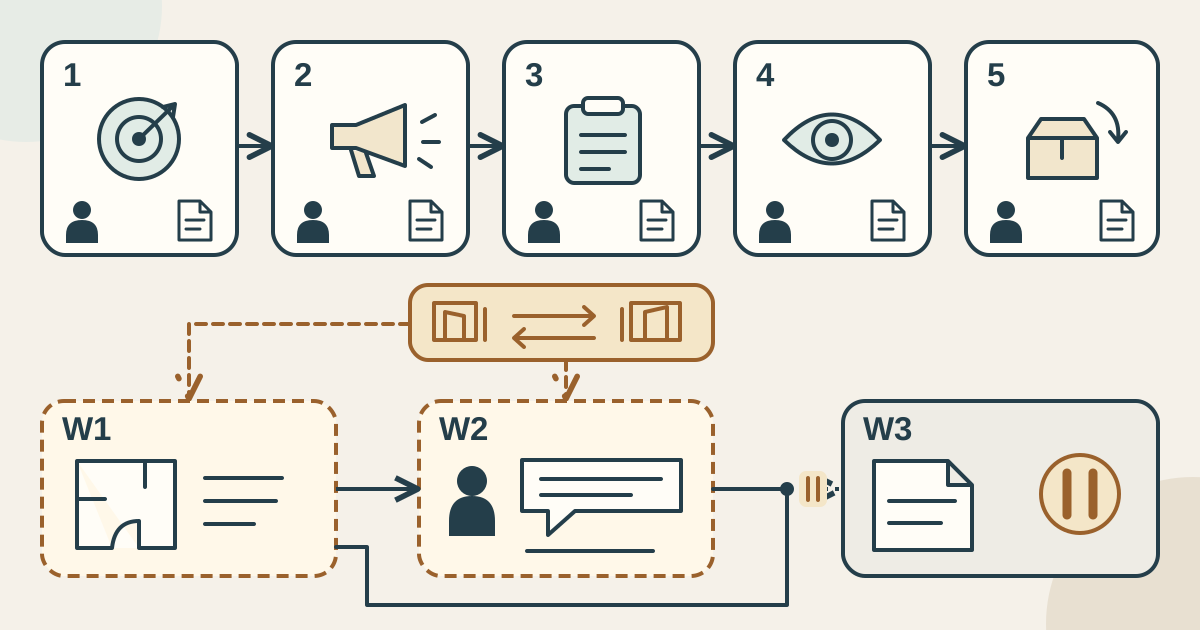
Give every critical task an owner and a closure test
Write each row as an outcome, not an activity: “confirm the current room and reviewed arrangements” is more useful than “email venue.” Record one accountable owner and backup, dependencies, due point or trigger, completion evidence and who can pause the next commitment. Contributors can share the work without making responsibility anonymous.
Use statuses such as blocked, in progress, ready for review and verified for stated scope. Evidence should identify its reviewer, date and configuration. A changed room or supplier may invalidate an earlier check. This owner-and-evidence method is an editorial tool informed by HSE monitoring and testing guidance, not an official approval scheme. HSE’s cited guidance concerns Great Britain; it is not a worldwide legal checklist.[1][3]
Review five commitments across the lifecycle
- Purpose and resources: agree the audience, useful outcome, format, demand assumptions, budget owner and key decision dates. Record what is confirmed and what remains an assumption.
- Public promises: verify the real date, venue configuration, applicable documented limits, supplier availability, admission conditions, change/refund information and guest-support contact before presenting them as settled.
- Operational readiness: assign competent workstream leads and backups; coordinate setup, public operation and breakdown, the running order, event-specific risk arrangements, staff briefing and actual checks.
- Run and monitor: name the live operations lead and handover process. Check arrangements before admission, monitor conditions and keep an issue/decision log. Changes reopen relevant dependencies.
- Close and learn: manage breakdown and load-out, assign outstanding support or payment cases, reconcile costs and record debrief actions with owners and due points. Guests leaving does not close every task.
These five gates are an original organizing framework, not a fixed calendar or regulator standard. They can overlap or repeat after a change. Set deadlines from real lead times, agreements and approvals rather than assuming every event starts three months ahead. HSE treats setup and breakdown as part of event management, not leftovers after the public program.[1]
Verify the actual venue and guest arrangements
Expected attendance, a registration target and a sales limit are not proof of safe or approved capacity. Obtain the assessment and applicable documents for the actual venue and layout from competent venue/safety people and relevant authorities. Record what configuration they cover. This guide supplies no floor-area formula, staffing ratio or capacity certification. HSE’s crowd assessment guidance distinguishes site and audience assessment from demand assumptions.[2]
Plan access and communication with the actual audience in mind: clear arrival information, a support-request route, assistance arrangements and accessible emergency communication. The US Department of Justice guidance addresses effective communication for entities covered by ADA titles II and III, with the context and person’s needs affecting the response. It is not worldwide accessibility law or a complete physical-access specification. HSE separately addresses assistance in emergency planning; check local duties and competent advice.[4][3]
Worked example: a room change reopens readiness
A fictional workshop expects about 80 guests. That is a demand assumption, not an approved occupancy. The venue contact owns W1: document the real room, configuration and applicable limit. The guest-experience lead owns W2: review access and communication arrangements using W1. The communication lead owns W3: publish accurate registration details only after W1 and W2 are resolved.
Before launch, the room changes. W1 and W2 return to review; W3 is blocked even if the old page was complete. The operations lead also rechecks the briefing and communications for the new room. The team does not inherit the old limit or squeeze in 80 because that was its forecast. It updates public promises after the relevant competent review. A changed dependency matters more than yesterday’s green status.
The same row method can trace supplier availability, a speaker replacement or changed access needs. Record which downstream tasks reopen, who decides the next commitment and who updates guests. The example illustrates dependency handling, not a calculation or assurance that a particular event is ready.
Prepare decisions and communication for interruptions
A contingency needs more than a spare supplier name. Identify who can hold, change or stop activity, the backup decision-maker, who contacts staff/suppliers/guests and the relevant service or authority liaison. Let competent event-specific assessment set the actual triggers and instructions. Do not invent weather thresholds, emergency numbers or evacuation procedures from this generic checklist. HSE’s emergency and liaison guidance supports risk-proportionate planning and clear roles in its GB context.[3][5]
Brief the real team and test the agreed communication arrangements before use. In a change log, record the concern, responsible decision-maker, applicable plan, decision or escalation, message owner and next check. An unresolved critical issue must remain visible to the person authorizing the next step. During an incident, follow the actual plan and competent instructions rather than improvising from an article.[3]
Close the loop, not just the checklist
- Can each important public promise be traced to an owner and current evidence?
- Are blocked dependencies and changes visible before the next commitment?
- Do the actual team and backups know their roles, and can guests request communication or access support?
- Are setup, breakdown and post-event support covered, with open actions assigned?
After the event, compare the plan with what happened and carry corrective actions into the next event. Keep unresolved support, financial or operational work open until the responsible owner has evidence to close it. HSE recommends monitoring and post-event review; a completed checklist alone is not proof of safety, legal compliance or any platform’s operational capabilities.[1]
Sources and further reading
- Managing an event: lifecycle, competence and review — Great BritainUK Health and Safety Executive · Accessed
- Crowd assessment and venue suitability — Great BritainUK Health and Safety Executive · Accessed
- Incidents and emergencies: roles, communication and testing — Great BritainUK Health and Safety Executive · Accessed
- Effective communication: US ADA covered-entity guidanceUS Department of Justice / ADA.gov · Accessed
- Working with others: proportionate liaison — Great BritainUK Health and Safety Executive · Accessed