Recover control of an organization domain: build an evidence brief
When the organization cannot access its domain account, the first deliverable is a clear evidence brief and an authorized route for help. A loading website does not answer who currently holds the registration or account. This guide organizes those questions using sources read October 14, 2026; no actual account, recovery request or ownership determination is involved.
Boletolibre editorial team
Published
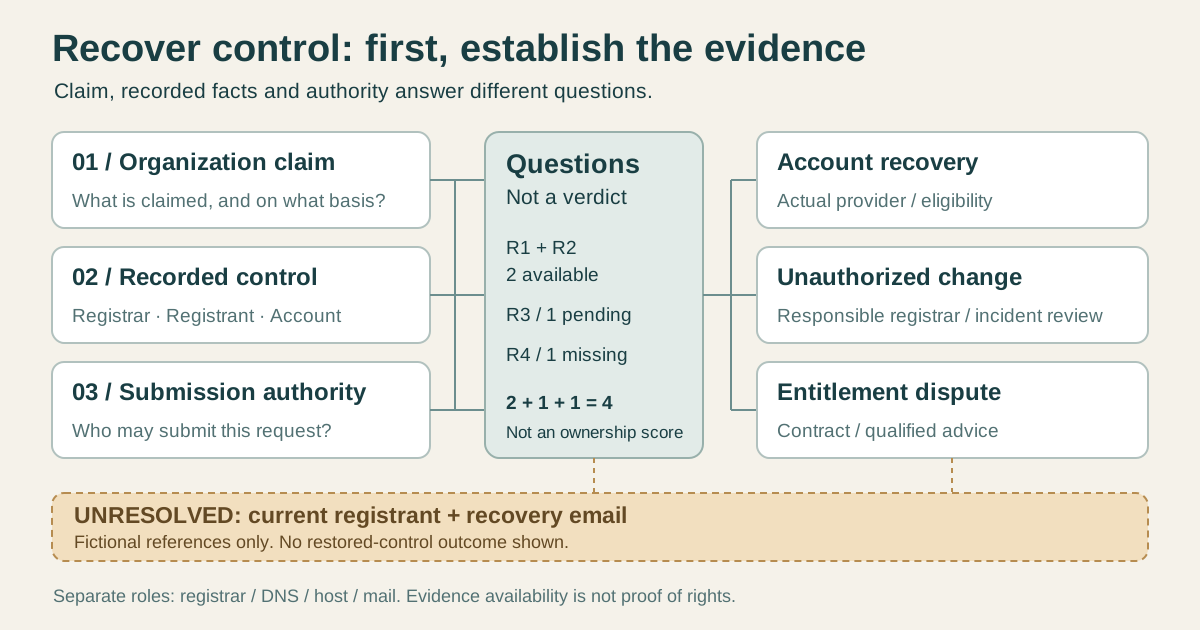
Describe the reported problem without deciding the rights
Start with one factual sentence: which organization reports which access or control problem, when it was noticed and who can provide the original observation. Distinguish a failed login, inaccessible recovery email, changed registration data, suspected registrar move and disputed entitlement. Several may coexist, but each needs its own supporting record. Do not convert “a contractor used to manage it” into a theft allegation.
Name a coordinator and record the internal authority reference. That assignment permits only the work it actually authorizes; it does not create registrant rights or guarantee provider acceptance. Keep registration, registrar account, authoritative DNS, website host and mail administration separate. Access to one does not settle the others.
Begin with a blank control record
For every entry add source/time ____, authorized custodian ____, what is known ____, uncertainty ____ and next review ____. A claim and a verified fact should remain visibly different. These are planning fields, not a mandatory registrar form.
| Field | Your record or open question |
|---|---|
| Organization and domain reference | Internal reference ____; claimed entitlement and its basis ____. |
| Coordinator | Authority reference and limits ____; person permitted to request help ____. |
| Registrar and registration | Suspected/confirmed provider ____; TLD/status/source/time ____. |
| Registered holder | Current recorded registrant evidence ____; privacy/redaction limits ____. |
| Account and recovery channel | Account-holder evidence ____; recovery-email accessibility known/unknown ____. |
| Other services | DNS operator ____; host ____; mail operator ____; separate evidence for each. |
| Incident and continuity | What changed/when/reporter ____; service impact and preservation owner ____. |
Leave unknown fields unknown. A public page or old receipt cannot fill in the current account holder by inference. Do not assume every registrant detail will be publicly visible; this guide performs no lookup and adopts no completeness promise from legacy WHOIS terminology.
Keep references and provenance, not private document copies
For each row note evidence locator ____, what it actually supports ____, custodian/authorized reader ____, availability/provenance gap ____ and question for the provider or qualified adviser ____. Keep sensitive proof in its approved private location.
| Reference category | Question the record should answer |
|---|---|
| 1 Registration or order record | Which transaction/customer/date does it establish, and what current control does it leave unknown? |
| 2 Organizational authorization | Who may investigate or submit, within what scope? Does the provider accept that authority? |
| 3 Agency or employment agreement | Which registrant, assignment and exit obligations are actually documented? Which clauses remain unread? |
| 4 Change notice or incident record | Is this the original notice, a dated copy or someone’s recollection? What changed, if anything? |
Use references rather than copying IDs, signatures, credentials, authorization codes or payment data into a shared worksheet. Before an authorized submission, verify the responsible provider’s official channel and current requirements. A well-organized internal file is not itself proof that a recovery request qualifies.
Choose an evidenced branch with a stop condition
Add a named internal receiver ____, evidence to hand over ____ and next review ____ to the selected row. Provider-specific steps must be confirmed with the actual provider. GoDaddy’s public help illustrates distinct email-access, listed-registrant and verification situations; it does not establish a universal workflow.[1]
| Situation supported by evidence | Branch and unresolved gate |
|---|---|
| Account email accessible, login unavailable | Check the actual registrar’s reset instructions; success and other verification requirements remain unproved. |
| Account email inaccessible or verification blocked | Authorized provider recovery route; no former worker’s shared password or verification bypass. |
| Listed registrant lacks account access | Provider domain-access eligibility; establish the listing and authority rather than relying on branding. |
| Apparent unauthorized transfer/data change | Registrar incident review; previous registrar for a claimed unauthorized transfer. Preserve facts without promising reversal. |
| Agency/current registrant disputes entitlement | Contract discussion and qualified advice as needed; not routine password recovery. |
| Registration has lapsed | Separate expiry/restoration route with actual registry/registrar rules; this brief supplies no grace period. |
ICANN directs claimed unauthorized transfers to the previous registrar immediately and unauthorized registration-data changes to the registrar immediately. A possible reversal depends on circumstances and applicable law. Do not wait for this worksheet to become perfect before an authorized person raises an evidenced urgent incident through the genuine channel.[2]
Keep provider requirements and ICANN authority in scope
The GoDaddy page documents identity verification and business documentation when a company is listed in the account. It also notes high request volume. Read the current exact requirements in the provider’s official process; this guide supplies neither a universal sufficient-document list nor a response deadline. No reset, upload, verification cancellation or support request has been attempted.[1]
ICANN describes contractual authority, not power to return a domain directly or edit registration data. A contract or registrant dispute may require qualified legal advice; narrow trademark proceedings are not a general lost-login remedy. Keep this accredited-gTLD context distinct from country-code registry rules. No linked proceeding, full legal policy or actual entitlement is assessed here.[2]
Fictional Lantern Assembly: four records, no rights score
| Fictional reference | Limit, availability and next question |
|---|---|
| R1 Old purchase receipt — available | Names the organization as customer, not current registrant/account holder. Ask what is currently recorded. |
| R2 Internal authority minute — available | Assigns investigation, not provider-recognized rights. Verify authority for the particular request. |
| R3 Previous service agreement — pending | Service is mentioned; assignment/exit terms unread. Ask its custodian for the relevant terms. |
| R4 Account-change notice — missing | No original located; a colleague’s report is not the notice. Ask an authorized custodian for legitimate correspondence. |
Two available + one pending + one missing = four references. This is an availability count, not ownership confidence, evidence sufficiency or recovery probability. Current registrant and recovery-email access remain unknown. The coordinator prepares questions, not a reset, unlock, transfer or payment. An actual unauthorized transfer would select the previous-registrar incident branch; an entitlement dispute stays on its distinct contract/advice branch.
Separate a completed brief from recovered control
An internally complete brief identifies the claim, evidence limits, responsible provider, authorized coordinator, chosen branch and next unresolved gate. Actual recovery needs a real provider outcome and authorized organizational acceptance: what access or recorded control changed, who accepted it and what remains unresolved. A draft request, reference number or working website cannot stand in for that outcome.
Assign separate owners to service preservation and later account stewardship. Record only what they actually confirm, with a review time. Registrar transfer, renewal and cooperative agency handover remain separate plans. This guide provides no Boletolibre domain-recovery capability or successful recovery case.
Sources and further reading
- GoDaddy: regain domain or account access, Spanish helpGoDaddy · Accessed
- ICANN: About Lost Domain NamesICANN · Accessed