Hand over a domain after an agency contract: record recipient acceptance
An agency contract can end while domain responsibilities remain unfinished. A working homepage and an email saying “handed over” do not establish who now controls the registration or accepts its ongoing care. Use this blank-first record for a cooperative exit, with public sources read October 14, 2026. Actual rights, provider eligibility and account outcomes still require their own evidence.
Boletolibre editorial team
Published
Define the change before calling it a transfer
Separate a change of registered holder, a move between accounts at one registrar, a move to another registrar, a DNS delegation change, a hosting or mail migration and contractual allocation of rights. They can interact, but they are not interchangeable. A cooperative handover starts with both parties able and authorized to participate; a disputed claim or inaccessible approval channel needs a different route.
Network Solutions distinguishes ownership changes from registrar transfers and describes approvals involving current and new registrants. Its provider-specific guidance also warns that associated services may need separate handling. Treat it as a useful set of questions for the actual provider, not a tested account procedure or a promise of uninterrupted service.[1]
Fill the bounded handover record first
For each field add source and observation time ____, authorized custodian ____ and unresolved question ____. Reference private records in their approved location; keep passwords, identity copies, authorization codes and payment information out of this shared sheet. These are proposed internal planning fields, not a mandatory ICANN form.
| Field | Your record |
|---|---|
| Parties and scope | Organization/domain reference ____; outgoing agency role ____; receiving organization role ____. |
| Allocation and authority | Relevant contract/assignment references ____; unread terms or disputed rights ____; recipient authority and limits ____. |
| Current recorded control | Registrar ____; recorded registrant ____; account controller ____; evidence/date for each ____. |
| Needed change | Registrant/account/registrar/none/unknown ____; actual provider eligibility question ____. |
| Sequence and dependencies | Registrar move also intended? ____; lock/eligibility and any offered advance opt-out question ____; service dependencies ____. |
| Proposed window and receiver | Planning window ____; authorized receiving coordinator ____; next review ____. |
Keep unknowns visible. The agency’s technical access does not by itself decide registrant entitlement; an internal assignment does not guarantee that a provider accepts a representative. A contract reference records an unresolved question until the appropriate people have read and accepted what it actually establishes.
Resolve the registration-policy question before changes
The cited ICANN Transfer Policy is the version updated February 21, 2024, mandatory from August 21, 2025. Its Change of Registrant provisions concern the accredited gTLD setting; do not apply them automatically to every country-code domain. A material name or organization change, or any registrant email change, can engage this process. Registrars have discretion around name/organization corrections; there is no universal typo exception.[2]
A Designated Agent needs explicit authorization from the relevant prior or new registrant. An agency job title or contract role alone does not establish that status. The policy sets eligibility and secure consent requirements for the relevant parties, with notifications to both. Do not reduce this to a universal email-only recipe or assume every expired registration is ineligible: the expiry restriction includes loss of the right to renew or transfer.[2]
A Change of Registrant normally produces a 60-day inter-registrar transfer lock. A registrar may offer an opt-out before any change request; availability is not universal. If a registrar move is also planned, establish the permitted sequence and the actual provider’s advance choice before requesting a material change. This is not a promise of later unrestricted lock removal, transfer eligibility or completion time.[2]
Use four independent acceptance gates
Complete every row with evidence reference and time ____, exactly what it establishes ____, authorized recipient ____ and status evidenced/pending/not checked ____. Add the unresolved stop condition ____. Provider confirmation and the organization’s acceptance answer different questions; retain both where needed.
| Gate | Evidence and recipient acceptance to obtain |
|---|---|
| A1 Registration/account control | What registered data or account control actually changed? Which provider confirmation and recipient review support that limited result? |
| A2 Recovery responsibility | Who is authorized to maintain the recovery arrangements? Has that recipient accepted the responsibility through legitimate access? No secrets in the sheet. |
| A3 Renewal responsibility | Who accepts ongoing renewal, settings review and the next review date? A role name alone is not acceptance or a proven renewal. |
| A4 Service dependencies | Who accepts the documented DNS, host, mail and associated-service position? Which unresolved dependency prevents closeout? |
“Evidenced” means the stated fact has its stated support, not that all rights are settled or every service works. Do not award a percentage or infer another gate from one successful observation. A homepage can load while mail administration and renewal responsibility remain unresolved.
Keep a separate service dependency rail
For each row record retain/move/unknown ____, relevant agency obligation ____, receiving owner and actual acceptance ____, source/time ____ and open issue ____. Keep the intended state distinct from an observed outcome.
| Dependency | Question before closing the agency role |
|---|---|
| DNS and zone inventory | Who holds legitimate administration and the necessary record inventory? Any separate delegation change? |
| Website and hosting | Who accepts hosting administration and continuing service obligations? Does anything remain with the agency? |
| Mail service | Who legitimately administers mail and accepts continuity responsibilities? A website check does not answer this. |
| Associated subscriptions | Which privacy/security or other services remain, move or need separate setup? Who accepts each dependency? |
Network Solutions describes associated services that may need migration, recreation or separate arrangements. Confirm the actual product and provider instead of assuming a registration change carries everything along. Record the receiving owner’s acceptance before proposing removal of remaining agency access or cancellation of a dependent service.[1]
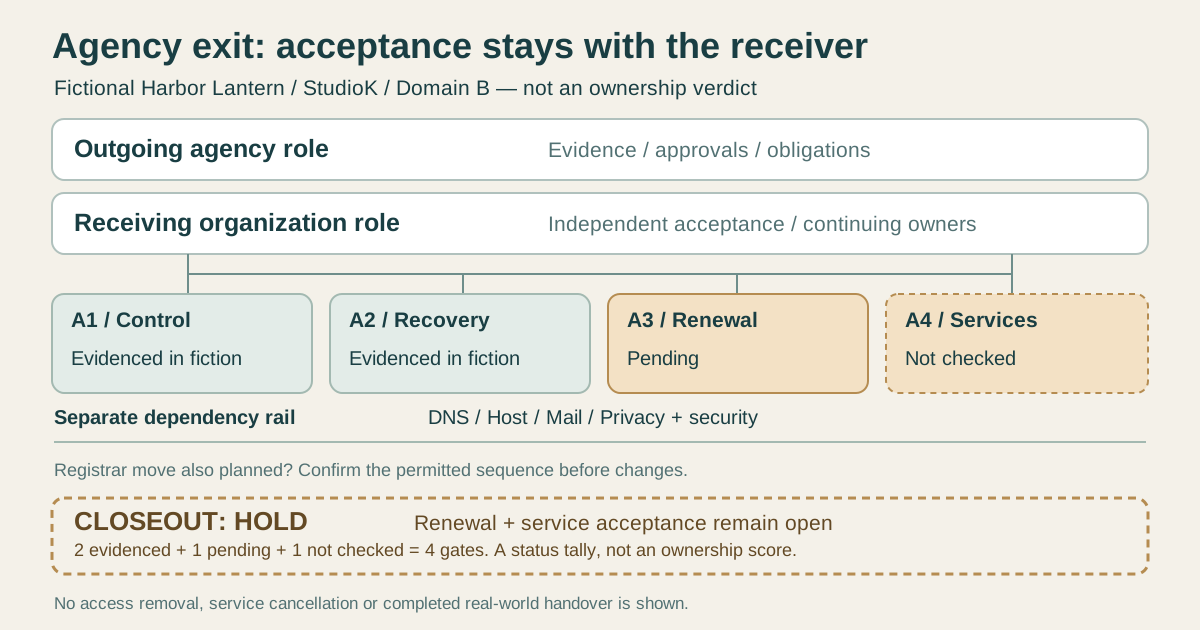
Fictional Harbor Lantern: two evidenced gates still leave HOLD
| Fictional gate | Recorded position and limit |
|---|---|
| A1 Control — evidenced in fiction | Invented provider confirmation plus receiving coordinator review support the stated account/control result only; it is not a legal ownership verdict. |
| A2 Recovery — evidenced in fiction | Invented authorized recipient acceptance records continuing recovery responsibility, without credentials or a real recovery operation. |
| A3 Renewal — pending | A role has been named; recipient acceptance and settings review have not been recorded. |
| A4 Services — not checked | DNS, hosting and mail rail remains unchecked. A loading homepage is insufficient. |
Two evidenced + one pending + one not checked = four gates. This is a status tally, not 50% ownership, recovery probability or a registrar score. Overall closeout stays HOLD. The fictional next custodians must document A3 and A4 evidence and acceptance; no agency access is removed and no service is cancelled.
Close only the scope that the recipient actually accepts
Record the actual provider outcome, its scope and observation time separately from the recipient’s independent authorized acceptance. List unresolved items, their owners and review dates. Plan any residual agency-access removal only within authorization and after relevant dependencies are resolved; the contract end date alone does not authorize cancellation or DNS changes.
If rights become disputed, approval access is unavailable or authority cannot be established, stop the cooperative path and choose the evidence-based recovery or contract/advice route. A completed internal sheet is useful preparation, not a completed real handover. Renewal, recovery and service stewardship continue with the people who actually accept them.
Sources and further reading
- Network Solutions: transferring domain ownership and associated servicesNetwork Solutions · Accessed
- ICANN: Transfer Policy, updated February 21, 2024ICANN · Accessed