Serverless vs traditional hosting for event websites
“Serverless” means the provider manages the compute environment, not that an event website has no servers or no operational work. A useful comparison separates public content from registration, checkout handoff and background jobs. The right answer can differ for each path.
Boletolibre editorial team
Published
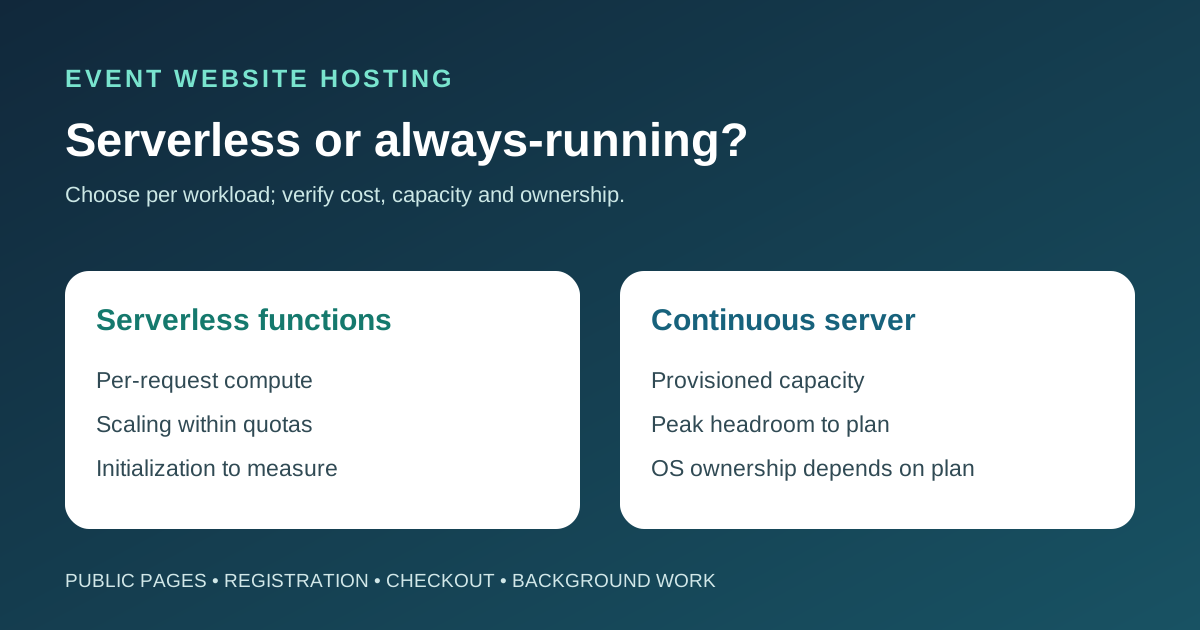
Compare workloads, not labels
A mostly static event guide may be delivered from a CDN without either an always-running application server or a function on every page view. Registration APIs, ticket checks, webhooks and scheduled email are different workloads. List each path and its data store, provider dependency and failure impact before choosing a platform. A hybrid arrangement is possible.
Map scaling and response-time limits
Serverless functions can add capacity as requests arrive, but account concurrency, function scaling and downstream database or payment limits still matter. Initialization may affect some requests; measured impact depends on the provider and application. A continuously running server avoids function initialization for that process, yet a single fixed server can saturate on an on-sale spike. Ask how each design queues, throttles and recovers under your expected peak.[1][2][3]
Compare full costs and ownership
Compare a realistic month plus the event launch burst. Include compute or instance charges, CDN and bandwidth, database, API requests, logs, monitoring, backups, support and engineering time. A low-traffic function can be economical; a server may suit steady compute. Neither is universally cheaper. Define who patches, deploys, monitors, restores and handles incidents in each option. “Managed” and “serverless” are different questions.[1][2][3]
Use the decision worksheet
Download the editable hosting decision worksheet (Markdown, English)
Download the editable workload-and-quote worksheet. For each candidate, record observed traffic, peak request rate, expected duration, cost components, capacity limits, the tested attendee journey and the owner. Choose only after the public page, registration, checkout redirect and confirmation path have an explicit plan. Do not use a generic request-count crossover or unverified vendor price as your decision rule.
Sources and further reading
- Serverless Vs Traditional Hosting Pros And ConsDaniel Toth Dev Blog · Accessed
- Understanding Lambda function scalingAWS Lambda · Accessed
- Amazon EC2 billing and purchasing optionsAmazon EC2 · Accessed