Wildcard or named certificate coverage for event subdomains?
An event may use the bare domain, www, a registration subdomain and a separate ticket provider. A certificate that works on one address does not automatically cover the others. Inventory the public hostnames first, then ask the team that operates each receiving service how it will present a valid certificate.
Boletolibre editorial team
Published
List every address visitors will open
Write one row for each public HTTPS hostname: example.org, www.example.org, tickets.example.org, or a provider-owned checkout name. Include old names that redirect. Record which organization controls DNS, which service receives the browser request, and who manages that service’s certificate. A marketing page and an external checkout may have different certificate owners even when visitors see them as one journey.
An old HTTPS address needs a valid name match even when its only job is to redirect. The browser establishes TLS and checks the old hostname before it can receive the HTTP redirect to the new site. Put the old receiving service and its certificate owner in the inventory rather than recording only the final destination.[1]
Compare exact names with one wildcard
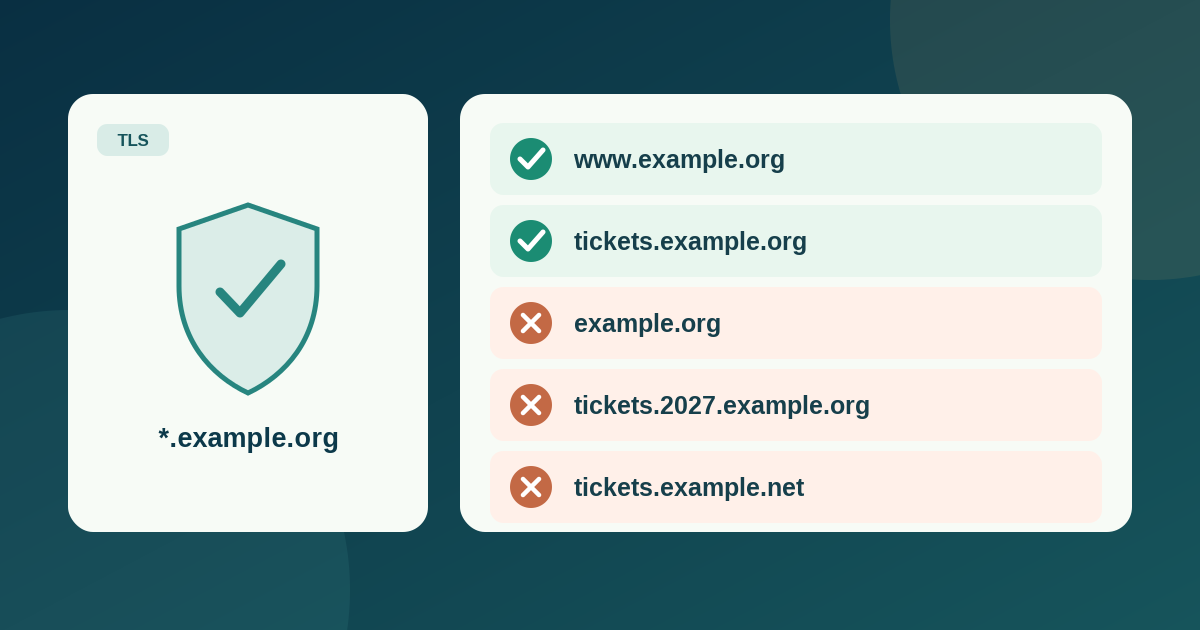
A certificate contains DNS names in its subjectAltName extension. These entries can be exact names or wildcard names, so “SAN versus wildcard” is not a strict either-or choice. The browser compares the requested hostname with a name the service presents. RFC 9525 limits a certificate wildcard to a complete leftmost label and one matching label. A certificate name of *.example.org can match www.example.org and tickets.example.org; it does not by itself match example.org, tickets.2027.example.org, or tickets.example.net.[1][2]
| Requested hostname | Matched by *.example.org? | Reason |
|---|---|---|
| www.example.org | Yes | One label before example.org |
| tickets.example.org | Yes | One label before example.org |
| example.org | No | Bare domain has no leftmost label to match |
| tickets.2027.example.org | No | Two labels before example.org |
| tickets.example.net | No | Different domain |
Use the diagram as a coverage test, not an issuance recipe. Add an explicit example.org name if the bare domain needs HTTPS; a wildcard alone does not include it. Conversely, a named list can cover the few stable hostnames an organizer actually uses. Do not assume that a wildcard certificate creates DNS records, routes a new subdomain to a site, or covers a different provider’s checkout. Those are separate service decisions.[1][2]
Choose a manageable handoff
For a few stable event addresses, ask each host whether it can manage certificates for the exact names assigned to it. If one team operates many changing subdomains at the same level, a wildcard may be worth evaluating with that team. Record where the certificate will be installed or managed, whether the platform accepts the proposed names, who will maintain it, and which names require separate coverage. The choice is based on actual hostnames and operating responsibility, not a claim that one product type is universally cheaper or safer.
A name matching in a diagram does not mean a certificate is deployed on every service. Ask each platform which certificate it actually presents for its assigned host, and whether it manages that certificate itself. An external provider-owned checkout domain is the provider’s own hostname; an event-owned custom checkout hostname needs a clear operator and matching certificate at the service that receives it.
Verify every public HTTPS route
After the operators confirm the setup, open every exact https:// address from a normal browser session. Check the bare domain and www separately, follow redirects, inspect the final hostname and page, and test the ticket destination as its own service. If the browser reports a name mismatch, stop at the warning and ask the host owner to correct the coverage; do not tell visitors to bypass it. Repeat this check whenever a public hostname or hosting provider changes.[1]
Sources and further reading
- RFC 9525: Service Identity in TLSIETF / RFC Editor · Accessed
- Public certificate characteristics and limitationsAmazon Web Services · Accessed