Transactional or marketing? Classify event emails before sending
A ticket receipt and an invitation to next year’s event can reach the same person, but they answer different needs. Classification is a decision about the message’s purpose and content, not the software that sends it, its automation trigger, or the size of its audience. Review the entire draft before choosing a recipient list or sending route. This guide gives event teams a reusable decision record; the legal treatment still depends on the recipient and applicable jurisdiction.
Boletolibre editorial team
Published
Start with the promise made to this recipient
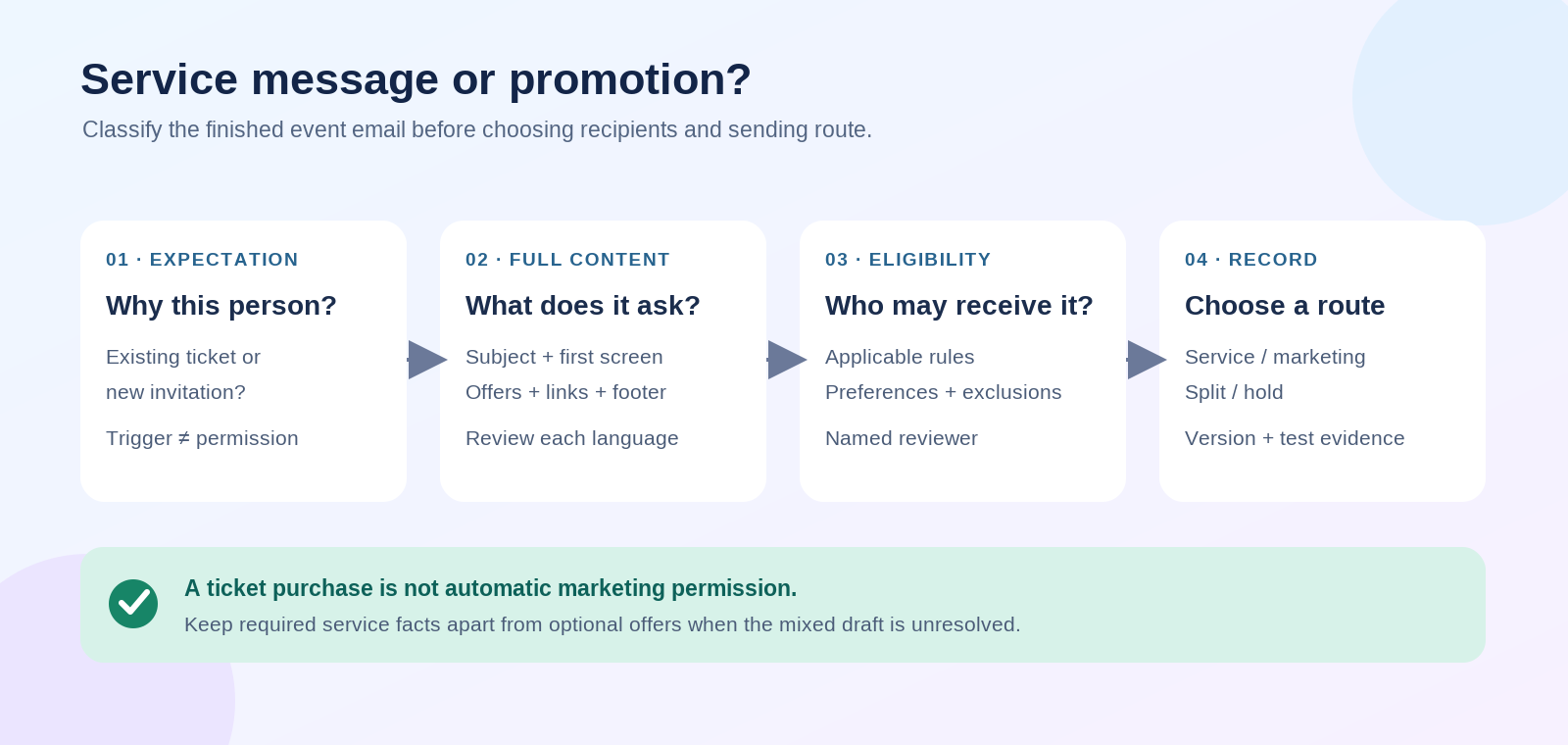
Write one sentence describing why this person expects the message now. “Here is the ticket you just bought” follows a specific transaction; “buy a ticket to our next edition” asks for a new purchase. A send can be automated and still promote something. A message can reach one person and still be marketing. The US FTC examines a message’s primary purpose and defines transactional or relationship categories narrowly; the UK ICO distinguishes a pure service message from direct marketing by its content.[1][2]
Download the editable event-email classification worksheet (Markdown, English)
Record the trigger, recipient relationship, promised information, proposed subject and next action. A ticket confirmation, password reset or requested access link may be operational, but the label “transactional” in an email tool is not a legal ruling. Mailchimp itself notes that even an abandoned-cart automation may be treated as marketing under some laws. Keep a difficult case in review instead of treating “triggered” as permission to send.[4][1]
Classify common event messages by purpose
Use the matrix as an editorial starting point, not a universal legal classification. A paid ticket receipt and a venue change that current ticket holders need are materially different from a broad invitation or sponsor offer. Ask whether the recipient needs the information to complete or understand an existing transaction, or whether the organization is trying to persuade them to act in a new way. The actual subject, body and audience can change the answer.[1][2]
| Event message | Starting classification | Decision to verify |
|---|---|---|
| Ticket purchase receipt or access link | Operational candidate | Was it tied to this recipient’s purchase? |
| Essential venue, time or entry change for current holders | Service candidate | Does it only explain the existing event? |
| Invitation to buy tickets for a new event | Marketing candidate | Is this recipient eligible for promotion? |
| Receipt with next-year discount | Mixed; review as marketing risk | Remove offer or review full message |
| Abandoned checkout reminder | Review | No completed purchase; check local rules |
| Waitlist opening notice | Review | What specific alert was requested? |
| Post-event feedback request with new offer | Mixed; review | Separate research from promotion |
| Newsletter signup confirmation | Request confirmation candidate | Does it only verify the signup? |
A waitlist opening, feedback request, abandoned checkout reminder or welcome email needs special attention. Someone may have requested one specific alert, but that does not authorize an indefinite promotional sequence. A newsletter signup confirmation can verify a request without turning all later newsletters into service messages. Keep request evidence and the marketing eligibility check separate.[1][2]
Treat mixed-purpose messages as a separate decision
Read the finished subject line, preheader, opening screen, images and links, not only the template name. “Your ticket for Friday” followed by an upsell for next year is not automatically a pure receipt. The FTC says a mixed US message may be commercial when its subject suggests promotion or the transactional content is not mainly at the beginning. The ICO says adding promotional material to a purely administrative service message makes it direct marketing under UK guidance.[1][2]
The simplest editorial fix is often to remove the promotional block and send it, if eligible, as a separate marketing message. Do not hide an offer in a footer, QR instruction or sponsor panel and assume its small size makes it harmless. Conversely, do not strip an essential schedule or entry correction because it happens to include the event name or logo. Have the responsible reviewer classify the actual final content, including localized versions.[1][2]
Apply the rules for the actual recipient and location
Do not use a single global “consent required” or “no consent required” checkbox as the classification rule. US CAN-SPAM regulates commercial email and gives recipients an opt-out right; its transactional or relationship exception depends on the message’s primary purpose. UK PECR has different rules for electronic mail marketing, including consent and specific exceptions. The team must identify the recipient’s jurisdiction and ask its legal or privacy owner how those rules apply to the intended audience.[1][3]
Keep the distinction between classification and eligibility. Even if a draft is marketing, a particular recipient may or may not be eligible under the applicable rules and recorded preferences. A ticket purchase does not by itself prove marketing permission. Likewise, an opt-out from promotions should not silently block a necessary ticket access or safety update. Map each message to the appropriate list, suppression logic and owner without claiming that every operational email is exempt everywhere.[1][2]
Keep operational and promotional streams identifiable
Keep a message inventory with separate purposes, templates and owners for receipts, ticket access and critical service updates versus campaigns. Where the provider supports it, use distinct sending configurations or reporting so a marketing edit cannot accidentally alter ticket delivery. Amazon SES, for example, documents configuration sets for separate event metrics and optional dedicated-IP pools; that is one implementation pattern, not a requirement to buy dedicated IPs.[5]
A sender address or subdomain can make the stream recognizable, but a different address does not change a message’s purpose. Confirm who maintains the sender identity, reply route and failure monitoring for each stream. An event team should be able to answer which system sent a ticket receipt, which system sent a promotion, and who can pause only the latter if a campaign is wrong. Do not promise that a provider’s “delivered” event proves an attendee saw the message.[6][4]
Worked decision: a venue update arrives with an upsell
At 10:00 an organizer confirms that a concert has moved to a different entrance. Current ticket holders need a timely message with the correct gate, arrival time, ticket validity and help contact. The draft subject says “Important entry change for your ticket,” but a sponsor later adds “Upgrade to VIP before Friday” and a purchase button. The first facts serve the existing purchase; the added offer asks for a new one. A triggered send to current holders is not automatically a pure service message once that promotion is present. In the United States, the reviewer should examine the finished subject and prominence of service facts under the FTC primary-purpose test. In the United Kingdom, the ICO says promotional material changes a pure service message into direct marketing.[1][2]
The owner makes two artifacts. The service version contains only the approved entrance instructions, ticket facts and support route, and its test confirms it goes to the affected holders. The upgrade version is a separate promotional draft, assigned to the marketing owner for audience, preference and jurisdiction review. If the sponsor cannot approve the split before the deadline, the needed service update proceeds and the offer waits. After translation, each final subject and body is checked again; a localized subject that leads with the discount could change the assessment. The decision log records who classified each version, the rule reviewed, the list or trigger used and the test evidence. It does not state that a ticket purchase grants permission to advertise.[1][2]
Review the rendered email and its recipient path
Before sending, compare a rendered sample with the approved message record. Check the subject and preheader, first screen, ticket facts, linked destination, personalization fields, footer, language, and the actual segment or trigger. Make sure the final copy has not gained a sponsor offer or future-event CTA after classification. If it has, send it back for a fresh purpose and eligibility decision rather than relying on an earlier approval.[1][2]
For an operational message, use an approved synthetic event/order in the provider’s safe test path and verify the action produces the right recipient and facts without creating a live purchase. For a campaign, test suppression and unsubscribe behavior according to the applicable rules and provider controls. Record evidence of the send route and the person who approved it. A preview that looks good cannot prove recipient eligibility or delivery.[1][2]
Record the decision and revisit it when copy changes
Save the message name, version, audience, trigger, purpose, promotional elements, jurisdiction review, owner and approval date in the worksheet. If the event is postponed, the recipient group and service facts change; if a sponsor asks to add a coupon, the purpose review changes. Reopen the classification when the subject, offer or audience changes, not only when a new template is created.[1][2]
If the team cannot resolve a mixed-purpose draft before a time-sensitive ticket update, separate the required operational facts from the optional promotion. Send the approved service information through its normal route and hold the marketing content for its own review. This is a workflow recommendation, not a claim that every event message has the same legal status.[3]
Sources and further reading
- CAN-SPAM Act: A Compliance Guide for BusinessUS Federal Trade Commission · Accessed
- Key concepts for direct marketing using electronic mailUK Information Commissioner’s Office · Accessed
- How do we comply with the PECR electronic mail marketing rules?UK Information Commissioner’s Office · Accessed
- About Transactional EmailMailchimp Help Center · Accessed
- Using configuration sets in Amazon SESAmazon Web Services · Accessed
- Creating Amazon SES event destinationsAmazon Web Services · Accessed