How to collect dietary requirements for an event without losing the handoff
A dietary question is useful only if someone can act on the answer before food is served. The first Google result is a Planning Center community question about a repeat attendee: a separate form can be skipped or overwrite an older profile value. That points to the operational problem: connect the right guest, meal and current request, then confirm what the kitchen can actually provide. This guide gives organizers a practical form-to-caterer handoff; food safety decisions belong with the qualified food provider.
Boletolibre editorial team
Published
Ask only when food is actually offered
List each meal, snack, beverage or hospitality period and who provides it. If a ticket includes no food, do not make everyone answer a dietary question “just in case.” For catered events, ask whether the attendee has a food requirement to discuss, invite the specific food or ingredient to avoid and a reliable contact route. Explain the purpose, who will receive the answer, when to update it and whether the organizer can confirm a suitable option. Avoid a single free-text box that silently becomes a promise. The UK ICO’s own event notice treats dietary information as potentially sensitive and explains its purpose and handling; apply the privacy rules for your actual location and event rather than copying its UK lawful basis.[4]
The leading Planning Center community thread describes a profile field that was not exposed during registration, a separate dietary form that could be missed, and an overwrite of older profile data. It is a user report about one product, not proof of a universal limitation. For repeat guests, show a current, event-specific answer or ask them to reconfirm it; never assume an old profile value is still accurate.[1]
Write a question that leads to a safe conversation
A practical label is: “Will you need us to discuss a food allergy, intolerance or other dietary requirement for the meals at this event?” Follow a Yes answer with “Which food or ingredient should the catering team know about, and which meal does this affect?” Offer a contact route for details that should not be put in a public or broadly shared form. Do not force guests to disclose a diagnosis to describe the food requirement. For group orders, identify which individual the request belongs to. Keep allergy-related responses distinct from a simple preference when the caterer needs different handling.
| Form field | Why it matters | Owner |
|---|---|---|
| Meal or service period | Connect request to the food actually served | Event food lead |
| Attendee identifier | Avoid attaching one guest’s need to another | Registration owner |
| Food or ingredient to avoid / requested option | Give caterer an actionable question | Caterer |
| Contact and update route | Resolve uncertainty and late changes | Named organizer |
| Acknowledged and confirmed status | Distinguish received from safely accommodated | Food lead with caterer |
Food Allergy Research & Education advises guests to communicate allergy needs again when attending meetings or conferences. Treat the registration answer as the start of a conversation, not the only check before service.[3]
Close the loop with the food provider and guest
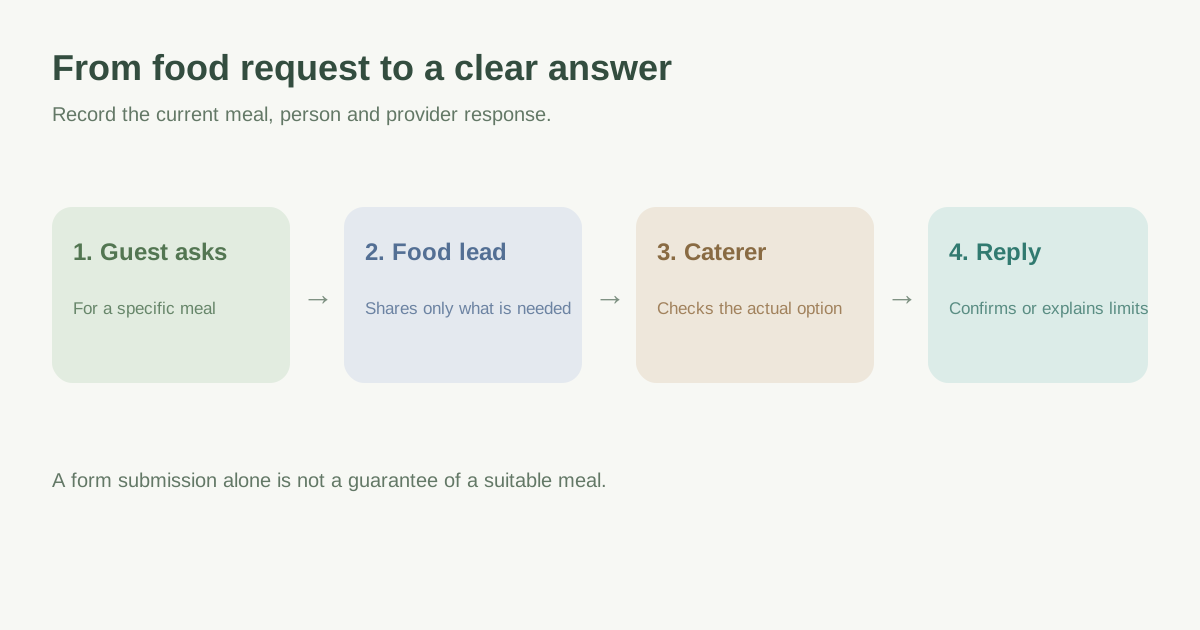
Give the caterer only the current requests needed for the relevant service, using an approved access route. Ask the provider to identify ingredient and preparation questions, cross-contact constraints, menu or packaging information and a named on-site contact. Do not relabel a dish “allergen-free” based only on a spreadsheet. The UK Food Standards Agency’s business guidance stresses accurate allergen information and effective allergen management in catering; local requirements differ, and the food provider should own its preparation and information controls.[2]
Record “received,” “question sent to caterer,” “provider response,” and “guest informed” separately. If the provider cannot meet a request or cannot verify an ingredient, tell the guest plainly before the event and offer a real contact route. Do not promise a safe meal based on an unconfirmed checkbox. On event day, provide a discreet way for the guest to confirm with trained catering staff and ensure staff know where the current information is.[2][3]
Reconfirm changes, access and retention
Set a published update route and a cut-off only if the caterer has a real operational deadline. After that time, accept the inquiry and explain what can and cannot be changed; do not silently discard it. Reconcile late updates into the caterer’s current list and mark old versions obsolete. Restrict access to people who need the request for planning and service, keep it out of public exports, and assign an owner to delete or archive it under the event’s approved retention rules. The ICO example shows that even a competent event organizer separately describes why and how it processes dietary details; it is not a template for every jurisdiction.[4]
Download the dietary request and caterer handoff worksheet (Markdown, English)
Sources and further reading
- How do I manage dietary requirements during event registration?Planning Center Community · Accessed
- Allergen guidance for food businessesUK Food Standards Agency · Accessed
- Meetings, Conferences and Business TripsFood Allergy Research & Education · Accessed
- Attend an event, seminar or workshop: privacy noticeUK Information Commissioner’s Office · Accessed