Event capacity planning: limits, ticket allocations and people inside
Event capacity planning connects an actual assessed configuration to the admissions you promise and the people present. Start with four separate records: the governing limit and its scope, admission allocations, a turnout forecast, and current occupancy. A ticket counter cannot establish a safe limit, and a quiet forecast does not create extra admission rights.
Boletolibre editorial team
Published
Get the configuration and scope before setting stock
Ask the venue and appropriate competent professionals for the actual assessed limit, applicable approvals and conditions for your configuration. Record the plan revision, population covered, zones, time period, evidence and people authorized to approve changes. A room’s marketing capacity, an old layout or a software field is not this record. Confirm how staff, contractors, performers, children and companions count rather than importing another event’s assumptions.
HSE guidance for Great Britain treats venue suitability, audience and workforce needs, circulation and exits as assessment matters. It also calls for plans to be updated as information changes. Use those distinctions, not an area formula from this guide. Local requirements need separate verification. Preserve designed accessible positions, routes and companion arrangements; they are not spare stock to release casually. Do not add zone limits together as if every place were interchangeable.[1][2]
Make every admission unit traceable
Choose a unit that matches the actual entitlement: one attendee, a group, a session or another documented scope. Map group tickets and re-entry explicitly. For the same event and date, separate valid issued entitlements from unissued channel stock, sponsor holds and controlled reserve. Buckets must not overlap. Include complimentary admissions, not just paid orders.
Reconcile record identifiers and entitlement status before correcting the total. In the fictional example below, 125 issued units include five explicitly voided units, leaving 120 valid units. A refund alone does not prove that admission was voided or stock became available. Duplicate export rows require a documented correction, not silent deletion of a genuine entitlement. Keep the circulated reconciliation limited to information needed for the task.
- Give each channel and hold an owner, a current snapshot and a release authority.
- Log event/date, configuration revision, time and time zone, units moved, operator, approver and affected-channel acknowledgments.
- Leave discrepancies visible with an owner; do not manufacture a balancing adjustment just to make the sheet agree.
A fictional transfer, not extra capacity
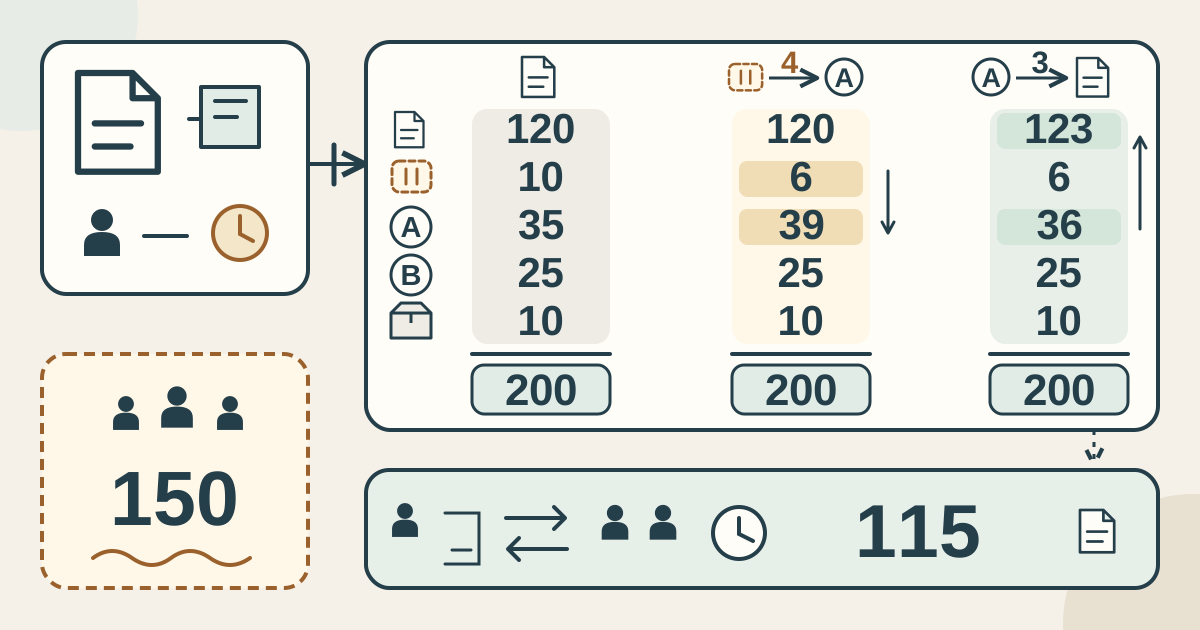
Assume one admission unit per attendee. The 120 valid issued units comprise 104 paid and 16 complimentary admissions. The opening allocation is disjoint:
| Allocation bucket | Units |
|---|---|
| Valid issued entitlements | 120 |
| Unissued sponsor hold | 10 |
| Unissued channel A stock | 35 |
| Unissued channel B stock | 25 |
| Unissued controlled reserve | 10 |
| Total allocated | 200 |
The opening check is 120 + 10 + 35 + 25 + 10 = 200. The sponsor authorizes release of four unissued units: move the hold from 10 to 6 and channel A from 35 to 39. Total allocation remains 200. When channel A sells three, issued units move from 120 to 123 and its stock from 39 to 36. The new check is 123 + 6 + 36 + 25 + 10 = 200. Neither step creates additional units.
Process each transfer as one logged change acknowledged by affected channels before making another allocation. If channel B retains an old snapshot, resolve the mismatch before reallocating. The reserve is an assigned bucket, not a recommended safety-buffer percentage or permission to alter the reviewed configuration.
Use the forecast for planning, not sales authority
A forecast of 150 attendees in this example describes expected turnout, not an increase in the 200-unit allocation or the given 240-person overall limit. Record evidence period, uncertainty, arrival peaks and possible walk-up or late demand. HSE identifies advance sales, registration and other signals as inputs to forecasting; assessing safe capacity remains a separate task.[1]
Do not use a generic no-show percentage to promise more admissions. A waiting or request process should state whether it grants an entitlement. Any later offer needs genuinely available allocation and authorization, not merely a prediction that someone else will stay away.
Hand over to a separate occupancy record
At a fictional checkpoint, 20 people initially inside + 110 recorded entries − 15 recorded exits = an estimate of 115 people inside. This is an all-person count, whereas the forecast concerns attendees. Record timestamp, population, entrance and exit coverage, counting gaps and the responsible admissions lead. If two people leave and return, record two exits and two entries; they do not acquire two new admission entitlements.
HSE recommends monitoring overall numbers and crowd distribution, and describes entry/exit counting as a way to estimate people inside. Ticket sales or one-way scans alone do not account for every exit, non-attendee or local concentration. A venue-wide number below its limit cannot prove that a particular area is safe.[3]
Plan arrivals, queues, movement and departure under the actual operating plan. Agree who monitors conditions, who can hold admission, how decisions reach staff and what happens if communications fail. HSE’s staffing guidance depends on event size, complexity and risk; this guide supplies no staffing ratio or guaranteed throughput.[4][5]
Require evidence before resuming changed allocations
Test the actual workflow for overlapping checkouts, combined ticket types, group quantities, offline sales, stale exports, cancellations and re-entry. Guest Manager’s documentation for its specific Shopify Event Ticketing app describes shared capacity but also warns of overselling caused by order-processing synchronization, including multi-type carts. This is a dated product-specific limitation, not a claim about every platform or a Boletolibre feature.[6]
For a layout change, counting gap, blocked route or unexpected increase in non-attendees, follow the pre-agreed admission-hold and escalation procedure and obtain competent review. Do not invent a replacement limit or release stock while the discrepancy remains open. Record the resolution, authorization, revised configuration and ledger versions, then notify affected operators before resuming the changed allocation.
Sources and further reading
- Assessing crowd risks — Great BritainHealth and Safety Executive (HSE) · Accessed
- Venue and site design — Great BritainHealth and Safety Executive (HSE) · Accessed
- Monitoring crowds — Great BritainHealth and Safety Executive (HSE) · Accessed
- Crowd-management controls — Great BritainHealth and Safety Executive (HSE) · Accessed
- Managing crowds inside — Great BritainHealth and Safety Executive (HSE) · Accessed
- Event capacity: specific Shopify Event Ticketing app and overselling limitationGuest Manager · Accessed