US event legal requirements: who owns each answer?
For a US event, start with the exact place and activities—not a nationwide permit checklist. Build one record connecting each question to the responsible team, relevant authority and evidence that actually covers your event.
Boletolibre editorial team
Published
Define the event before asking about permits
Write down the legal organizer, operator, seller, exact address, state, county, city, date, audience and proposed activities. Include the queue or installation outside the venue. A room booking and an event using the adjoining sidewalk are different factual descriptions; sending only the venue name makes an authority answer hard to apply.
The US Small Business Administration routes licensing questions by activity and location. A federally regulated activity needs the relevant federal agency; state, county and city requirements vary. This does not establish that every organizer needs an LLC, EIN, federal permit or identical annual license.[1]
Separate the questions that need different answers
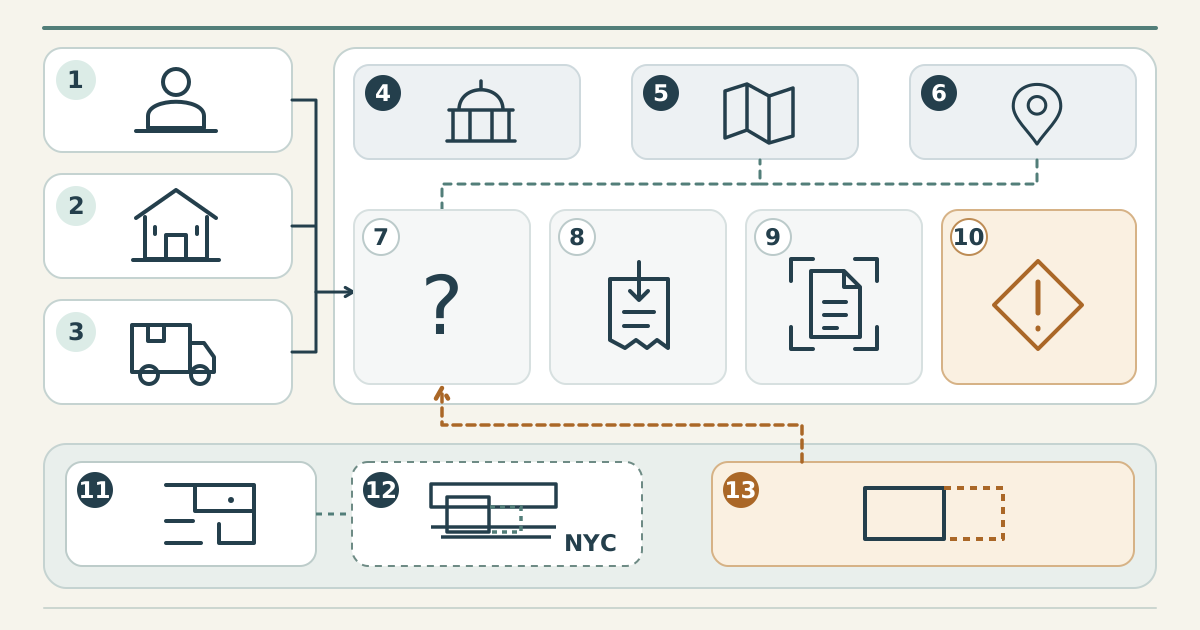
Keep business-operation, venue/configuration, event-activity and public-offer questions in separate rows. Ask which entity and activity an existing document covers, who issued it, what conditions apply and what has changed. A vendor promise or application receipt is not interchangeable with an applicable authorization.
For accessibility, first assess whether the operation is a covered Title III public accommodation. The DOJ technical-assistance page identifies access, effective communication, reasonable modifications and ticketing workstreams, with provision-specific standards and exceptions. It is informal guidance, not binding law or certification. Neither “every private gathering is covered” nor “the venue handles everything” is a sound conclusion from it.[2]
Alcohol needs its own routing question when proposed. TTB directs readers to state and local authorities because their rules vary and may add restrictions alongside the federal layer. Its directory does not establish a particular state license or permission for your event.[4]
Use a blank responsibility and evidence matrix
Copy this two-column worksheet once for each activity. Put a named organizer lead beside the venue or vendor evidence owner. Keep the person collecting the document separate from the authority or professional deciding what it establishes.
| Record field | Complete for this event |
|---|---|
| Activity and footprint | ____; address, date, indoor/outdoor and affected public space: ____ |
| Authority question | Federal/state/county/city or other competent route: ____; issue to confirm: ____ |
| Operational owners | Organizer lead: ____; venue/vendor evidence owner: ____ |
| Evidence and scope | Document/official answer: ____; issuer, version, event, conditions and source link: ____ |
| Dependency and state | Needed before which decision: ____; unknown/submitted/evidenced/needs review: ____ |
| Recheck trigger | Expiry or changed activity/layout/vendor: ____; reviewer and next check: ____ |
Record what was reviewed, not merely “done.” Submitted means sent; evidenced means a document exists; neither label settles whether it authorizes the proposed activity. An answer about one footprint may not cover a later extension. Keep unresolved questions visible and link the relevant decision to its evidence.
A local answer can restrict, not just add paperwork
New York City’s SAPO FAQ is a local example, not a US-wide rule. Street or sidewalk interference or obstruction routes to SAPO. The FAQ routes food sale or distribution to the public to DOHMH and prohibits alcohol in its listed parade, block-party, street-event and street-festival settings. A separate alcohol license is not an override of those restrictions.[3]
If your event is elsewhere, find its competent route rather than copy NYC’s rules. This guide supplies no universal deadline, insurance minimum, sound or generator answer. Tax, employment, music rights, privacy and public-land questions may need separate specialist review; the sources here do not resolve them all.
Give the ticket seller a separate price-evidence row
For covered live-event-ticket offers, FTC staff guidance says the upfront total includes known or calculable mandatory charges. Permissible initial exclusions, such as qualifying government charges or shipping, and genuinely optional additions still need disclosure and inclusion in the final amount before payment is requested. This is not a ban on fees or a rule for every registration.[5]
The FAQ expresses staff views and is not binding Commission action. Current consolidated eCFR text was not read for this guide; do not treat the staff FAQ as an independently audited regulation. Check applicable state protections and current law for the actual offer.[5]
Fictional case: an indoor concert with a sidewalk proposal
Harbor Notes is an invented NYC charity concert. No venue approval, license, capacity or permission has been established. The matrix shows the next evidence request, not a legally approved event.
| Proposed workstream | Next owner action and unresolved point |
|---|---|
| Venue and accessibility | Organizer and venue map the customer journey and seek configuration evidence and qualified Title III coverage review. A booking is not clearance. |
| Sidewalk installation | Permits lead asks SAPO about the exact footprint. Keep the addition out of the operating plan unless required authorization is established. |
| Public food and alcohol | Caterer supplies activity-specific evidence for the local food route. Review any indoor alcohol proposal separately; do not move it onto the prohibited SAPO street-event footprint. |
| Covered ticket offer | Seller uses fictional USD 40 admission + USD 4 mandatory charge = USD 44 upfront. No tax rate is assumed; any permissible exclusions enter the final amount before payment. |
If the sponsor adds a structure or the vendor changes the activity, reopen the affected row. Finish with an issue log naming the authority or qualified reviewer, missing evidence and next decision. A complete spreadsheet is not sale or opening clearance; it is a way to prevent unresolved questions from disappearing.
Sources and further reading
- Activity and location routing: expanded federal and state license sectionsUS Small Business Administration · Accessed
- Title III coverage, access workstreams and technical-assistance limitsUS Department of Justice · Accessed
- NYC SAPO FAQ: street, public food and listed alcohol restrictionsCity of New York · Accessed
- State and local alcohol-authority routing; no event permission establishedUS Alcohol and Tobacco Tax and Trade Bureau · Accessed
- FTC staff FAQ: covered live-ticket totals and permitted exclusions; nonbinding guideUS Federal Trade Commission · Accessed