Organizing live events in the USA: work backwards from evidence
An event date is a proposal until the work supporting it has caught up. For a live event in the United States, build a schedule around the evidence each team needs—not a generic countdown. This guide offers an original backwards-planning worksheet and a named Commerce City, Colorado illustration. It is educational planning guidance, not legal advice, a complete permit list or clearance to sell or open.
Boletolibre editorial team
Published
Start with the version of the event you actually mean
Write down the exact site, activities, equipment and proposed access hours before assigning deadlines. A shelter concert, a trail activity and a performance with an added stage are different proposals. Give the record a version and name one local liaison who will ask the relevant office which route and documents apply.
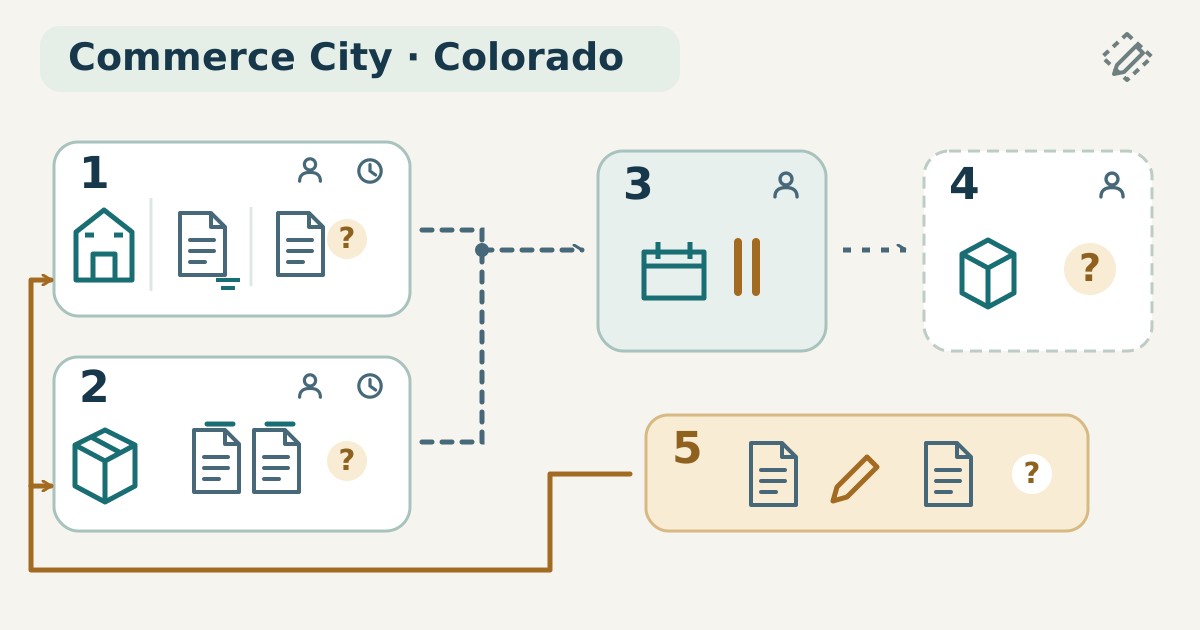
Commerce City, Colorado is the local example here, not a rulebook for the United States. Its Organized Event page describes activity-dependent Temporary Event and Use Permit (TEU) requirements and exceptions. Renting a shelter does not settle applicability when listed additions change the use. The page also identifies applicable site-plan and structure-document inputs. Ask about your precise configuration rather than treating a rental receipt as an exemption.[1]
Gather venue and supplier replies against that same version. A provider saying it can supply equipment is not proof that the application has the necessary supporting documents. Assign an evidence recipient so an attachment does not disappear into someone else’s inbox.
Keep external horizons and internal targets apart
The Commerce City Organized Event page asks for an application at least 30 days before the event. That is local application guidance, not a national deadline or a promise of approval within 30 days. The separate parks page sets a two-week advance shelter application/payment horizon. Trail rentals have a different minimum eight-week processing branch; do not paste it onto a shelter-only schedule. Shelter power is not guaranteed, and rental hours do not waive event-specific requirements.[1][2]
Plan backwards from proposed load-in and the commitments you intend to make publicly. Record the source-specific external horizon, then choose an earlier internal target for supplier inputs and corrections. Label the buffer as your choice. If day counting, the controlling event/access date or an applicable deadline is unclear, leave it unknown and ask; a familiar calendar template cannot answer it.
Keep five statuses distinct: not submitted, submitted, acknowledged, corrections requested, and issued with conditions still to resolve. An acknowledgement proves receipt, not permission. Record conditions separately even after a decision exists. Choosing to hold a sale launch while facts remain unresolved is an organizer policy, not a statutory ban on every presale.
Copy this blank evidence board
Use one record per dependency. First fill the scope header: exact site/local office ____; activity and equipment version ____; proposed load-in/doors/end/load-out ____; venue contact/access terms ____; authority question and dated reply ____. Repeat the compact table for each gate.
| Record field | Your entry |
|---|---|
| Dependency and accountable owner | ____ / ____ |
| External horizon; precise source and access date | ____; ____ |
| Internal target and reason for buffer | ____; ____ |
| Evidence recipient and required version | ____; ____ |
| Current status and unresolved question | ____; ____ |
| Downstream decision and change trigger | ____; ____ |
- Create records for applicability, reservation/access, supplier inputs, application, corrections/conditions, launch wording and load-in readiness.
- For each owner, name the person who must receive and review the evidence. Responsibility for collecting it is not statutory-duty transfer.
- Save the scope and date of a reply. Replace an outdated version explicitly; do not leave two contradictory plans labelled current.
Fictional case: Prairie Window Sessions
The organizer proposes access at 09:00, doors at 16:00, performance at 17:00 and load-out at 19:00. Those are requests, not venue-approved hours. The liaison first asks whether the proposed activities need a TEU and what documents are applicable. The technical lead asks the venue about actual power and obtains the appropriate supplier inputs; an electrical assumption cannot close that record.
| Chosen checkpoint | Evidence and present gap |
|---|---|
| March 19, 2027: local liaison | Scoped applicability reply for activity v1; pending. |
| March 26, 2027: venue and technical leads | Accepted reservation/access terms, matching plan inputs and power reply; not obtained. |
| April 2, 2027: local liaison | Chosen early application target; not submitted. |
| April 16, 2027: producer | Chosen launch review; decision/conditions remain unresolved, so launch is held. |
| Before proposed May 22 access: stage lead | Current access, conditions and required qualified technical confirmations; pending. |
For this arithmetic exercise, 30 calendar days before May 22 is April 22, 2027, and two weeks before is May 8, 2027. Neither date verifies the rules for a 2027 event. Reconfirm the route, controlling date and counting with the responsible office. The April 2 internal target is earlier by choice, not a city instruction; it does not guarantee a decision by April 16.[1][2]
A changed proposal reopens the relevant work
Suppose a supplier later adds an erected stage. The liaison reopens applicability and document questions; the technical lead obtains appropriate qualified documentation. The producer checks whether public wording and the launch decision still match the new scope. Adding a trail activity starts the separate rental branch. Moving the date reopens all affected horizons—not just the poster.
Before load-in, circulate the current version and a list of unresolved conditions to the venue and responsible leads. Refer structural, electrical and safety decisions to the competent authority, venue and qualified providers; this worksheet supplies no design, capacity formula or safety sign-off. If evidence is still missing, record the blocked decision and its owner instead of changing the status to ready.
Sources were accessed on October 14, 2026; no authored rule-update date was established for the municipal pages. They do not verify a real booking, the full local code, an individual permission or sale-opening clearance. Recheck current sources and actual agreements for the real event. Your next useful action is to complete one dependency record and request its missing evidence—not copy an all-US deadline chart.[1][2]
Sources and further reading
- Organized Event: Permit Requirements and Minimum Submission Documents (Commerce City, Colorado only)City of Commerce City, Colorado · Accessed
- Park Shelter & Trail Rentals: separate rental routes and power qualification (Commerce City, Colorado only)City of Commerce City, Colorado · Accessed