Event risk register template: turn concerns into owned actions
An event risk register is a working record of what could disrupt delivery or harm people, which controls are real, what remains unresolved and who will act. It is useful only when the venue, organizer and suppliers can see the same current decisions. Use the editable worksheet below as a coordination tool, then connect safety entries to competent, site-specific assessments and approved plans.
Boletolibre editorial team
Published
Download the editable event risk register
Download the event risk register template
The file contains an event header, a working risk table, two illustrative rows, a change log and review prompts. Copy it for one event edition. Replace the examples with conditions at your actual site, name the register owner and link to the current venue safety plan. Keep the file accessible to the people who must act, but keep personal or security-sensitive details in the appropriate restricted system.
A register is a coordination record, not a certificate of safety. The UK Health and Safety Executive advises planning proportionate to event scale and risk, assigning safety responsibilities and using risk assessment to develop an appropriate safety plan. Requirements and approval routes depend on the jurisdiction, venue and activity; have a competent local lead review the actual arrangements.[1]
What the register should answer
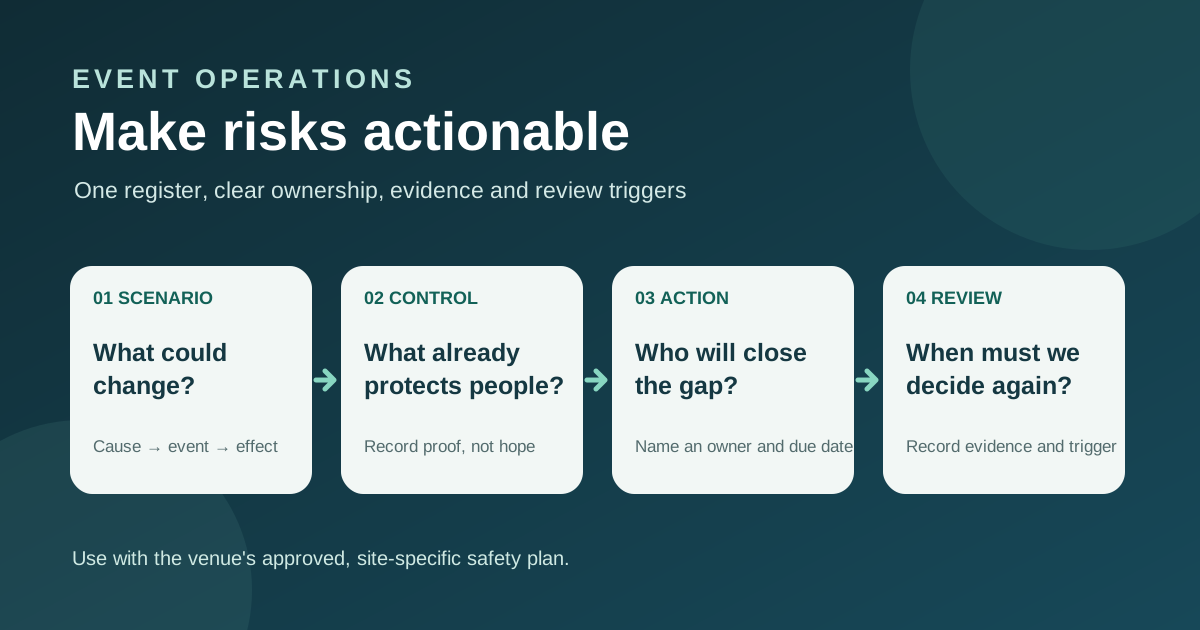
Before an event opens, one person may know that an entrance is changing, another may have the revised map, and a third may still be preparing the old attendee email. A useful register connects those pieces. Each row should describe a condition, a possible event and its consequence, then distinguish a control already operating from an action still promised. A named person owns the open action, and a date or change trigger forces a fresh decision.
Project risk guidance separates the cause, possible event and effect, and uses a register to document responses and action ownership. That separation prevents a vague entry such as “venue risk” from hiding what must be checked. For an event, write “the approved entrance route changes after directions are sent → attendees use a closed gate → delayed or inaccessible entry.” The example is a prompt for investigation, not a conclusion about your venue.[4]
Use fields that lead to a decision
Start with a stable risk ID and plain-language scenario. Record whom or what the consequence affects: attendees, workers, access routes, schedule, revenue or data. For a safety concern, also identify people whose needs may change the control, including disabled attendees or workers. The HSE specifically asks crowd planners to consider arrivals, movement and exit and the needs of young people and people with disabilities.[2]
- Existing control: describe a measure that is actually in place and link evidence, such as a confirmed venue route or an approved supplier plan.
- Gap and next action: state what remains to be decided, verified, purchased, briefed or tested.
- Owner and decision authority: name the person doing the work and the role that can approve a change or escalate a serious concern.
- Due point and review trigger: use a real milestone or changed condition, not only an arbitrary calendar reminder.
- Status and linked plan: show whether the action is open, in progress, monitored or closed and where the authoritative procedure lives.
Keep the register lean enough to use in a meeting. If a single row needs detailed engineering, crowd calculations or emergency instructions, link the specialist document instead of squeezing it into a narrow cell. An empty “evidence” field is a useful signal: the team may believe a control exists without having confirmed it.
Three examples to adapt, not copy into your plan
An accessible entrance becomes unavailable. The possible effect is that attendees are directed to a route they cannot use. Existing evidence could be a venue-approved alternative route; the open action is a joint walk-through and a coordinated correction to the public page, confirmation email, signs and gate briefing. Escalation belongs with the venue role authorized to approve the route. Do not publish a new route until that approval and verification are complete.
A room promised by a supplier is not ready at the agreed handoff. The effect may be a displaced session and conflicting information. The register can link the delivery checkpoint, name the programme decision-maker and record which audience channels will be corrected if an alternative room is approved. This is an operational dependency; the supplier contract and venue plans still control the actual remedy.
An event ticket or registration link points to the wrong edition. The team can record the source URL, the observed destination, the owner who verifies the correct link and the public pages that need correction. If Boletolibre.com is part of the event journey, inspect the exact event page and its actual ticket destination; do not assume that a link, checkout or attendee record updates automatically across systems.
Prioritize without invented precision
Use a likelihood and consequence description that your team understands, but do not let a colored score replace a decision. A low-frequency situation can still require attention when the consequence is serious. Ask what evidence supports the judgement, what uncertainty remains, and what can be changed before the next gate. Escalate material safety concerns to the appropriate venue or specialist lead rather than allowing a spreadsheet formula to accept them.
Separate three states: a risk under active control, an open action that still needs evidence, and an issue that has already occurred. An incident belongs in the incident process, while the register can record what changed for future planning. HSE guidance emphasizes proportionate controls and periodically checking whether crowd-management arrangements work in practice.[2]
Get input from the teams that own the work
The organizer should invite the venue, production, front-of-house, accessibility, ticketing, communications and key suppliers to identify the conditions they control or observe. A single planner cannot verify every entry. Ask each contributor what changed, what control exists, where proof lives and who can authorize the next action. The HSE recommends involving workers and liaising with venue management and relevant agencies as part of event planning.[1]
Give the register one editor or custodian so versions do not diverge. That person does not become the safety authority for every row. A venue lead may own an approved route, a production supplier may own equipment arrangements, and the event director may own a public schedule decision. Where responsibilities are shared, write down the handoff and the person who will confirm completion.
Review at changes and decision gates
Open the register when the event scope changes, when a venue plan or supplier delivery changes, before a public information send, before doors and after an incident or exercise. Also set ordinary review points that fit your event. The correct cadence depends on how quickly conditions change; a fixed universal daily or weekly rule would be misleading. Record the version, time zone and next trigger so an old copy cannot silently become the operating copy.
In each review, close the loop: ask the owner for evidence, decide whether the remaining condition is acceptable, update the linked plan or briefing, and record who approved the decision. If a risk changes materially, do not merely change its status color. Note the new fact, the decision authority and the next public or staff communication. HSE event guidance calls for periodic checks of crowd arrangements and debriefing after significant incidents or changes.[2]
After the event, preserve the final version and the decision log with the event records. Separate a lesson for next year from an unresolved obligation that still has an owner, such as a supplier dispute or an attendee follow-up. A post-event note without the evidence and decision trail is hard to use for the next edition.
Connect internal risks to attendee information
Some entries are internal only; others change what attendees need to know. When a verified decision affects location, time, entry, accessibility or ticket use, name the person who will update the public source of truth and the channels that repeat it. Compare the final web page, ticket or registration destination, email draft, signage and staff brief. Keep the wording factual and identify what remains uncertain rather than turning a risk hypothesis into a public statement.
Emergency messaging is a separate authority path. HSE guidance calls for event emergency plans proportionate to the risk, clear roles and planned public communications, developed with the appropriate venue and emergency partners. A risk-register row can point to that approved plan; it should not invent an evacuation route, show-stop instruction or emergency announcement.[3]
Common ways a register becomes unusable
- The row names a topic such as “weather” but gives no event, consequence or decision.
- A planned control is written as though it has already been installed, tested or approved.
- The owner is a whole department, leaving no person accountable for the next step.
- A severity color is treated as permission to proceed without competent review.
- The register, venue plan and published event details describe different routes or times.
- The file is never reopened when the audience, site, supplier or programme changes.
Keep the record proportionate and specific. A small meeting may need a short register; a complex public event will require more coordination and specialist plans. The goal is not to fill cells. It is to make the next safe, authorized decision visible to the people who must carry it out.
Sources and further reading
- Getting started: planning an eventUK Health and Safety Executive · Accessed
- Assess crowd safety risks and identify hazardsUK Health and Safety Executive · Accessed
- Planning for incidents and emergenciesUK Health and Safety Executive · Accessed
- What is risk management?Association for Project Management · Accessed