Compare event ticketing platforms: evidence before weighted scores
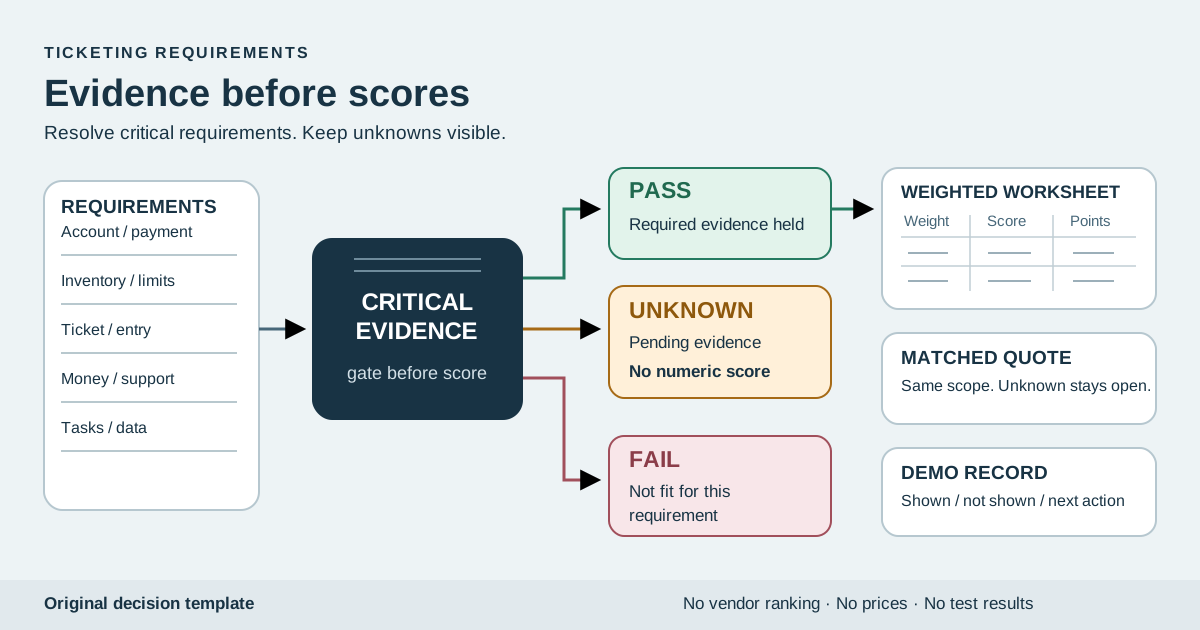
A useful comparison starts with the event you must deliver. Give every candidate the same requirements, request evidence for essential tasks, and score only options that clear those gates. This original worksheet helps record a decision; it does not rank real vendors or report demonstrations we performed.
Boletolibre editorial team
Published
1. Put the event requirement above the brand
Write the event/date, selling entity and account country, buyer countries and currency, ticket model, proposed quantities and accountable owner: ____. List what the team must operate itself or commission from another supplier. Decide which outcomes are essential before reviewing a polished sales presentation.
A payment receipt alone does not establish ticket issuance, inventory control or admission. Request evidence for each required outcome. A translated interface does not establish account eligibility. Your planned ticket quantity also needs a separate venue-capacity decision from the responsible party.
Stripe documents country, currency, product and method restrictions; connected-account eligibility can differ. Check the intended Checkout mode.[3]
2. Resolve critical gates before adding points
Copy this blank record for each candidate. Enter pass, fail or unknown only against your defined outcome, with evidence appropriate to it. A documentation link may answer a configuration question while leaving an operational requirement unresolved.
| Critical gate | Required outcome | State | Evidence and date | Owner / missing action |
|---|---|---|---|---|
| Selling, account and payment eligibility | ____ | ____ | ____ | ____ |
| Inventory and overall limits | ____ | ____ | ____ | ____ |
| Ticket outcome and admission | ____ | ____ | ____ | ____ |
| Financial, refund and support responsibilities | ____ | ____ | ____ | ____ |
| Essential accessible tasks and data handling | ____ | ____ | ____ | ____ |
Fail excludes the candidate for this requirement. Unknown pauses eligibility pending evidence. Neither is a permanent verdict on the product. Strong design or an attractive assumed price cannot compensate for a critical unknown. Mark which evidence expires when the plan, account, devices or contract changes.
3. Ask for a scoped demonstration and written answers
TicketTailor distinguishes ticket-type limits from overall event capacity. This is one provider’s documentation, not an inventory test.[1]
Stripe refund handling depends on balance, method and charge architecture. A requested refund and the buyer’s receipt are different states.[2]
- Sale: request a mobile buyer journey covering disclosure, required fields, a failed payment and recovery, and the actual ticket outcome. State the intended payment mode and account configuration.
- Inventory and admission: request authorized ticket-type and overall-limit scenarios, concurrent demand for a last unit, first and duplicate scans, staff permissions, and connection-loss reconciliation on declared devices. Do not infer offline or fraud protection from a QR picture.
- Finance: identify who receives funds and who handles cancellation, refund requests, processor outcomes and escalation. Ask for written conditions rather than treating a button as final buyer receipt.
- Accessible tasks and data: propose buyer and staff tasks involving labels, navigation, instructions, errors and time limits. Record required fields, processing roles, access, export, retention, deletion and optional marketing for the applicable jurisdiction. These are original questions, not a conformance or legal audit.
- Support: request accountable contacts, language, time zone, event-day escalation, service scope and written terms. A contact form alone cannot evidence an agreed response commitment.
4. Use weights only after eligibility is resolved
Choose weights totaling 100 before comparing eligible candidates. For each criterion, record the evidence location/date, a score or unknown, the contribution and the missing check. Keep this blank template separate from the fictional numbers below.
| Criterion | Weight | Evidence / date | Score 0–5 or unknown | Weight × score ÷ 5 | Missing check |
|---|---|---|---|---|---|
| Sale and checkout | ____ | ____ | ____ | ____ | ____ |
| Eligibility and inventory | ____ | ____ | ____ | ____ | ____ |
| Admission | ____ | ____ | ____ | ____ | ____ |
| Settlement and refunds | ____ | ____ | ____ | ____ | ____ |
| Accessibility | ____ | ____ | ____ | ____ | ____ |
| Data handling | ____ | ____ | ____ | ____ | ____ |
| Support | ____ | ____ | ____ | ____ | ____ |
| Total cost | ____ | ____ | ____ | ____ | ____ |
Customize this editorial rubric: 0 fails the task; 1 has major gaps; 2 fits partly with substantial supported work; 3 meets the defined need; 4 adds useful documented fit; 5 strongly fits defined priorities with adequate evidence. A low-priority scored criterion differs from a critical gate failure.
5. Compare the same written cost scope
Quote record: country/currency/plan/tax treatment ____. Fixed setup or subscription ____. Billable ticket count and basis ____. Order count and basis ____. Percentage and exact charging basis ____. Included processor costs or separate costs ____. Required or selected services, hardware and support ____. Payer for each line ____. Refund, dispute and settlement conditions ____.
For known inputs, combine fixed amounts, counted units at their documented rates, percentages of their specified bases and selected services. Add processor costs only when the quote has not already included them. Match the same event assumptions and show organizer-borne and buyer-borne amounts separately.
An essential unknown keeps the all-in comparison unknown, not zero. Show refunded principal separately in cash/revenue reconciliation; do not count it as an operating fee. Record any retained or extra processing costs separately. This template promises no net revenue, payout timing or actual fee.
6. Fiction: Meridian Workshop, two imaginary options
An invented organizer plans 180 general-admission places. Options A and B, every score and every assessment here are fictional. The quantity is neither tested stock enforcement nor venue approval. Assume admission is critical; no actual prices have been entered.
| Criterion | Weight | A score | A points | B score | B points |
|---|---|---|---|---|---|
| Sale / checkout | 10 | 4 | 8 | 4 | 8 |
| Eligibility / inventory | 15 | 5 | 15 | 4 | 12 |
| Admission: critical | 20 | Unknown | Unknown | 4 | 16 |
| Settlement / refunds | 15 | 4 | 12 | 3 | 9 |
| Accessibility | 15 | 3 | 9 | 4 | 12 |
| Data handling | 10 | 4 | 8 | 4 | 8 |
| Support | 5 | 4 | 4 | 3 | 3 |
| Total cost | 10 | 5 | 10 | 3 | 6 |
The weights total 100. A has 66 known points across 80 of the 100 weight, with no final score and no eligibility because admission remains unknown. Do not present 66 as a complete score or divide it by 0.8. Its next action is an authorized admission demonstration and written responsibilities.
B’s fictional contributions are 8 + 12 + 16 + 9 + 12 + 8 + 3 + 6 = 74/100, only assuming every critical gate has adequate evidence. This illustrates arithmetic, not a real winner. Either option still needs real evidence and a matched quote before a real purchase.
7. Leave an evidence receipt for the decision owner
Record authorization ____, behavior actually shown ____, configuration ____, failures/fallbacks ____, not shown ____, written agreement and quote date ____, evidence expiry/recheck ____, owner and next action ____. Link each gate and score to that record rather than a remembered sales conversation.
Keep the required outcome, missing evidence and next action visible. When evidence changes, revisit eligibility first, then recalculate applicable scores and costs. Documentation from TicketTailor and Stripe illustrates bounded questions; it does not establish another provider’s performance. The final decision belongs to the responsible organizer with the actual operational and contractual evidence.
Sources and further reading
- Ticket-type limits and total capacityTicketTailor · Accessed
- Refund handling and payment scopeStripe · Accessed
- Payment-method country, currency and product supportStripe · Accessed