Eventbrite vs Boletolibre: who owns each step of the ticket journey?
For an organizer deciding between Eventbrite and Boletolibre, the useful question is not which name wins a feature count. It is who will complete each step from finding the event to resolving a ticket problem. Sources accessed on October 14, 2026 support different scopes: Eventbrite’s publisher documentation describes ticket-service tasks; the scoped Boletolibre code review establishes website surfaces. Neither is a completed buyer-journey test.
Boletolibre editorial team
Published
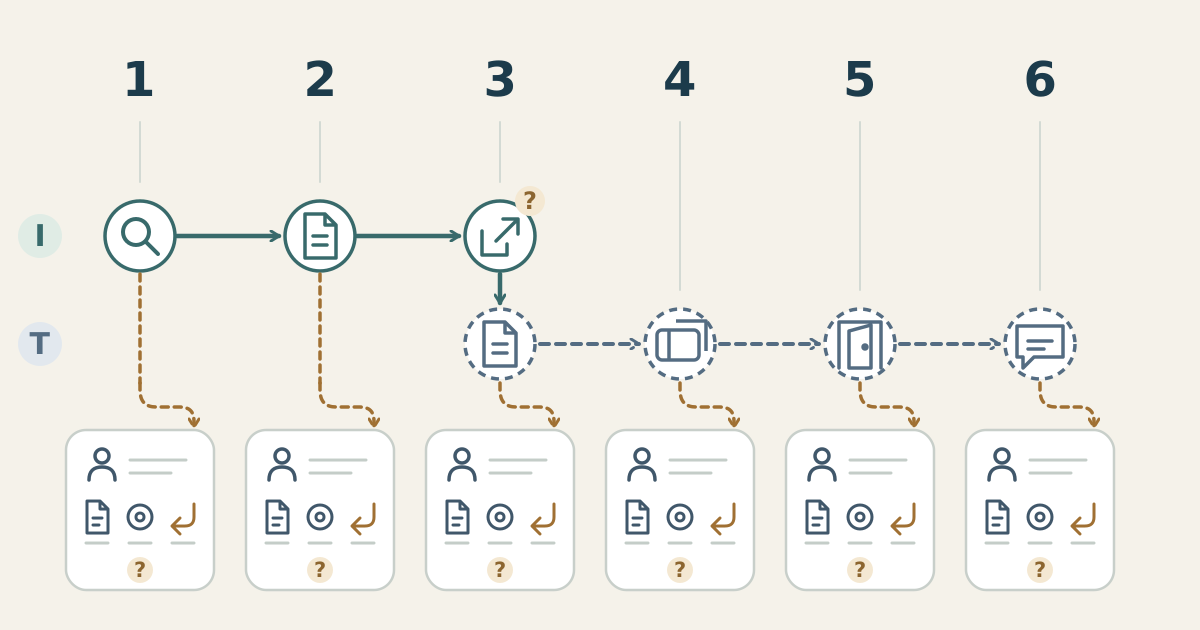
Start with one visitor, not two matching product columns
Imagine someone finds your event, checks the venue and time, pays, retrieves a ticket, arrives at the door and later needs help. At each transition, name the destination, the person accountable for the result and what the visitor should do if it fails. “The website handles it” is not a useful assignment when another system receives the order.
Eventbrite’s own description of its attendee app in the US Apple storefront covers event discovery, listings, booking and ticket-tab or wallet access. This is relevant documented scope, not a promise that your event will receive traffic, that every country or account is eligible, or that delivery will succeed. It also describes sharing purchase or registration information with the organizer; that does not settle every data, privacy or contractual question.[1]
Choose one authoritative source for ticket inventory and order status. An information page can explain venue access, schedules, policies and contacts, but duplicating those details creates another place to update. Identify who keeps the event date, time zone, venue, admission instructions and cancellation contact consistent. A clear handoff matters more than making every screen look like one product.
Understand what the available evidence establishes
The scoped Boletolibre source review used for this guide found page, link, form and payment-link route types. The inspected rendering code supports supplied page blocks and styles, configured form fields and submission code, and a supplied external checkout link. It does not establish a successful form response or purchase. Public loading depends on configuration; no live configuration or buyer journey was tested.
The inspected Premium billing checkout uses subscription mode for the platform, not event-ticket buyer processing. The inspected event, report and tool dashboard pages return null. Native ticket issuance, ticket recovery, QR admission, inventory, refunds, ticket analytics and operational custom-domain provisioning were not established by the scoped review. Unverified means evidence is still needed, not impossible, broken or promised for a future release.
Eventbrite’s publisher description of its Organizer app documents scanning and check-in, order reissue, cancellation and refund actions, and attendance or sales monitoring. Those descriptions are not our tests of permissions, duplicate handling, offline behavior, synchronization or refund settlement. Provider documentation, static source implementation and a successful demonstration are three separate records.[3]
Copy a blank six-stop responsibility record
Event/country/currency: ____; organizer accountable contact: ____; ticket-inventory authority: ____. For each row, fill in the visitor need, exact system or destination and evidence, accountable person, handoff proof, failure fallback and unresolved verification. Keep blanks or mark “pending” rather than assigning a vendor by default.
| Journey stop | Need, destination and owner | Handoff, fallback and unknown |
|---|---|---|
| Discovery | Visitor need: ____; landing URL/evidence: ____; owner: ____. | Expected arrival: ____; wrong-link fallback: ____; unverified: ____. |
| Details and policies | Visitor need: ____; authoritative information/evidence: ____; owner: ____. | Consistent instructions: ____; discrepancy contact: ____; unverified: ____. |
| Checkout and order | Visitor need: ____; ticket/payment destination and account/evidence: ____; owner: ____. | Order proof: ____; failed-redirect fallback: ____; unverified: ____. |
| Ticket access and recovery | Visitor need: ____; issuing/access system/evidence: ____; owner: ____. | Ticket proof: ____; recovery route: ____; unverified: ____. |
| Admission and reconciliation | Visitor need: ____; admission system/evidence: ____; owner: ____. | Admission record: ____; exception route: ____; unverified: ____. |
| Support and refund request | Visitor need: ____; responsible contact/terms: ____; owner: ____. | Request record: ____; escalation: ____; unverified: ____. |
This is an original planning worksheet, not a universal legal checklist or a report of checks performed here. Keep the evidence date and relevant configuration with each entry. A contact form can receive a question without proving that anyone is contracted to resolve a ticket or refund problem.
Make the checkout-to-ticket handoff explicit
A provider-branded Eventbrite help article on a Salesforce host describes button or embedded checkout on another website, with HTTPS and qualifying configuration, publication or preview conditions, and a redirect fallback. It supports possible coexistence of a website and ticket service. Its current canonical version, freshness and universal eligibility were not established; do not use it as confirmation that your particular site qualifies.[2]
Nothing in that article establishes a Boletolibre embed, partnership or interoperability. The narrower source-supported option is an organizer information page linking to a chosen external ticket destination. Confirm the exact destination and ownership before relying on it. Do not copy legacy plugin instructions or mistake a payment-only checkout for a ticket system.
Write three different outcomes in the record: form response received, payment recorded, and ticket issued or accessible. One does not prove the others. Ask the responsible provider to demonstrate the transition from order to ticket access and the recovery route when a buyer cannot find the ticket. Eventbrite’s attendee-app description identifies ticket access, not a successfully demonstrated recovery journey for your event.[1]
A candidate Eventbrite ticket-help page returned an access-block response and was not substantively read during research. It is excluded as evidence. Exact delivery and recovery instructions, the current canonical help page and applicable account conditions still need confirmation; no assumed email flow fills that gap.
Assign admission and support separately
For admission, the Organizer app description documents scanning and check-in. Ask the admission owner for an applicable demonstration of a first scan, a repeated attempt, a disconnected device and reconciliation after an exception. These are evaluation scenarios, not claims that a particular offline or duplicate-control behavior was observed. A documented scanning action is not a security or fraud-prevention guarantee.[3]
For support, distinguish the organizer’s event decision, the website’s information or link problem, and the ticket or payment provider’s order action. Record who receives the request, who can authorize the action and where it escalates. A published contact or form is not a staffed support commitment. An available refund action does not guarantee approval, processing or money reaching the buyer.[3]
Obtain event-specific written terms for country, currency, seller/account eligibility, taxes, services, charges, settlement, cancellation and support. No matching all-in prices or complete contractual conditions were verified here, so prices are omitted rather than entered as zero. This guide supplies no legal, privacy, accessibility, security or operational clearance.
Fictional Nimbus Hall: decide whether another page earns its upkeep
Nimbus Hall, Maya and every number below are invented for teaching. The plan proposes 120 admissions; that is not approved venue capacity, eligibility, actual inventory or sales. Maya already has an accepted ticket provider and event listing in this fictional scenario. The assumption does not select Eventbrite or establish a working arrangement with Boletolibre.
Design A keeps the listing as the event-information destination if its content and an actual applicable demonstration meet the requirements. Maya owns information and policy accuracy; ticket and support responsibilities need named, agreed provider contacts. If the listing is sufficient, a second website has no automatic role.
Design B adds an organizer page for fuller venue-access and contact information and links to the same ticket authority. A source-supported Boletolibre page and external link could fit this narrower layer, subject to real configuration and journey verification. Maya now owns consistency between two destinations. The page does not inherit issuance, admission or refund duties, and this is not a tested Eventbrite integration.
| Invented review assumption | Four-week maintenance time |
|---|---|
| Listing only: 6 minutes per week | 6 × 4 = 24 minutes |
| Two destinations: 10 minutes per week | 10 × 4 = 40 minutes |
| Additional review time in this example | 40 − 24 = 16 minutes |
These invented minutes describe information-maintenance responsibility, not vendor speed, fees, conversion or a performance benchmark. Extra context may justify the extra work. Both designs still have an unresolved gate: demonstrate checkout through ticket access/recovery and admission, and agree order and support ownership. A fictional receipt or imagined form success cannot close it.
Choose the next evidence request, not a predetermined winner
- If you need a documented ticket-service journey, use Eventbrite’s relevant publisher descriptions to frame an event-specific demonstration and written scope; they are not a tested recommendation.
- If an accepted external ticket workflow already exists and the missing work is information, assess Boletolibre’s narrower page/form/link layer without transferring ticket responsibilities to it.
- If the existing listing already explains the event adequately, retain it unless a separate page solves a named information problem. More destinations are not inherently better.
Take the first unresolved row to the accountable person. Ask for the exact destination, evidence of the handoff and the fallback contact, then record what remains pending. Revisit the map when the event, seller, account, workflow or terms change. The useful output is six owned transitions, not a feature-parity badge or a promise to activate unverified functions.
Sources and further reading
- Attendee-app discovery, booking and ticket access: US publisher description, not a tested journeyEventbrite via Apple App Store · Accessed
- Provider-branded embedded-checkout help: qualifying conditions; current canonical version unconfirmedEventbrite-branded Salesforce help · Accessed
- Organizer-app order actions and check-in: US publisher description, not performance or settlement proofEventbrite via Apple App Store · Accessed