Linktree vs an event website: choose the visitor task and its owner
Choose the destination that lets an event visitor complete the next task with enough information. A link hub and a fuller event website can overlap, or work together. This comparison uses provider evidence accessed on October 14, 2026 and a scoped source inspection; it is not a product test, price quotation or universal recommendation.
Boletolibre editorial team
Published
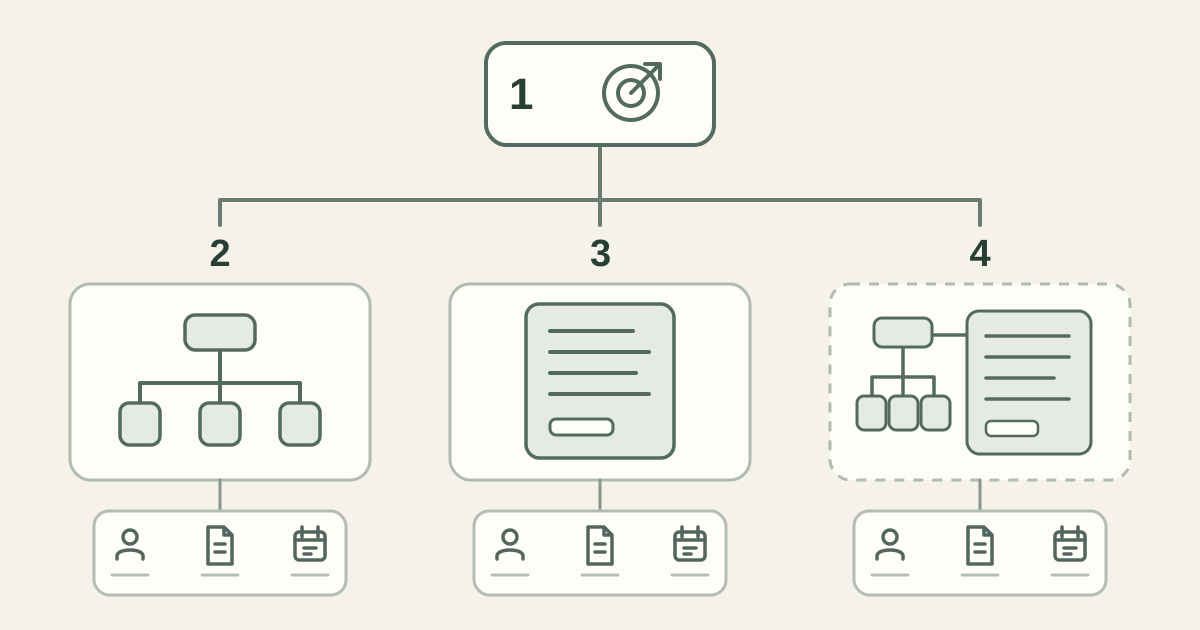
Decide what the visitor needs here
A social-profile visitor might need three clear destinations, while someone deciding whether to attend may need a schedule, venue context, policies and a contact route. Write the task as an outcome: “find the current event information” or “send an enquiry to the responsible person.” Then decide whether the destination must complete it or can hand off to another verified page. A category name does not answer that question.
Linktree describes a shareable destination connecting content across websites, social channels and stores. Its observed Free plan card also lists email and phone sign-ups; it is not simply a tool that cannot collect information. Paid cards differ, and availability and processing-fee notes matter. Collection does not by itself establish ticket issuance, a complete registration workflow or lawful use of the collected data.[1][2]
Check configuration and responsibility, not category stereotypes
An event website can be a single links page or a more detailed information surface. Do not assume it includes forms, native payments or ticketing. Check the actual implementation, selected plan, accepted content and handoff. In our scoped Boletolibre source inspection, page, redirect, configured-form and external-checkout-link surfaces are implemented in source. A form interface and POST code are not a successful submission test; a checkout link is not a demonstrated event-payment engine.
Separate editing access, account control, domain and hosting contracts, content rights and data responsibilities. “Our website” does not mean independence from every provider. Linktree terms effective July 5, 2026 retain user content rights subject to a provider licence and assign user responsibilities for content and visitor/customer interactions. These are bounded contractual observations, not a full legal assessment or proof that either choice automatically handles compliance.[3]
Name the information owner and the person who receives enquiries. If a ticket provider is separate, identify the seller and payment/support handoff. A visually consistent button cannot establish who issues tickets, changes bookings or handles refunds. Resolve those responsibilities before treating a destination as ready for visitors.
Copy a blank task-and-owner record
Use the same record for every candidate. Keep unknowns visible instead of filling them with a feature cross or zero price. The blanks are a planning aid, not a platform specification.
| Record field | Your entry |
|---|---|
| Visitor task | Outcome: ____; must finish here or hand off: ____; authoritative destination: ____. |
| Information and policy | Schedule, venue/access context, seller/contact and relevant policy versions needed: ____. |
| Collection or payment handoff | Required enquiry/sign-up task: ____; recipient: ____; separate ticket/payment owner: ____. |
| Evidence | Chosen plan/configuration: ____; documentation date: ____; actual visitor check still needed: ____. |
| Control and duties | Editor/account owner: ____; domain/provider terms: ____; data and customer responsibilities: ____. |
| Maintenance | Information owner: ____; change trigger: ____; destinations to update and inspect: ____. |
| Decision | Fit for this task: ____; unresolved condition: ____; person who closes it: ____. |
Fictional case: two needs lead to different decisions
Lantern Studio is invented. Assume its accepted information page already explains the event, a separate ticket provider is agreed, and a named support contact exists. Social visitors only need three destinations: event information, tickets and contact. If the owner has verified the selected Linktree plan and links, a maintained hub is a reasonable choice for that narrow routing task. A links page on an existing site could also work; duplicating detailed content has no demonstrated benefit in this scenario.
Now change the assumptions: there is no accepted event-information page, and visitors need schedule and venue/access context, policies and a defined enquiry route. Resolve that destination and its owner first. A suitably configured event website is a reasonable option if its content and contact/form behavior are confirmed. Linktree can still point to it; evaluate Linktree’s collection features rather than pretending they are absent. Neither option supplies automatic accessibility, privacy or ticketing clearance.
| Fictional need | Provisional decision and remaining check |
|---|---|
| Accepted destinations; quick routing | Maintained hub or existing links page. Check current destinations and owner. |
| Detailed context and enquiry route missing | Resolve the information destination and enquiry handling first; confirm actual configuration. |
| Both distribution and detailed context needed | Optional hub plus site, only with an agreed authoritative page and coordinated updates. |
Budget the second surface honestly
Suppose the fictional owner allocates 8 minutes to inspect and update the hub and 12 minutes for the event site per change cycle. Both total 20 minutes per cycle: 60 over three cycles, compared with 36 for the site-only assumption. The additional workload is 24 minutes. These are invented inputs, not measured setup times, prices, conversion results or a reason to skip checks. Different content and owners may change them completely.
When a date, venue instruction, policy or provider changes, identify the authoritative information and every affected destination. An optional second surface is useful only if someone can keep its handoffs current; record that owner rather than relying on “the team.”
Close the next evidence gap before choosing
Compare an actual country, currency, billing choice, tax treatment and service bundle before comparing costs. The observed Linktree pricing notes allow processing costs and qualify feature availability; a Free label or promotional zero-percentage statement is not a zero all-in payment-cost guarantee. No matched checkout quote was verified here, so numeric prices and a cheaper-platform verdict are omitted.[2]
Product and pricing update dates were not established. Independent source review read 19,000 of 53,900 rendered characters of the Linktree terms, through sections 1–8 and the start of 9; later clauses were not fully reviewed. The July 5, 2026 effective date is not a whole-contract or jurisdiction-specific audit. Recheck applicable terms and selected-plan availability before use.[3]
Take the first unresolved row—missing context, unowned enquiries or an unclear payment handoff—and obtain the relevant evidence. Check the real visitor journey before operational use. Choose the smallest maintained arrangement that completes the required tasks; no SEO, conversion, ownership, security or compliance result follows automatically from its label.
Sources and further reading
- Shareable destinations and customization: provider descriptionLinktree · Accessed
- Free and paid plan cards, availability and processing-cost qualificationsLinktree · Accessed
- Terms effective July 5, 2026: bounded sections 1–8 and start of 9Linktree · Accessed