What is event website SEO? A practical starting guide for organizers
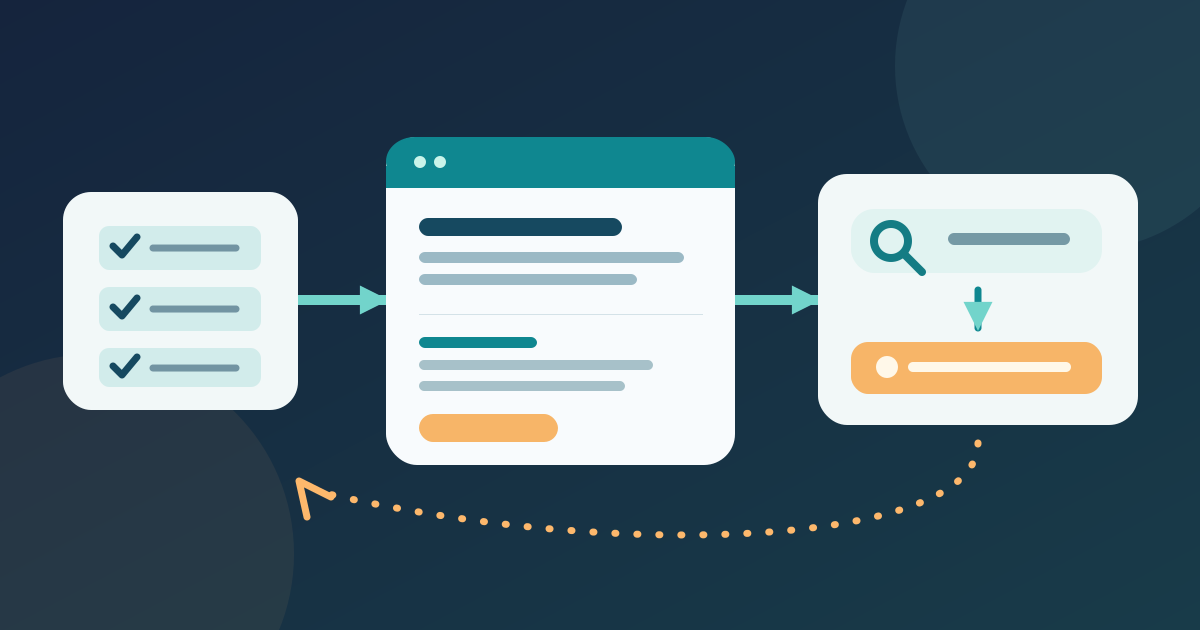
Event website SEO is the work of making a public event page understandable, reachable and useful when someone searches for the event or its topic. It is one part of event publishing, not a substitute for a clear program or a working ticket path. This guide gives an organizer a short order of operations: confirm facts, answer likely attendee questions, make the page discoverable, then check what visitors can actually do. Use the worksheet to assign a source and owner to each claim before release.
Boletolibre editorial team
Published
Start with the visitor, not a ranking promise
Search engine optimization (SEO) helps search engines understand a page and helps people decide whether to visit it. For an event, that page should immediately say what happens, who it is for, when and where it happens, and what the next action is. Someone looking for a named conference has a different question from someone exploring workshops on a topic; the first needs reliable logistics, while the second also needs to understand the format and value. Write for those questions in ordinary language.
Organic search is only one route to the event. Email, partners, listings and paid campaigns may bring visitors to the same page, so its facts and navigation need to work for everyone. Do not describe SEO as a guaranteed source of registrations. Google says no site is guaranteed inclusion in its index or a top position; search visibility depends on systems beyond the organizer’s control.
- Record the event name, format, audience, date, venue or online access, and official next step.
- Write down two or three real attendee questions before choosing page headings.
Choose the main event page and approved facts
Pick a maintained public page as the primary explanation of this edition. A recurring series can have a stable overview, but edition-specific dates, venue, speakers, session titles and ticket conditions need a dated source. Decide who approves each field and where a correction first appears. If a speaker or venue is provisional, say so rather than turning it into a firm search-facing claim. A page that is easy to find but wrong on arrival has failed its visitor task.
Map supporting pages only when they answer a separate question: a full agenda, travel directions, accessibility contact or exhibitor directory may need its own page. Link them visibly from the main event page and back to the relevant next step. Do not create many near-identical pages solely to repeat a phrase. If ticket sales happen on a separate destination, label that handoff clearly. If the event is listed on Boletolibre.com, compare its public date, venue and ticket link with the organizer’s page; this does not require assuming a site-editing feature on the ticket platform.
- Use one approved facts source for each edition-specific claim.
- Give every supporting page a distinct attendee question and a route back.
Write a page people can scan
Use a descriptive page title and a visible first heading that identify the event. Follow with a short summary of format, intended audience and essential logistics. Then arrange sections in the order a visitor needs: program, date and time with time zone where relevant, location or online access, ticket or registration terms, and contact or help route. Search snippets can be generated from page content, so make the visible copy accurate rather than relying on a meta description to repair an unclear page. Titles and descriptions are useful editorial fields, but they are not a control panel for how every result appears.
Give photos and diagrams a purpose. A map image cannot be the only way to find an entrance; provide a readable address and link. Use informative alternative text when an image conveys details, and leave decoration decorative. Keep important information as readable page text rather than burying it in a poster. Test the page on a phone before publishing: can a person read the time, identify the venue and reach the correct next action without pinching or hunting through menus?
- Title and first heading: event identity, without awkward repeated phrases.
- Visible body: clear facts, supporting pages and one obvious next step.
Make the public page reachable and check its status
A page cannot serve a search visitor if its public URL is broken, hidden behind sign-in or disconnected from the organizer’s site. Link it from an appropriate navigation page and from relevant internal pages. Check that the live URL loads, its links work and the intended public content is visible. For a new or substantially changed page, the site owner can use Google Search Console’s URL Inspection tool to see the reported indexing state and request a crawl where appropriate. A request is not an indexing or ranking promise.
Technical checks should answer a concrete question, not become a ritual. Confirm that the chosen URL is the one you share, that old campaign links have an intended destination, and that there is no accidental “noindex” or access restriction. Use the existing sitemap or canonical guides when those are the actual issue. If the site is hosted by a provider, document which settings the organizer controls and which need the site owner or provider. Record evidence before changing configuration.
- Open the exact public URL in a signed-out browser and follow its ticket path.
- Record URL Inspection status, observation date and the person who can fix each issue.
Treat event structured data as an optional accuracy task
Google documents Event structured data for eligible event pages. It can help Google understand event details and may make a page eligible for an event appearance, but the appearance is not guaranteed. The markup must reflect visible, current page facts and Google’s current required properties. Do not add a date, price or location to markup that has not been approved for the public page. If the site builder or event publisher already manages structured data, first inspect what the live page emits before adding a second copy.
A ticket destination and an organizer website may be operated by different teams. Decide who owns each public URL and the event facts shown there, then test the visitor handoff. Avoid promising that a third-party ticket page inherits edits from the organizer page. If you have no access to markup, a useful and accurate public page is still the first publishing job.
- Check visible event facts against any emitted Event markup.
- Use Google’s current Event documentation and Rich Results Test for implementation checks.
Work through launch, changes and the event close
Before launch, approve the facts, publish the primary page and test the complete path from search-style question to ticket action. At launch, record the page URL and distribute that same maintained destination to partners. When the agenda, venue, date, ticket terms or access details change, update the source record and all affected public pages, previews and partner links. Check the published result after the edit; a saved draft is not proof that visitors see the correction.
After the event, decide what the old page should answer. A dated recap, a clearly archived edition or an intentionally removed page may each be appropriate depending on what useful information remains. Do not silently replace an old edition with new dates while keeping old speaker and venue details. The existing past-event indexing guide covers that decision in depth. Carry forward stable series identity and lessons, not stale edition facts.
- Launch: public facts, working URL, phone check and ticket-path check.
- Change: source update, affected surfaces, live verification and owner.
- Close: archive or removal decision recorded for each edition.
Read the evidence and choose one repair
Search Console can report search queries, pages and clicks for a verified property. It can show whether a page is appearing for searches, but a low count alone does not diagnose the cause or prove that a title rewrite will help. Compare the reported page with its publication date, event timing and the questions the page actually answers. Look for a specific mismatch: wrong date in visible copy, an inaccessible ticket destination, a missing internal link, an unintended index restriction or a page aimed at a different audience.
Choose one repair, record it, and check the visitor path again. Treat registration and ticket outcomes in the system that actually records them rather than equating a search click with a sale. The separate Search Console and GA4 guide handles measurement setup and interpretation; this overview is the editorial and publication map. Download the worksheet to keep the event facts, public URL, search question, change owner and verification evidence in one place.
- Measure the exact page and time period, then inspect the published page.
- Keep a short change log so the next organizer can tell what was tested.
Download the event SEO page and evidence worksheet (Markdown, English)
Sources and further reading
- SEO Starter GuideGoogle Search Central · Accessed
- Control your snippets in search resultsGoogle Search Central · Accessed
- Event structured dataGoogle Search Central · Accessed
- How to use Search ConsoleGoogle Search Central · Accessed
- URL Inspection toolGoogle Search Console Help · Accessed
- Informative imagesW3C WAI · Accessed