Keep an event email experiment log across editions
A subject-line test from last year can be useful at the next ticket launch, but only if the team remembers what was tested, who received it, and what changed. A longitudinal experiment log keeps each result beside its context and next decision. It is different from the run sheet for a single A/B test: this is the index that helps the next edition decide whether an old lesson still applies.
Boletolibre editorial team
Published
Start with a reusable index
Make one row for each completed experiment, including tests with no clear result. Link to the approved provider report and keep the raw recipient data in its restricted system. The editable log includes a blank index, two worked fictional editions and a transfer note for the next owner.
Record the test, not just the winner
Give the run a stable ID and name the event edition, audience, language, send date, offer and destination. Keep the original question, the one element changed between A and B, and the controls that stayed the same. Mailchimp describes A/B tests as comparisons of email variations and can choose a winner using a configured metric; the log should retain the question and evidence behind that label.[1]
- Record exclusions and the provider or method used to allocate eligible recipients.
- Record price, availability, registration path or other event facts that changed during the observation window.
- Store links to approved copy and reports, not subscriber-level details in a shared sheet.
Keep the measure comparable
Copy the primary outcome, denominator, observation window and data source exactly as used in the run. In Mailchimp, click rate is based on successfully delivered emails, while total clicks can include repeat clicks by one recipient; those are not interchangeable. If one edition measured unique registration-link clickers and another counted all link clicks, label them different measures instead of lining up their percentages.[2]
Mark tracking quality too. Apple Mail Privacy Protection can make opens unreliable, and bot activity can inflate open or click data. A change in filtering or reporting configuration can make two editions look different even when the audience response did not change. Prefer a metric tied to the decision, and keep the measurement caveat beside the result.[3][2]
Compare conditions before carrying a lesson forward
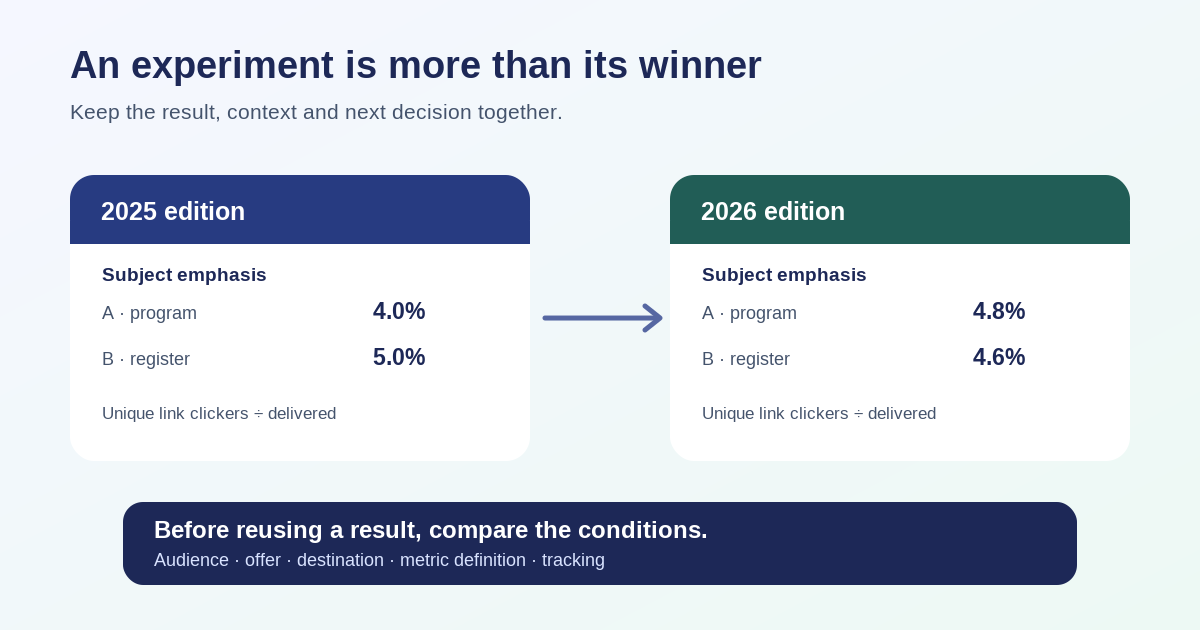
A test within one edition compares assigned variants in that edition. Two editions are not one randomized experiment: audience mix, event program, offer, season and landing path may differ. Use the log to ask whether those conditions are similar enough to repeat a hypothesis, not to pool A/B rates or declare a permanent best subject. Mailchimp’s experiment guidance stresses changing a defined variable and checking results against the original hypothesis.[4]
- Similar context: reuse the prior result as a provisional starting point and verify the current path.
- Changed context: repeat a clean test if time and eligible audience allow.
- Incomplete or compromised record: preserve “no conclusion” rather than inventing a winner.
Read two editions without forcing a winner
In the fictional log, a registration-action subject drew 100 unique registration-link clickers from 2,000 delivered messages (5.0%) in 2025, versus 80 from 2,000 (4.0%) for the program-led subject. In 2026 the program-led version had 72 from 1,500 (4.8%), versus 69 from 1,500 (4.6%) for the action version. The audience and program changed. These numbers support a fresh question, not a claim that either subject always wins or that ticket sales improved.
| Edition | A: unique clickers / delivered | B: unique clickers / delivered | Bounded decision |
|---|---|---|---|
| 2025 | 80 / 2,000 = 4.0% | 100 / 2,000 = 5.0% | Test B again in a comparable context |
| 2026 | 72 / 1,500 = 4.8% | 69 / 1,500 = 4.6% | No durable winner across editions |
Write the next action into the log
At review, record “reuse as a hypothesis,” “repeat,” or “no conclusion,” plus the reason and a named owner. List the conditions that must still match: audience, language, offer, ticket availability, destination, metric definition and tracking setup. Set a review date before the next campaign is approved. Do not delay a required correction or service notice merely to obtain a cleaner experiment.
The archive is useful when the next operator can see what was learned, what remains unknown and which report supports the decision. The single-test worksheet can hold the detailed setup; this index preserves the cross-edition memory.
Sources and further reading
- About A/B testsMailchimp · Accessed
- About Email ReportsMailchimp · Accessed
- Apple Mail Privacy Protection FAQsMailchimp · Accessed
- Running Marketing Experiments That WorkMailchimp · Accessed