Plan an email CTA wording A/B test without changing the destination
A CTA test is easy to misread when the button text, position and destination all change together. This plan isolates the words on one primary link so the team can ask a narrower question: did a clearer action phrase lead to more clicks on the tested link among comparable recipients? It works with an email service that supports controlled variants; if yours does not, treat the worksheet as a planning record, not permission to improvise a biased split.
Boletolibre editorial team
Published
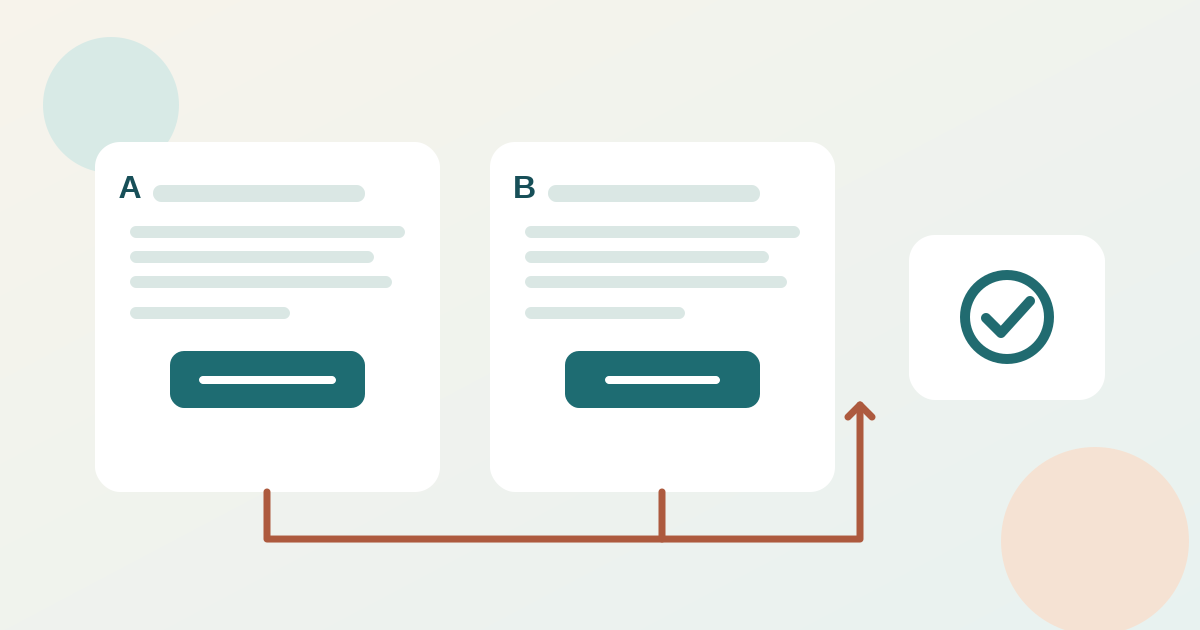
Download the two-variant test card
Download the editable CTA test plan (Markdown)
Use the worksheet before building either version. It captures the question, A/B wording, fixed elements, audience split, source of counts, review cutoff and decision rule. Make a copy for each test. The example numbers below are invented, and the file should contain campaign metadata rather than subscriber addresses.
Name the question and the reader task
Write the reader's immediate task before polishing a button. A useful question is: among eligible subscribers who receive this guide email, does ‘View the guide’ produce more interest in the guide link than ‘See the details’? This is not a test of which phrase creates more purchases. Twilio's guide discusses testing CTA wording and keeping the destination relevant to the promise; Mailchimp describes A/B tests as comparisons of controlled email variations.[1][2]
Choose wording that is truthful in both versions. If the destination is an information page, do not label one button ‘Register now’ merely to increase clicks. If the difference changes the offer or promise, it is a different hypothesis and needs its own review. A team that cannot name a reader benefit for either phrase should improve the underlying message before testing microcopy.
Change one phrase and lock the rest
Prepare two versions of the same email. Keep subject line, preview text, sender, audience eligibility, body, CTA placement, button treatment, URL and landing page identical. Alter only the primary CTA words. If the service rewrites tracked links, verify both still resolve to the same approved destination. Test messages should reach a comparable audience at the same time unless send time is the variable under test.[1]
- Variant A: the current, accurate CTA wording.
- Variant B: one alternative phrasing of the same action and promise.
- Constant: one destination, same placement and visual treatment, same surrounding copy and offer.
- Release check: both links work on mobile and desktop; the destination delivers the promised next step.
Do not change the button color to make B more visible or move A below a long section. Those changes would make the result hard to interpret as a wording effect. Keep version identifiers in your planning record so reviewers can inspect the actual sent creative, not just a remembered phrase.
Choose a fair audience and a usable window
Use the sending service's supported random split where available, and confirm that a recipient can enter only one variant. Apply the same permission rules, exclusions and suppression state to both. Do not put first-time subscribers in A and long-time customers in B; their prior relationship may explain the difference. Check whether the eligible audience is large enough to provide useful counts before promising a winner. Mailchimp's A/B documentation describes variants, test recipients and winner settings, but exact controls depend on the service and plan.[2]
Decide the observation cutoff before sending, such as 72 hours after the same send time. A short deadline may be necessary for a time-sensitive campaign, but it limits what can be learned. If the audience is small, the offer expires quickly or the setup cannot keep variants comparable, record an editorial preference and postpone the experiment. Never expose one group to an inaccurate or inaccessible version just to get data.
Before sending, estimate the number of eligible recipients per variant from past campaigns and write the smallest click-rate difference in percentage points that would change your decision. If the expected counts are too small to assess that difference, use editorial judgment instead of promising a statistically supported winner. Keep the planned cutoff: a temporary lead in a live dashboard is not a reason to end the test early. Formal significance claims need a sample-size and analysis plan made before the send, not a calculation chosen after seeing the result.[6]
Count the action that the wording can influence
For a CTA wording test, use unique recipients who clicked the tested link divided by successfully delivered messages in each variant when the reporting system provides those fields. If the same destination appears in another link, confirm the report can isolate this CTA; URL-level counts alone may combine placements. Record numerator and denominator as well as the percentage; avoid comparing a count from a 400-person group with a count from a 900-person group. Mailchimp's reports distinguish total clicks from unique clicks and provide delivered-message context. If your provider defines these fields differently, use its documented definitions consistently.[3][4]
Open rate is not the primary measure for a button inside the email. Opens depend on image loading and can be distorted by privacy protections; automated activity can also inflate clicks. Inspect bot filtering and suspicious click patterns if the platform exposes them. A click measures interest in the destination, not a completed signup, sale or read. Count those downstream outcomes separately in the receiving system if the question actually concerns them.[4][5]
Write a guardrail as well: for example, relevant replies saying the CTA was misleading, a broken destination or an unusual complaint spike. A numerical lift is not a reason to keep wording that misstates the next page. Decide who will check the creative and destination before release and who will read the report at the cutoff.
Also record how many recipients were assigned and sent each variant, as well as how many were delivered. A click rate among delivered messages describes delivered recipients, not necessarily everyone assigned at random. If delivery rates or bot-filtering conditions differ materially between A and B, investigate before attributing a click-rate gap to the wording.[4][6]
Read an example without declaring a winner too soon
Suppose A reaches 500 delivered recipients and 24 unique recipients click its guide link: 24 ÷ 500 = 4.8%. B reaches 505 delivered recipients and 30 unique recipients click: 30 ÷ 505 ≈ 5.9%. B is ahead by about 1.1 percentage points at the agreed cutoff. That arithmetic describes this send; it does not prove B will outperform A in future sends. The gap is only six people, and automated clicks or audience differences could matter.
The useful record says: ‘B led on unique-link click rate in this limited test; keep both wordings eligible, inspect click quality and repeat on a comparable message before adopting a standard.’ If the same outcome recurs with adequate volume and no guardrail problem, the team can prefer B for a similar reader task. If the numbers are sparse or mixed, say ‘inconclusive’ rather than manufacturing a winner.
Close the loop in the next campaign
Save the two final creative versions, send date and time zone, audience definition, split method, destination URL, metric definition, raw counts and cutoff alongside the decision. Revisit the result when choosing copy for the next comparable email. Avoid transporting a winning phrase into a different promise or audience without checking whether it still describes the destination.
A CTA test is a small piece of campaign planning. It cannot repair a weak offer, an irrelevant audience, a broken landing page or missing permission. The best outcome is a decision the team can explain, including when the evidence was too weak to change anything.
Sources and further reading
- Guide to Email A/B Testing and CTA OptimizationTwilio SendGrid · Accessed
- About A/B Test CampaignsMailchimp · Accessed
- About Email ReportsMailchimp · Accessed
- About Open and Click RatesMailchimp · Accessed
- About Bot Activity and Bot FilteringMailchimp · Accessed
- Three Key Checklists and Remedies for Trustworthy Analysis of Online Controlled ExperimentsMicrosoft Research · Accessed