When to merge or keep overlapping event-guide pages
Two articles about the same event topic are not automatically duplicates. Before merging them, compare the question each one answers and the job each reader needs to finish. A ticket pricing guide and a payment-fee explainer may mention fees but serve different decisions. A pair of guides that both answer the same registration checklist question may be confusing. Record the decision before touching URLs.
Boletolibre editorial team
Published
Compare the pages as a reader would
For each candidate URL, record its title, primary question, audience, intended action, unique examples or template, locale, publication state and maintainer. Read the pages side by side. Note whether one is merely a stale edition of the other or whether they solve different steps. Search queries, Search Console page data, internal links and support questions can help prioritize review, but low traffic alone does not prove a page has no value. The leading accessible Google result presents an inventory-and-decision matrix; this guide narrows that idea to actual event-guide overlap.[1]
| Pair | Keep separate when | Consider merging when |
|---|---|---|
| Event budget vs marketing budget | One owns whole-event finances; the other owns promotion spend | Both answer the same budget question with repeated tables |
| Registration fields vs confirmation email | Different stages and actions | Two pages offer the same field checklist |
| Past event vs current edition | Each date and history has a distinct purpose | A duplicate URL has no separate event history |
Choose keep, improve or merge deliberately
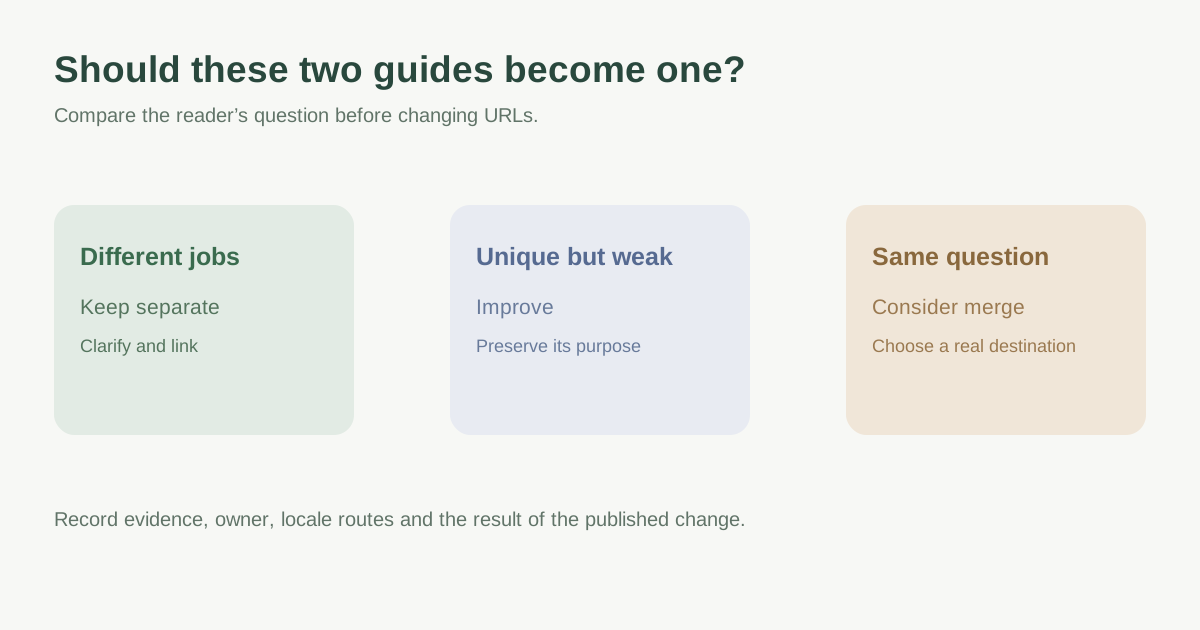
Keep both when each page has a clear independent outcome; make the distinction visible in headings and cross-links. Improve a weak page when the reader needs its distinct answer but the current explanation is thin or outdated. Merge only when one complete destination can preserve the useful material and satisfy the same reader intent. Decide where a merged reader should land before removing a source URL.[2]
Do not apply a mechanical rule such as “merge every low-traffic page,” and do not assume two related pages must compete in search. Google explains that duplicate content is common and not itself a spam-policy violation; canonical selection is about representative versions of the same or very similar content. Distinct user tasks deserve distinct pages.[2]
Plan the destination before changing URLs
Choose the best maintained, relevant page for the combined answer. Preserve essential examples, downloadable tools, source citations and updated facts; remove contradictions and repeated introductions. Map each retired URL to a relevant replacement. A permanent server-side redirect is appropriate for a genuine permanent move; Google cautions against redirecting many unrelated old URLs to an irrelevant destination such as a homepage. If no relevant replacement exists, do not manufacture a misleading redirect.[3][4]
Review alternate-language pages separately. A merge of two English guides does not automatically mean the Spanish, German, French, Japanese and Dutch versions are ready to collapse; translate the revised destination and map locale-equivalent URLs. Update internal links and sitemap entries to the intended final URL. Inspect canonical signals rather than assuming a redirect or canonical tag forces Google to choose your preference.[2][4]
Verify the reader path and record the decision
After publishing, open both former and retained URLs. Confirm a retired URL reaches a relevant complete answer, the retained page is readable on mobile, downloads work and links use the correct locale. Review Search Console indexing and queries over time without promising a traffic lift or a particular crawl date. Keep a small decision log: URLs, separate reader jobs, evidence, chosen action, destination, owner and review date.[4][2]
Download the event-guide consolidation decision worksheet (Markdown, English)
Sources and further reading
- Content pruning for AI search: When to remove, redirect, or consolidate pagesSearch Engine Land · Accessed
- What is URL canonicalization?Google Search Central · Accessed
- Redirects and Google SearchGoogle Search Central · Accessed
- Site moves and migrationsGoogle Search Central · Accessed