Build an internal linking plan for event-planning guides
A library of event-planning articles is easier to use when each page points to the next decision a reader actually faces. Internal links also help crawlers discover related pages, but adding a fixed number of links to every post is not a strategy. Map the reader’s task, the destination’s distinct purpose and a meaningful place in the source page before editing links.
Boletolibre editorial team
Published
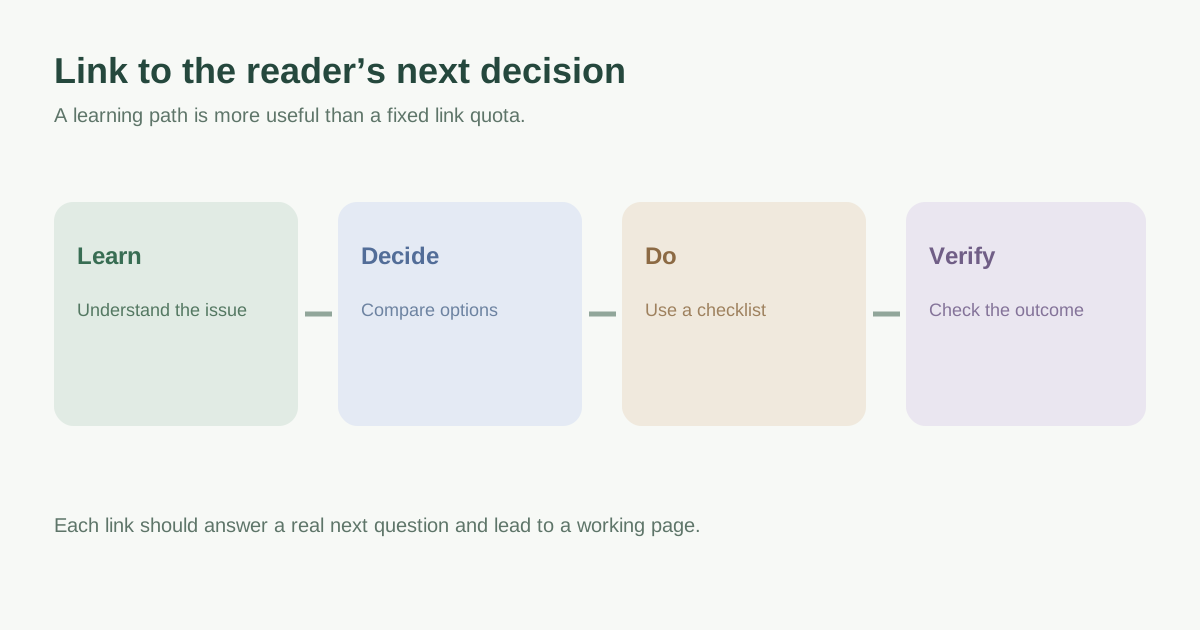
Inventory pages by the decision they answer
List every published guide with its URL, reader question, intended outcome, current status and primary language route. Group pages by real workflow: for example, understand domain choices, plan an event-site launch, test registration, then handle event-day operations. Do not group solely because two titles contain the word “event.” If two guides answer the same question, settle the duplication or canonical content decision before connecting them as though they were complementary.[3]
| Reader stage | Example event-site question | Next useful type of page |
|---|---|---|
| Learn | What does this technical choice mean? | A comparison or glossary with scope |
| Decide | Which option fits this event? | A decision worksheet or requirements guide |
| Do | How do we implement or rehearse it? | A task checklist or template |
| Verify | Did the attendee path work? | A test or monitoring guide |
Draw links around prerequisites and follow-up tasks
For each guide, identify one prerequisite the reader may need, the immediate next action, and a related exception or troubleshooting page only if it genuinely helps. A broad topic overview can act as a hub, but every spoke need not link mechanically back to it. The first Google result describes hub-and-spoke clusters; the useful part is intentional relationships, not a required diagram shape or promised ranking gain. For an event registration guide, a useful path might move from required fields to accessibility review to confirmation-message checks.[1][3]
Record both sides of an important link: a new page should point to the relevant established guide, and an older guide may need a contextual link to the new one where the reader would otherwise stop. Avoid irrelevant “related articles” grids that send a ticket-support reader into domain hosting. Check whether the destination is live, current and appropriate for the same locale; a Spanish guide should normally lead to the Spanish route of its related guide.[2]
Write anchors that predict the destination
Google recommends crawlable HTML anchors with href values and concise, relevant link text. Write the anchor as the destination decision: “event registration accessibility checklist” is clearer than “click here.” Place it in a sentence where the reader needs that decision. Do not force an exact keyword repeatedly, and do not turn every mention of a related term into a link. A text label should make sense even when read apart from its surrounding sentence.[2]
Prefer a direct link to the best answer. If a page already explains the necessary point in a short paragraph, link only when the destination offers a deeper step, evidence or reusable template. For a PDF or worksheet, tell readers what they will open. If the implementation uses a scripted card or button rather than a normal anchor, inspect the rendered page because Google may not reliably extract a link without an href.[2]
Review discoverability and keep the plan current
Inspect the published navigation and content links for pages with no useful incoming route, broken destinations, redirects and outdated editions. A sitemap helps discovery, but it does not replace a useful path for people. Review the live page at mobile width: links should not interrupt the main answer or hide the primary action. Check that canonical URLs and locale routes are consistent with the link destination rather than mixing old and new slugs.[2][3]
At publication, add the new guide to the map, choose its most useful outgoing links, and update relevant older pages. At later editorial review, retire links to withdrawn pages and change links when the destination’s scope changes. Track a completed link by source URL, anchor, target URL, reason and reviewer. The objective is a connected learning path; rankings and crawl timing remain outside the worksheet’s control.[3]
Download the event-guide internal link map (Markdown, English)
Sources and further reading
- Internal Linking Strategy GuideClusterMagic · Accessed
- Link best practices for GoogleGoogle Search Central · Accessed
- SEO Starter GuideGoogle Search Central · Accessed