Do your event subdomains need wildcard DNS? A decision worksheet
An organizer may have a few named addresses such as tickets.example.org and media.example.org. A wildcard DNS record can make additional, unlisted names resolve, but that convenience changes what a mistyped or retired hostname does. Use this worksheet to decide whether a catch-all is actually needed before asking a DNS operator to make a change.
Boletolibre editorial team
Published
List the names you actually intend to use
Start with the current zone and an inventory of public hostnames. Give each event edition, ticket destination, media site or partner service a purpose, owner and expected lifetime. Mark names that belong to another team's delegated DNS zone. A fixed, short list is a reason to consider explicit records first; an application that must accept many names created on demand is a different case.[2][3]
Do not equate a DNS answer with an approved event page. A hostname can resolve while the web host has no matching site, shows a default page, or lacks HTTPS coverage. Confirm the intended behavior with the hosting owner before treating a catch-all as a publishing method.
Understand which names a wildcard can answer
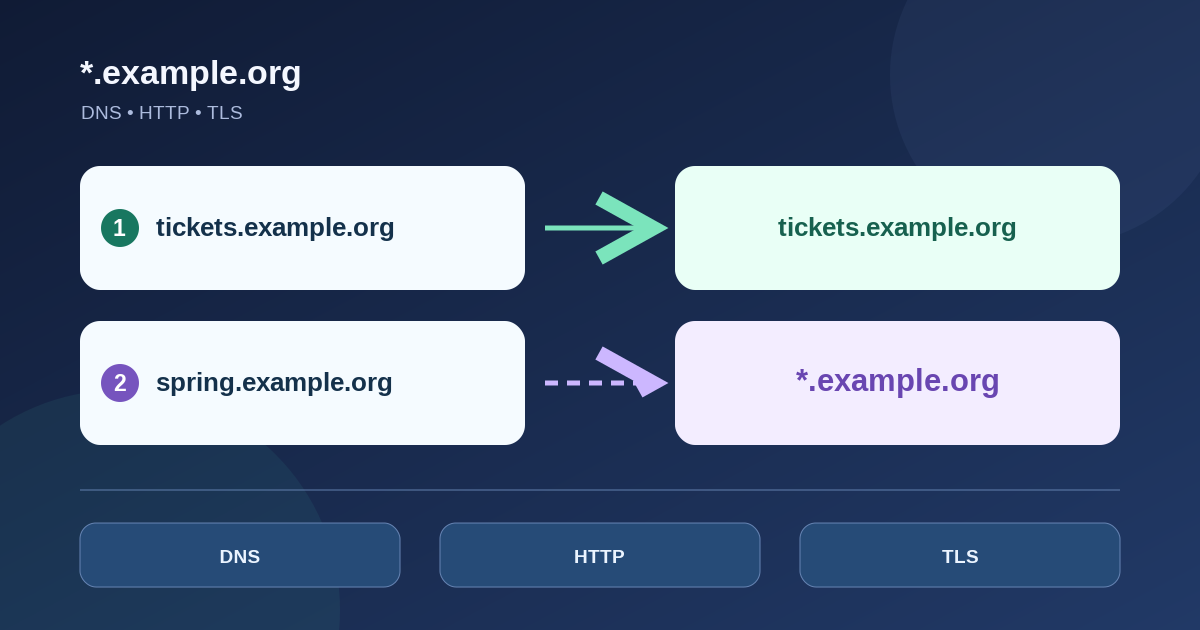
In an illustrative zone, a record for *.example.org can answer an unlisted name such as spring.example.org. An existing exact name such as tickets.example.org takes precedence. The wildcard does not answer the apex example.org. This is DNS matching, not an HTTP redirect to another URL.[1][2][3]
Avoid the shorthand that a DNS wildcard always covers exactly one level. Route 53 documents possible answers for deeper names, and the DNS standard makes the closest existing name relevant; a specific record or delegated branch can stop a broader wildcard from applying. Ask the authoritative DNS operator to check the actual zone and provider behavior rather than guessing from the spelling alone.[1][2][3]
Walk through five names in one illustrative zone
Assume the example.org zone contains an exact tickets.example.org name and an A record at *.example.org. The table describes possible DNS matching, not live configuration or an instruction to create records. A wildcard answer is synthesized only when the standard's closest-encloser rule and the requested record type permit it. A name that exists for another type can block the parent wildcard instead of inheriting its A record.[1][2][3]
| Name requested | Possible DNS path | Publishing decision |
|---|---|---|
| tickets.example.org | Existing exact name | Keep its named service and owner. |
| spring.example.org | Wildcard may supply the A answer if the branch is otherwise absent | Use only if a reviewed service generates this name. |
| ticket.example.org (typo) | The same wildcard may answer | Define a deliberate unknown-host page response. |
| example.org (apex) | Not covered by *.example.org | Plan the apex separately. |
| a.tickets.example.org | The existing tickets branch can block the parent wildcard | Have the DNS owner check that branch and any delegation. |
The typo row is a practical reason to avoid a catch-all when names are finite: DNS may answer a spelling nobody approved. It does not mean a ticket page is automatically published or redirected. The branch row is why a diagram that says a wildcard always covers every deeper name would be misleading. Compare the authoritative zone and provider's behavior with a sample lookup before deciding.[1][3]
Keep the DNS, web and certificate questions separate
DNS wildcard matching and TLS certificate matching use different rules. In an appropriate zone, *.example.org may supply a DNS answer for a deeper name such as checkin.spring.example.org. Under RFC 9525, a certificate identifier *.example.org matches one label such as spring.example.org, not checkin.spring.example.org or the apex. An answer in DNS is therefore not evidence that the browser will accept HTTPS for that hostname.[1][2][4]
Ask the web-host owner to state what an unrecognized hostname returns before using a catch-all. Check the exact names visitors will see on a real browser path, including the page content and HTTPS result. Keep certificate-name selection with the separate coverage plan; this worksheet records the DNS decision and its dependencies, not a certificate request or a deployment instruction.[3][4]
Compare a fixed list with a genuine catch-all need
| Question | Write down the answer before deciding |
|---|---|
| How are names created? | Named and approved one at a time ____ / generated on demand by a known service ____. |
| What should an unknown name do? | Remain unresolved ____ / reach a reviewed application response ____. |
| Who handles each layer? | Authoritative DNS ____; web host ____; HTTPS certificate ____; event content ____. |
| What is already present? | Exact records, delegated branches and retired names ____; owner of each ____. |
| What evidence is needed? | Provider documentation ____; expected DNS answer ____; visitor-page and HTTPS checks ____. |
| Decision and review date | Use named records ____ / request a scoped wildcard review ____; approver ____; date ____. |
A handful of known event names normally does not require catch-all routing. If new subdomains are generated by a platform, document which application accepts them and what it shows for an unrecognized name. Keep the DNS, hosting and HTTPS decisions with their respective owners; none of the three proves the other two.
Hand the operator a testable decision, not a guessed record
Download the editable wildcard DNS decision card (Markdown)
Use a non-production example on the card. Ask the DNS owner to compare one intended named hostname, one deliberately unlisted hostname and the apex with the expected results. The hosting owner checks whether each reachable name has the right page or a deliberate unknown-host response, while the certificate owner confirms HTTPS for names visitors will use. Record the actual observations and any exception before approval. Do not use this card as a set of DNS values to paste into a live zone.[2][3]
If the catch-all is not needed, keep the named-host inventory and its review date. If it is needed, document the generating service, scope, owner and retest point when that service changes. A wildcard certificate is a separate TLS choice; adding a wildcard DNS record does not issue or attach one.[3]
Sources and further reading
- RFC 4592: The Role of Wildcards in the Domain Name SystemRFC Editor · Accessed
- DNS domain name format: wildcard recordsAmazon Route 53 · Accessed
- Wildcard DNS recordsCloudflare DNS documentation · Accessed
- RFC 9525 §6.3: Matching a DNS domain name and wildcard certificatesRFC Editor · Accessed