Scheduled website tasks stopped after a hosting migration: a diagnosis worksheet
A site can look healthy after a host move while scheduled publishing, cleanup, feeds, or other background work has stopped. Start with the task's last successful result, not with a new cron expression. This worksheet separates the scheduler, the command, and the outcome so you can repair the right layer without accidentally repeating a job.
Boletolibre editorial team
Published
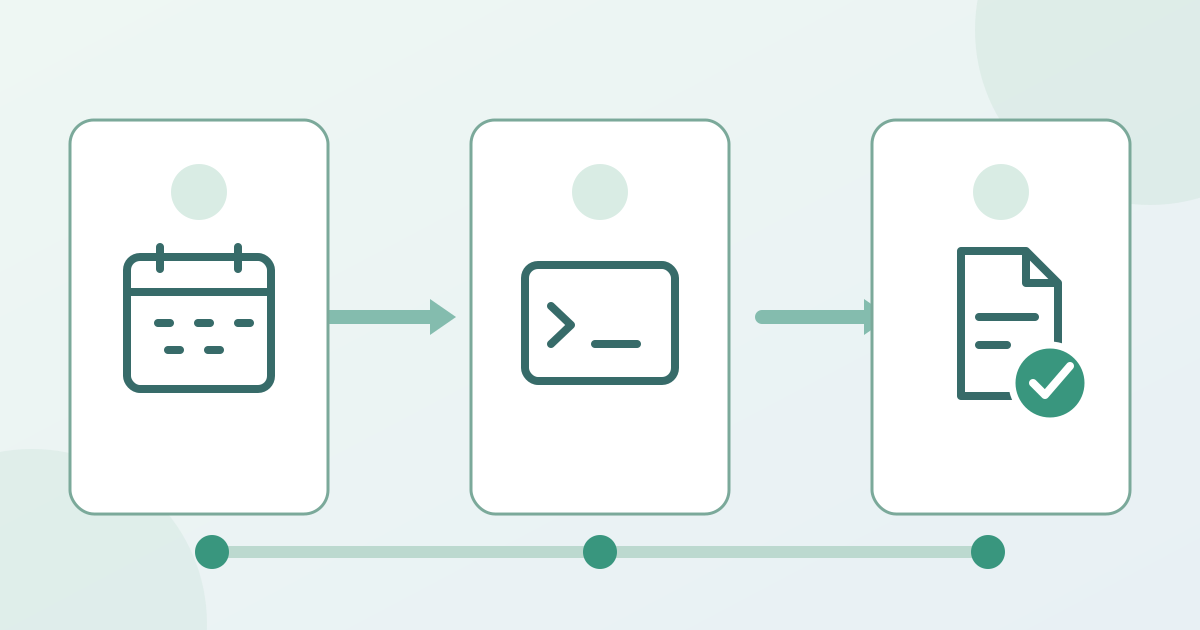
1. Name the missing result before editing anything
Record the task owner, expected interval, last known success, and one observable output: a published page, updated feed, completed report, or application event. A green homepage does not prove a background task ran. Decide whether the job is a host cron entry, a CMS scheduler, or an outside service calling a URL. These are different owners and can fail independently.
If the task sends money, deletes data, or emails people, pause manual reruns until its owner confirms whether it is safe to repeat. Record the old and new hosting accounts, application path, and cutover time in one place.
2. Check that the schedule exists on the new host
Look in the new host's scheduled-task interface or the crontab of the actual account user. A copied website file tree does not establish that the host's schedule was copied. Compare the exact command, minute/hour fields, user, and intended time zone with the old configuration. cPanel's Cron Jobs screen lists current jobs and requires all schedule fields and a command; its cron email can expose command output.[1]
If the hosting plan no longer exposes scheduled tasks, ask the provider which scheduler is available and who owns it. Do not create a second trigger until you know whether the application already schedules the same work.[1]
3. Separate a missed trigger from a failed command
At the next expected minute, look for an execution record or temporary command output, then check the application's result. No invocation points toward a missing entry, wrong account, wrong schedule, disabled scheduler, or time-zone misunderstanding. Invocation with an error points toward the command or environment. Invocation with exit success but no business result points toward application logic, a queue, permissions, or a downstream service.[3][2]
Preserve stderr while diagnosing. A command ending in `>/dev/null 2>&1` hides useful output; cPanel describes suppressing cron mail for one job by discarding its output. Capture only the failure detail needed for support, and keep secrets out of screenshots and tickets.[1]
| Observation | Likely layer | Next evidence |
|---|---|---|
| No job on new host | Schedule transfer | Old entry and new account inventory |
| Job exists, no invocation | Clock or scheduler | Account, time zone, next run |
| Invoked, command error | Runtime environment | Exit/output, paths, permission |
| Invoked, no useful result | Application or downstream | App event and output timestamp |
4. Recheck the command's new environment
Compare the interpreter path, script path, working directory, executable permission, and account user on the new host. Cron's default environment is limited and may differ from an interactive shell; use explicit paths and document required environment variables without pasting secret values into the worksheet. A manual run as your own user is weaker evidence than a run under the scheduler's account.[2][1]
If a command fetches a URL, record the final response and the application outcome separately. A successful HTTP response can still leave the actual work queued or skipped. If the task may run longer than its interval, prevent overlapping runs before shortening the schedule; cPanel warns that overlapping jobs can degrade performance.[1]
5. For WordPress, identify which cron mechanism is active
WordPress WP-Cron is event-driven and is not the same as the host's time-based cron. Some sites rely on visits to trigger it; others disable that trigger and use a system scheduler. After migration, check whether `DISABLE_WP_CRON` is set and whether the replacement trigger exists. Do not turn off one mechanism before proving the other works.[4]
WordPress Site Health can expose loopback problems. Use `wp cron test` only when visit-triggered WP-Cron is intended: it reports an expected error if `DISABLE_WP_CRON` is true. When a system scheduler is intended, inspect that host trigger and use `wp cron event list` to see scheduled events; the list alone does not prove they ran. A failed loopback can affect scheduled posts and plugin events. Apply these checks only to WordPress.[5][6][7]
6. Prove recovery without a blind replay
Change one cause at a time, then observe one expected run and its final result. For a harmless task, an approved manual run can narrow the cause; for payments, deletion, bulk email, or inventory changes, get the owning application's replay rule first. Record the next scheduled time, actual invocation, output, result, and who accepted the fix.
Leave a small heartbeat or last-success check for the outcome that matters, not merely a process-start alert. Revisit the schedule after the next normal interval and hand the worksheet to the hosting or application owner if the invocation and outcome disagree.
Sources and further reading
- Cron JobscPanel & WHM Documentation · Accessed
- crontab utilityPOSIX / Linux man-pages · Accessed
- crontab file formatLinux man-pages · Accessed
- Hooking WP-Cron Into the System Task SchedulerWordPress Developer Resources · Accessed
- LoopbacksWordPress Developer Resources · Accessed
- wp cron testWordPress Developer Resources · Accessed
- wp cron event listWordPress Developer Resources · Accessed