Does your event website need a CDN? A practical decision guide
A content delivery network can serve eligible event pages and assets from edge locations closer to attendees. Whether it helps your site depends on what is slow today. The first Google result recommends inspecting the actual page rather than assuming every site needs another CDN. For events, the crucial split is between public details and posters that can be shared, and registration, inventory or checkout requests that must remain correct for each attendee.
Boletolibre editorial team
Published
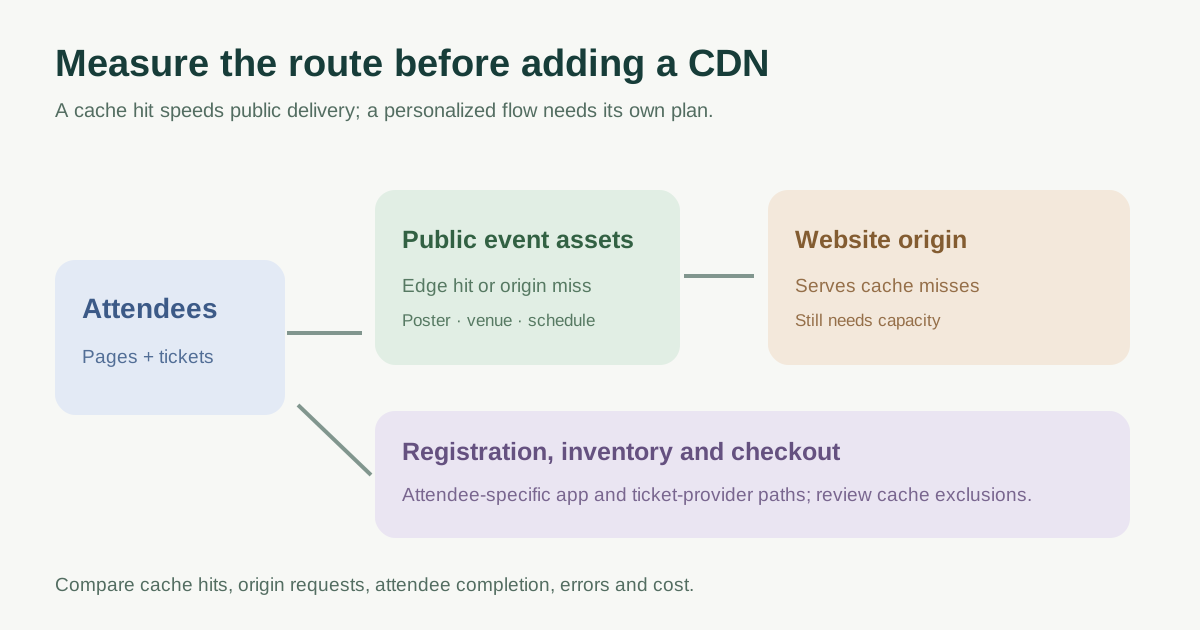
Map your event journey before choosing a CDN
List the home and event pages, schedule, venue map, poster, sponsor logos and downloadable guides. For each, record file size, update frequency, current delivery host and audience geography. Then list form submissions, account pages, ticket availability, cart, payment and confirmation separately. These are not automatically safe to put in a shared cache. A ticket vendor may already use its own edge service; your CDN cannot repair its checkout.[1][2]
| Event route | Likely delivery path | Decision question |
|---|---|---|
| Public event page and poster | Existing host or edge cache | Are distant attendees waiting for bytes or for page generation? |
| Schedule and venue updates | Cache hit or origin miss | How quickly must a correction appear? |
| Registration and availability | Application, database or ticket vendor | Is this path personalized or time-sensitive? |
| Checkout and confirmation | Ticket/payment provider | Who owns latency, errors and capacity? |
Measure the bottleneck on real pages
Use a representative event page from attendee regions. Capture document response, largest assets, transfer size, cache status and origin request rate during an ordinary window and a legitimate busy window. Compare a first request (often a miss) with subsequent hits. CloudFront describes the edge hit versus origin fetch path; a cache hit can reduce origin work, while a miss still needs the origin.[2]
If images are oversized, resize and compress them before judging the CDN. If the delay is server rendering, database queries, a third-party embed or checkout API, moving static assets to an edge may not address the main problem. Check whether your current hosting already delivers files through a CDN before paying for overlapping service. Avoid treating a generic speed-test recommendation or an arbitrary number of checklist “yes” answers as proof.[1]
Set cache boundaries around attendee-specific flows
Define which public resources may be cached and how updates will be invalidated or expire. Check current cache-control headers, cookies and any edge rules. Cloudflare documents default behavior that respects private/no-store directives and examples for bypassing cache on a cookie; other providers and custom rules differ. Review actual responses under signed-in and anonymous sessions. Never rely on a public poster test to prove private registration data cannot be shared.[3][4]
Keep inventory, account, registration, cart, checkout and confirmation out of shared caching unless the application team has a reviewed design for each response. Plan a correction drill: change an event date or venue in a safe environment, then confirm the public page and edge copies show the approved version. Record who can purge or roll back an incorrect cache rule.
Run a bounded trial and record the decision
Compare baseline and trial for the same pages and attendee locations: load time, cache hit ratio, origin requests, error rate and cost. Note the workload shifted to the CDN, the remaining origin-bound tasks and any new operational responsibility for DNS, TLS, cache rules or purges. If the site is already edge-hosted and the main delay is a checkout vendor, the decision may be to improve that flow rather than add another CDN.
Make the decision reversible: list the configuration owner, expected benefit, acceptance criteria and rollback. Recheck when the audience spreads, media weight changes, a major sale is announced or the site architecture changes.
Download the event-site CDN decision worksheet (Markdown, English)
Sources and further reading
- Do I Need a CDN? A Practical Decision FrameworkImage CDN · Accessed
- How CloudFront delivers contentAmazon Web Services · Accessed
- Default cache behaviorCloudflare · Accessed
- Bypass Cache on CookieCloudflare · Accessed