Website hosting total cost: an event-site worksheet
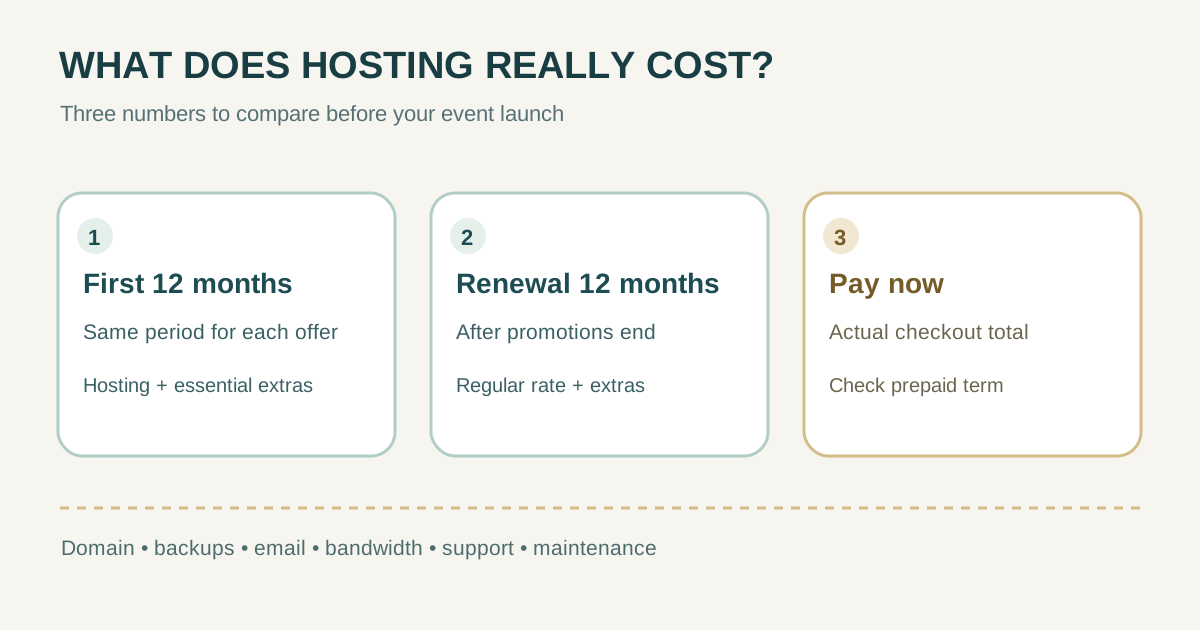
A low advertised monthly hosting price may describe a long prepaid introductory term, while your event website also needs a domain, backups, email, support and perhaps other services. To answer ‘what does hosting really cost?’, compare the same 12-month period for every offer, then separately record how much cash is due now and what the service costs at renewal. Use the downloadable worksheet to compare two offers without relying on a market-price roundup that may already be outdated.
Boletolibre editorial team
Published
Download the two-offer cost worksheet
Enter each quote in one currency. The workbook has first-12-month and renewal-12-month columns for two offers, a place to record the source and scope of each charge, and a separate field for cash payable at checkout. Enter zero when an item is genuinely included or not applicable; an incomplete column intentionally leaves its total blank rather than understating it.
Download the event website hosting cost worksheet (.xlsx)
This is a comparison tool, not a quote. No current provider prices are prefilled. Copy amounts from the actual plan and checkout shown for your location, currency and billing term.
Keep three different numbers separate
| Number | How to calculate or find it | Why it matters |
|---|---|---|
| First 12-month equivalent | Add the first-term cost of each required item, converting longer terms to a 12-month rate | Compares plans on one time basis |
| Renewal 12-month equivalent | Use the next regular rate for each item after promotions end | Shows whether the plan remains affordable |
| Cash payable at checkout | Copy the actual upfront total from checkout, including any multi-year prepayment | Shows what the organizer must fund now |
An advertised ‘per month’ price does not always mean monthly billing. For example, a purely hypothetical 24-month commitment of 240 currency units has a 12-month equivalent of 120, but still requires 240 upfront. If renewal is 180 per 12 months, use 180 in the renewal column. Do not confuse annualized comparison with cash flow. Hostinger's support documentation, for example, says its subscription term is charged upfront and that renewal price and billing cycle are shown separately; check the terms of the provider you are actually considering.[2][3]
List every item needed to keep the event site usable
Use the same scope for both offers. A plan that includes a domain, certificate, basic backup or email is not equivalent to a cheaper headline plan that charges for those pieces separately. Confirm what ‘included’ means after the first term, how many mailboxes or sites it covers, backup retention and restore access, and whether support handles application issues. Provider documentation explicitly distinguishes renewal prices, term lengths and included services.[1][4]
| Cost line | What to verify |
|---|---|
| Hosting plan | Actual first term, renewal rate, term length, resource limits and upgrade path |
| Domain | Registration, renewal, privacy and DNS service; avoid counting a domain already paid elsewhere twice |
| Backup and restore | Frequency, retention, restore assistance and whether backup is an extra product |
| Email and TLS | Mailboxes, sending limits, certificate inclusion and renewal |
| CDN, bandwidth and overage | Traffic allowance, metering unit and what happens above the allowance |
| Support and monitoring | Hours, response scope and who investigates failed forms or checkout links |
| CMS, plugins and fixed platform fees | Licenses and subscriptions necessary for the site |
| Migration and labor | Setup, updates, incident response and someone to test registration before launch |
These lines are not hypothetical add-ons: providers can charge separately for backups and excess transfer. DigitalOcean, for example, documents backup charges and outbound-transfer allowances for its Droplets. Its rates are specific to that product, so use them only if it is a candidate, not as a universal hosting estimate.[5][6]
Account for the event's short peak and its other vendors
An on-sale announcement can concentrate traffic into a short window. Estimate page views, image weight and how many people reach a registration form at once. Ask the host which limits apply and whether a temporary peak changes the bill or simply throttles the account. If ticket checkout runs on a separate service, its transaction fees and capacity are a different budget and operational dependency. Put only fixed platform subscriptions in this hosting worksheet; model per-ticket charges against expected sales in a ticketing budget.
- Write down the public event page, registration page, checkout destination and confirmation email provider.
- Check where each service is billed and who supports it during a sale.
- Ask for the renewal terms and an itemized checkout total, including taxes in your jurisdiction.
- Compare both offers at the same currency, period and service scope.
- Keep the quotes and review the renewal budget before any auto-renewal date.
The cheaper first-year total is not automatically the better choice. If one offer lacks restoration help or adequate support during a ticket launch, note that difference beside the number and price the missing service before deciding.
Sources and further reading
- How to choose a web hosting planHostinger · Accessed
- Renewal periods and advance paymentsHostinger Help Center · Accessed
- How to renew a hosting planHostinger Help Center · Accessed
- How to use the billing sectionHostinger Help Center · Accessed
- Backups pricingDigitalOcean Documentation · Accessed
- Bandwidth billingDigitalOcean Documentation · Accessed