Free event budget template with a worked example
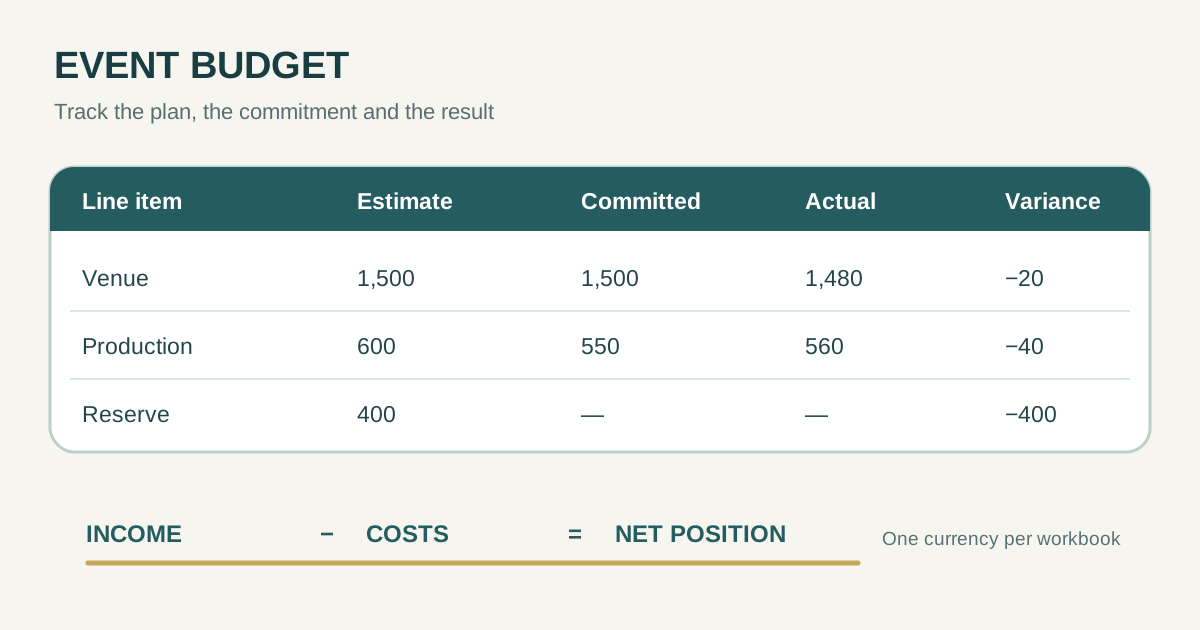
An event budget is useful when it changes with the event. This free, editable Excel workbook gives you a cost list, income list, committed amounts, actuals, automatic variances and a net summary. It includes a fictional community-workshop example so you can see the formulas work before replacing its numbers. The workbook and this guide focus on a single event in one currency; adapt the categories to your format and local rules.
Boletolibre editorial team
Published
Download the editable event budget
Download the event budget workbook (.xlsx)
Open it in Excel or another compatible spreadsheet app. Replace the fictional amounts and event name, edit the item labels, then use the extra rows for costs or income unique to your event. The summary and line variances update from the input cells. Save your own copy before entering confidential vendor details.
The workbook is deliberately small: one working sheet, separate cost and income sections, and a summary at the top. It does not claim to provide tax advice, cash-flow timing, or a platform-fee quote.
Estimate costs before you approve spending
List each thing you expect to buy or pay for, even if the supplier is undecided. Enter a realistic estimate, how you obtained it, and what the quoted price includes. A venue quote may omit staffing, cleaning, overtime, furniture or audiovisual equipment. Keep those as separate lines if they have different owners or approval dates.[1][2]
- Venue and production: rental, staging, sound, lighting, internet and signage.
- People and program: staff, security, speakers, travel and hospitality.
- Audience and promotion: marketing, ticketing, registration and attendee support.
- Requirements and reserves: insurance, permits where applicable, taxes to confirm, and contingency.
Keep a contingency line as a reserve for uncertainty. It is not a bill already paid and should not be presented as a supplier quote. Set its amount from the event’s exposure and approval policy rather than assuming a universal percentage.
Keep estimates, commitments and actuals separate
An estimate is what you expect a line to cost. A commitment is an accepted contract, purchase order or otherwise approved obligation. An actual is a recorded invoice, payment or final charge, depending on the accounting basis you choose. A quote that has not been accepted remains an estimate. Do not treat the three columns as interchangeable.
The cost-line variance is actual minus estimate. A positive number means that recorded cost is above plan; a negative number means below plan. The summary reverses the expense sign so a positive summary variance means the event’s net position improved. Keep notes beside lines whose scope changed; a cheap invoice may simply exclude a service you still need.
Model income separately from costs
Enter ticket sales, sponsorship, merchandise or other income in its own section. Use gross ticket revenue as the income input and show ticketing and payment costs as expenses, so fees do not disappear inside a net deposit. Record signed sponsorship as committed income and actual receipts as actual income only under the basis you have chosen.
A planned surplus equals estimated income minus estimated expense. It is a decision aid, not cash in the bank. During sales, actual recorded values may be incomplete; the actual net shows only what has been entered so far. Do not use it as a final event result until both income and cost lines are complete.
Read the fictional worked example
The included sample is a community workshop in USD. The estimates total 6,300 of income and 5,430 of expense, including 400 of contingency. Its planned surplus is therefore 870. The recorded sample figures total 6,680 of income and 4,925 of expense, producing 1,755 of net. The 885 improvement is 380 more income plus 505 lower expense. These are invented teaching numbers, not market prices or Boletolibre fees.
| Measure | Estimate | Recorded actual | Difference |
|---|---|---|---|
| Income | USD 6,300 | USD 6,680 | USD 380 above plan |
| Expense | USD 5,430 | USD 4,925 | USD 505 below plan |
| Net | USD 870 | USD 1,755 | USD 885 better than plan |
The unspent 400 contingency remains in the estimate. Do not subtract it twice or silently move it into actual spending. If a risk materializes, put the specific new cost on a cost line and leave the reserve as a planning reference until the budget is formally revised.
Update the budget at each decision point
Revisit the sheet when a supplier quote changes, a contract is signed, ticket sales materially diverge, or a new expense is approved. Date and describe meaningful changes in your own copy or change log. Ask the owner of each line whether tax, service charges and cancellation terms are included. If the event spans currencies, build an explicit exchange-rate assumption outside this simple one-currency template.
Before final close, reconcile actual income with settlement reports and actual costs with invoices. A financial close also needs cash timing, refunds, taxes and any unpaid balances; this simple template does not replace that process.
Sources and further reading
- Wharton event budgeting guidanceWharton Marketing & Communications · Accessed
- Smartsheet event budget template overviewSmartsheet · Accessed