How to price event tickets with a simple cost model
A ticket price is a decision under uncertain demand, not a number obtained by dividing every bill by venue capacity. Start with costs you commit to, costs that rise with paid attendance, the number of tickets you realistically expect to sell, and the total the buyer will see. Then compare a few scenarios. The worked example below is entirely fictional in USD; it is a planning method, not a current provider quote, tax answer or profit forecast.
Boletolibre editorial team
Published
Define what the price must accomplish
Decide whether the event must merely cover direct costs, fund future work, support a community price or reach a stated surplus. Those goals lead to different prices. Research comparable events for audience expectations, format, location, duration and what admission includes. A nearby premium concert is not automatically a useful comparison for a small workshop. Treat observed prices as context, not proof that your audience will buy at that price.
Write the price the buyer will see and the amount the organizer expects to receive separately. If taxes or service charges may be added, obtain the applicable provider and local terms before publishing. Do not promise a final checkout total from a model that excludes them. Keep access and affordability decisions visible beside the arithmetic.
Separate committed costs from per-attendee costs
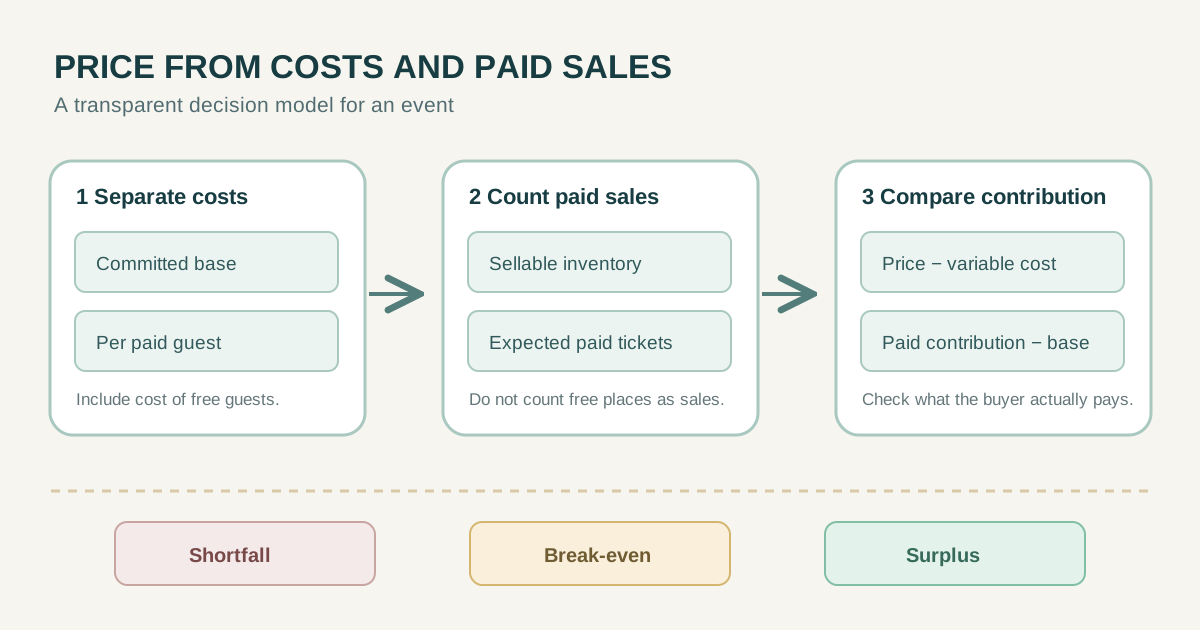
Fixed or committed costs are due even if fewer tickets sell: venue, core staff, production, permits and a base marketing plan may belong here. Variable costs rise with each attendee or sale: a meal, printed badge or an organizer-paid per-ticket fee can belong here. Some bills contain both a minimum and a per-person component; split them if the quote permits. Do not put the whole bill in both columns.
Use the period and currency of actual quotes. Some deposits leave your account before ticket income arrives, so a profitable scenario can still face a cash-timing problem. Ask who owns each estimate and when it will be rechecked. The U.S. Small Business Administration's single-product break-even method uses fixed costs divided by price less variable cost per unit; the event version below applies that idea to paid tickets.[1]
| Fictional input | USD or count | Why it matters |
|---|---|---|
| Production costs | 3,520 | Committed before paid sales |
| 10 complimentary guests × 8 | 80 | Added to committed base |
| Committed base | 3,600 | Amount paid contribution must recover |
| Cost per paid guest | 8 | Subtract from each ticket price |
| Expected paid tickets | 100 | Forecast, below 140 sellable |
| Illustrative ticket price | 48 | Before unmodeled charges |
Count paid sales rather than total capacity
Distinguish venue capacity, sellable inventory, complimentary allocations and forecast paid sales. In the fictional example, the room holds 150 people. Ten complimentary places are reserved, leaving at most 140 sellable tickets. The forecast is only 100 paid tickets, not 150. If complimentary attendees receive the same per-person service, include their cost even though they bring no ticket revenue.
Assume fictional production costs of USD 3,520 and a USD 8 service cost for each of ten complimentary guests. The USD 80 complimentary cost is committed in this scenario, so the base to recover is USD 3,600. Each paid guest also costs USD 8. If the complimentary allocation or service changes, rebuild the base; do not silently count complimentary places as sales.
Calculate a break-even point and a downside case
At a fictional USD 48 ticket price, each paid sale contributes USD 40 after its USD 8 variable cost. The break-even paid count is USD 3,600 ÷ USD 40 = 90 paid tickets. At the expected 100 paid, contribution is USD 4,000 and the scenario surplus is USD 400 before any unmodeled tax, provider fee, refund or overhead. At 80 paid, it is USD 3,200 − USD 3,600 = a USD 400 shortfall. Both 80 and 100 are below the 140-ticket sellable limit.
Turn the calculation around when testing an audience price: at 100 paid sales, the simple break-even ticket price is USD 3,600 ÷ 100 + USD 8 = USD 44, again before omitted charges. If the price attendees will accept is below that, adjust costs, funding, inventory or the event plan rather than assuming capacity will sell out. When price is no greater than the per-paid-ticket variable cost, this simple model cannot reach break-even through additional paid tickets.
| Paid sales | Contribution at USD 40 each | After USD 3,600 base |
|---|---|---|
| 80 | USD 3,200 | USD 400 shortfall |
| 90 | USD 3,600 | Break-even |
| 100 | USD 4,000 | USD 400 surplus |
Check a tier mix instead of averaging labels
Early and regular tickets require a sales mix. Keep the same fictional base and per-paid cost. If 30 early tickets sell at USD 40 and 70 regular tickets at USD 52, gross ticket receipts are USD 1,200 + USD 3,640 = USD 4,840. The 100 paid guests cost USD 800 in variable services, leaving USD 4,040 contribution and USD 440 after the USD 3,600 committed base. The weighted ticket price is USD 48.40, not either tier's advertised price.
That tier scenario reaches break-even after 30 early and 60 regular paid tickets: USD 960 early contribution plus USD 2,640 regular contribution equals USD 3,600. Do not divide committed costs by the number of ticket types or treat an unsold expensive tier as revenue. If a tier bundles a meal or merchandise, assign its own incremental variable cost before comparing it with the base ticket.
Keep fees, refunds and timing outside hidden assumptions
Obtain an actual ticketing and payment quote for your account and event. Fees can be per order, per ticket, percentage-based, fixed, organizer-paid, buyer-paid or mixed. Refunds, chargebacks, taxes, exchange rates and payout delays can change cash received and timing. Keep each as a separate line until applicable terms are confirmed. A marketing claim such as 'free ticketing' does not settle who pays for processing or an optional add-on.
For sensitivity only, suppose a fictional organizer-paid fee adds USD 2 per paid ticket. Then the variable cost becomes USD 10, contribution at USD 48 becomes USD 38, and break-even is the next whole ticket above 3,600 ÷ 38: 95 paid tickets. At 100 paid, the fictional surplus falls to USD 200 before other unknowns. The USD 2 is not a Boletolibre fee or an estimate of any provider's current price. Remove or replace it with the actual quote.
Record a decision you can revise
Document the chosen ticket names, capacity and complimentary reserve; committed and variable cost sources; paid-sales scenarios; tier mix; checkout price assumptions; fees and taxes still unknown; and the person allowed to approve the price. A useful decision note states what would trigger a reprice or a cost cut. Do not change published prices merely because one scenario looks weak without reviewing promises already made to buyers.
The model is a floor and a stress test, not a market valuation. Compare it with what attendees receive, any access goals and reliable evidence about demand. Recalculate when quotes or paid-sales estimates change, and revisit the actual settlement after the event. The goal is a price decision whose assumptions are legible, not a claim that a formula guarantees sales or profit.
Sources and further reading
- SBA single-product break-even formula: fixed costs divided by price less variable cost per unitU.S. Small Business Administration · Accessed