How many event check-in lanes do you need? A peak-arrival worksheet
“One staff member per hundred guests” hides the two numbers that matter at the entrance: how many people reach it during the busiest interval, and how long the actual check-in task takes. Use a short observation or defensible scenario to estimate processing work, then test enough lanes, support roles and physical queue space. The arithmetic is a planning aid, not a staffing standard or a safe-capacity assessment.
Boletolibre editorial team
Published
Estimate a peak window, not a daily average
Write arrivals in 15- or 30-minute intervals based on comparable event records, ticket arrival guidance or an explicitly labeled scenario. Note whether transport, a hard program start, bag search or a second event shares the approach. Premier Staff’s leading guide likewise focuses on peak arrival rather than total attendance, but its generic percentages and staff ratios are not evidence for your specific event. Record the source and uncertainty of each interval.[1]
| Input | Planning use |
|---|---|
| Peak arrivals | Count people in a stated short window, not the full day |
| Service sample | Observe seconds per normal check-in plus range |
| Theoretical stations | Arrival count × service seconds ÷ window seconds; round up |
| Operational plan | Rehearse actual lanes, separate roles and physical queue controls |
Measure the actual work at a station
Time a representative set of normal check-ins using the equipment and access policy that will actually be used. Include the ticket read, status confirmation, badge or wristband handoff and directions if they happen at the same station. Record slow cases separately: help desk, printing, walk-ins, payment and accessibility assistance may need different people or spaces. An average with no range hides tail delays; a best-case scan time is not a planning sample.
- Choose a short peak interval and record its evidence or assumption.
- Measure actual station service times and separate exception tasks.
- Calculate the theoretical floor, then rehearse additional capacity and roles.
- Get venue-specific queue/route review and name adjustment or stop authority.
Calculate a lower bound and rehearse a plan
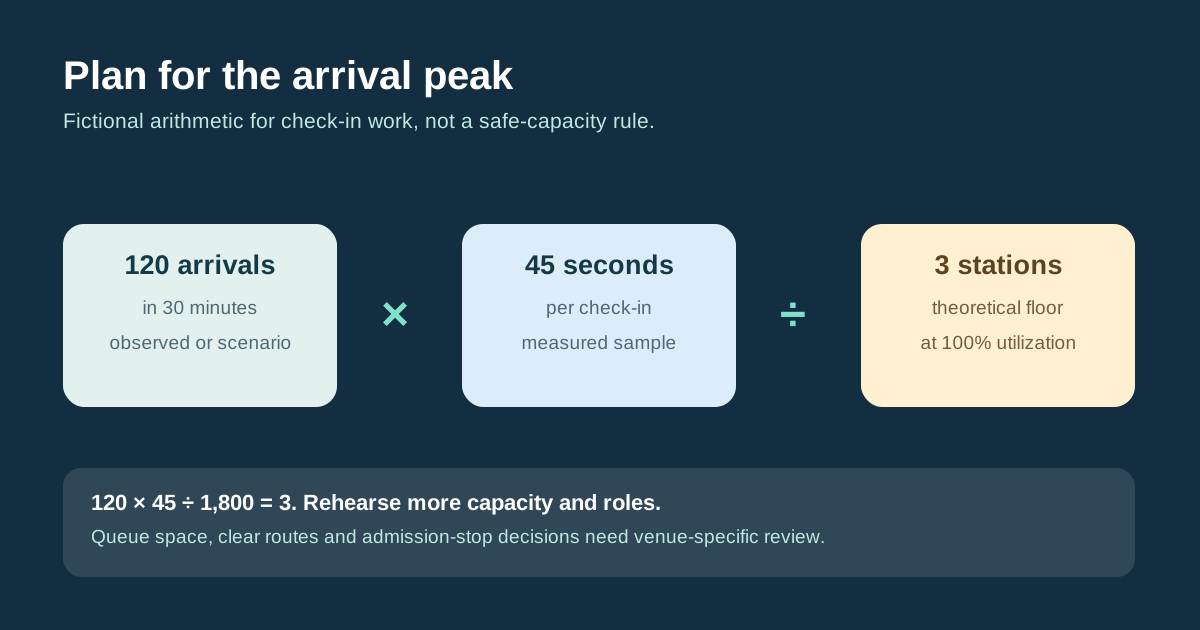
For a fictional 30-minute peak of 120 people at 45 measured seconds each, processing work is 120 × 45 = 5,400 station-seconds. One continuously occupied station has 1,800 seconds in that window, so 5,400 ÷ 1,800 = 3 stations is only a theoretical floor at 100% utilization. It leaves no room for variation, pauses or a growing queue. Rehearse a four-lane scenario and revise from observation rather than treating four as a universal recommendation. A host, issue resolver, supervisor and breaks are separate roles, not automatically included in the station count.
Review queues and adjust during the event
Walk the real queue with the venue team before opening. HSE guidance for Great Britain addresses arrival routes, queuing space, signs, barriers, stewarding and emergency access; it says queues should not block emergency routes. A faster scanner does not make an unsafe approach safe. Agree who monitors queue length and conditions, who may open another lane or pause admission, and how staff communicate a change. During the event, compare arrivals, completed check-ins and unresolved exceptions in short intervals; update the plan if service times or the route differ from rehearsal.[2]
Sources and further reading
- How Many Event Registration Staff Do You Need? Free Calculator Embedded!Premier Staff · Accessed
- Put crowd controls in placeHealth and Safety Executive (Great Britain) · Accessed