Event feasibility assessment: a practical go/no-go worksheet
An appealing idea is not yet a deliverable event. A feasibility assessment asks whether the audience is likely to come, the downside is affordable, a suitable venue and team exist, and essential requirements can be met. The relevant event-organizer result in Google covers market, financial, operational, technical and legal feasibility; this shorter worksheet turns those categories into a dated decision with named evidence and conditions.
Boletolibre editorial team
Published
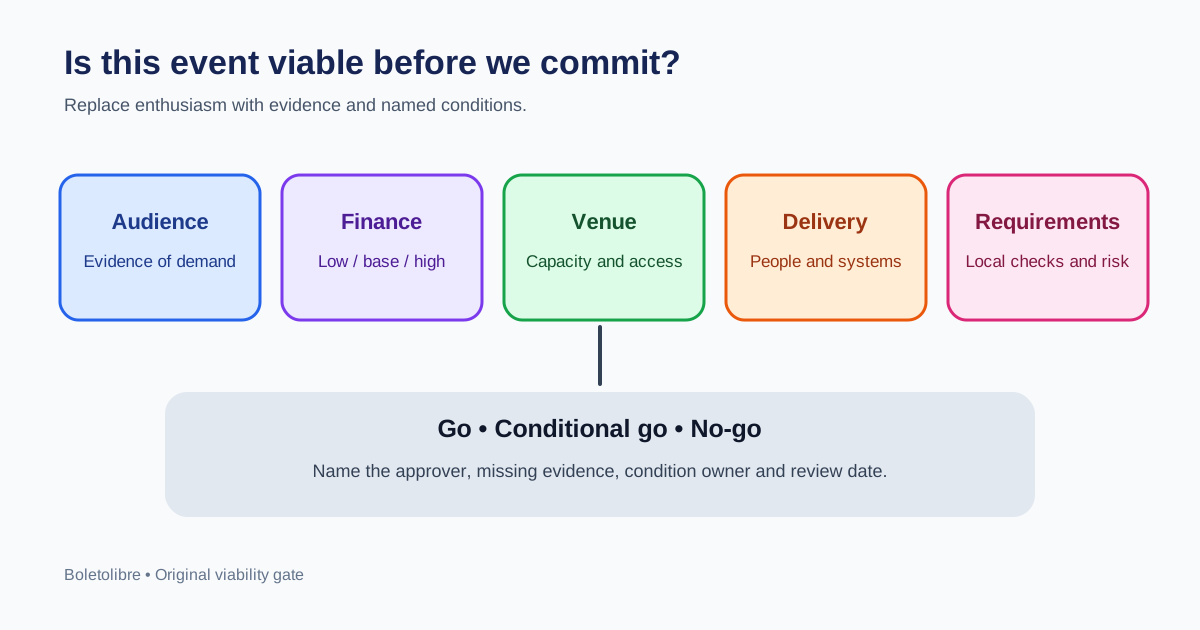
Define the decision and the latest safe date
Write a one-sentence event purpose, intended audience, approximate format and decision deadline. Name the person authorized to commit the organization. The first gate is before a nonrefundable venue payment, public ticket promise or supplier commitment. List what evidence must be available by then. Feasibility is a decision under uncertainty, not a promise that all risk disappears.
- Go: critical evidence is sufficient and required approvals are in place.
- Conditional go: specific missing items have owners, deadlines and a limit on what may be committed meanwhile.
- No-go or redesign: a critical requirement fails or the affordable-loss limit is exceeded.
Check demand, venue and delivery with evidence
Demand is more than likes or a large follower count. Review comparable past sales, direct conversations with the intended audience, credible partner commitments and competing dates. State which evidence is observed and which is an assumption. For the venue, verify availability, usable capacity, access route, location, operating hours and contract terms. For delivery, name the people and suppliers who will own production, ticketing, safety, communication and check-in. Southland NZ’s organizer toolkit separates market, finance, operational, technical and local legal questions rather than assuming one strong area compensates for all others.[1]
| Area | Useful evidence | Weak signal to flag |
|---|---|---|
| Demand | Past conversion or direct commitments | Social interest with no purchase intent |
| Venue | Written availability, capacity and access terms | Verbal assurance before inspection |
| Team | Named owner, time and backup for critical duties | “Volunteers will handle it” |
| Technology | Provider capability and test plan | Assumed checkout or scanner behavior |
Run low, base and high financial cases
Estimate fixed commitments and costs that rise with attendance. Model conservative, expected and optimistic paid attendance or funding using assumptions you can explain. Include ticketing fees, refunds or cancellation obligations where relevant; distinguish committed sponsorship from hoped-for sponsorship. Ask how much cash is needed before sales arrive and what loss the organizer can actually absorb. The separate event budget template supports the detailed calculation. Here the decision is whether the low case is survivable and what trigger would stop or resize the plan.
Resolve local requirements and the major failure modes
List permits, venue conditions, insurance, accessibility, security, health and safety and any other duties relevant to the location and format. Ask the appropriate local authority, venue or qualified adviser where the rule is unclear; rules vary. Separately identify the few failures that could stop the event, such as a key supplier withdrawing, severe weather or insufficient ticket sales. Record prevention, fallback, cancellation terms and the person empowered to act. A requirement with unknown status is a condition to investigate, not an automatic approval.
- What must be confirmed before public sales?
- Which condition could make the event unsafe or impossible?
- What can be scaled down without breaking attendee promises?
- Who decides to postpone, cancel or proceed under conditions?
Write the verdict with evidence and conditions
Summarize each area as supported, uncertain or blocking. A conditional go must state exactly what can happen now, what cannot, who closes each gap and when the team will reconsider. Record the decision date and approver in the decision log, then build the project timeline only for the approved path. If assumptions change, reopen the gate rather than treating the first verdict as permanent. The result should be a decision someone can audit, not a color-coded score that hides a failed hard requirement.
Sources and further reading
- Event FeasibilitySouthland New Zealand · Accessed