Event brief template: define purpose, audience and success
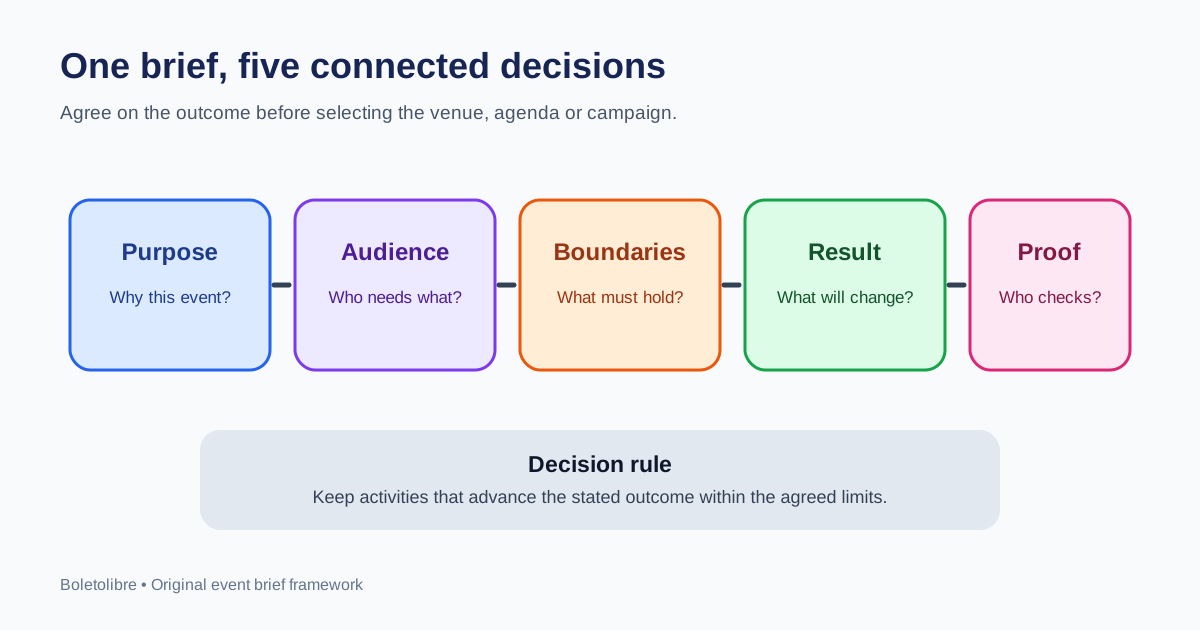
Before booking a venue or designing the agenda, write down why this event should exist and what would count as a useful result. A short brief gives organizers, sponsors and suppliers the same decision rule. The first Google result for this query frames the brief around outcomes, audience, boundaries and measurement; the template below turns those ideas into an event-ready document rather than a long wish list.
Boletolibre editorial team
Published
Start with one purpose and a specific audience
State the reason for the event in one sentence: “We are bringing [audience] together so they can [change or accomplish something].” Then identify the people who need that outcome, not merely a demographic or a target headcount. Ask what they already know, what prevents progress and what evidence supports your assumption. A sponsor may want visibility, but the attendee may need a practical answer. Put the primary attendee need in the brief so agenda choices serve it.[1]
- Purpose: why this event is needed now.
- Primary audience: the people whose situation you intend to improve.
- Attendee need: a question, obstacle or decision they face.
- Desired change: something they should know, decide or do afterward.
Record constraints and non-goals before ideas multiply
List the conditions that cannot be traded away: spending ceiling, accessibility needs, capacity, timing, speaker or venue commitments, privacy rules and any approved public claims. Separate a true constraint from a preference such as a favored venue. Add two or three non-goals so the team can decline attractive ideas that do not advance the purpose. Assign one person to approve changes. This is the short strategic brief; a detailed budget, project timeline and production plan can follow.
| Field | Question | Example |
|---|---|---|
| Constraint | What must remain true? | Accessible venue within an approved spending ceiling |
| Preference | What would be nice if feasible? | An outdoor networking area |
| Non-goal | What will this event deliberately avoid? | No product launch or sales pitch |
| Decision owner | Who may change the brief? | Named sponsor after reviewing tradeoffs |
Choose a measure that tests the purpose
A measure is useful only if it relates to the change you want. Registrations can show interest; checked-in attendance can show reach; neither proves learning or later action. Write the outcome, metric, target, denominator, evidence source, collection date and owner before promotion starts. If the target is arbitrary, mark it provisional and revise it using a known baseline. Do not treat a small survey response as the voice of every attendee.
| Purpose | Measure | Evidence and limitation |
|---|---|---|
| Help attendees apply a skill | Share of consenting attendees who complete a follow-up action | Day-seven follow-up; report number invited, responses and missing data |
| Make a local community event accessible | Share of requested accommodations delivered | Operations record and optional feedback; protect individual details |
| Connect prospective collaborators | Number of mutual follow-up introductions accepted | Opt-in introduction log; count quality, not badge scans |
Worked example: a first-time organizer workshop
“We will help local first-time organizers publish a clear event page for their first paid workshop.” The primary audience has a program idea but is uncertain what a page must explain about schedule, price and access. The desired change is a draft page submitted within seven days. The team agrees on an accessible venue, a fixed spending ceiling and no sales presentation. A program lead owns the follow-up form; the sponsor approves any change in purpose. The team sets a realistic target before launch and reports the number of opted-in attendees, responses and drafts separately. A low response rate makes the outcome estimate uncertain, even if registration was high.
This example is deliberately specific enough to reject a flashy but irrelevant speaker. A practical page-writing session fits the purpose; a generic keynote would need a clearer link to the intended action. The brief guides the choice without dictating every production detail.
Share, review and use the brief as a decision rule
Circulate the one-page draft to the sponsor, program lead, operations lead and whoever owns measurement. Ask each to flag a conflicting assumption. Confirm the decision owner and review date before committing to costly choices. Revisit the brief when new audience evidence appears or a major constraint changes, noting the reason and approval. After the event, compare the stated outcome with observed evidence in the post-event report; do not rewrite the original target to make the result look better.
Download the event purpose and success brief worksheet (CSV)
Sources and further reading
- Ultimate Event Brief Template: Outcomes, Audience, Red Lines, and Success MetricsChartwell Speakers · Accessed