Event lessons learned register: free template for the next edition
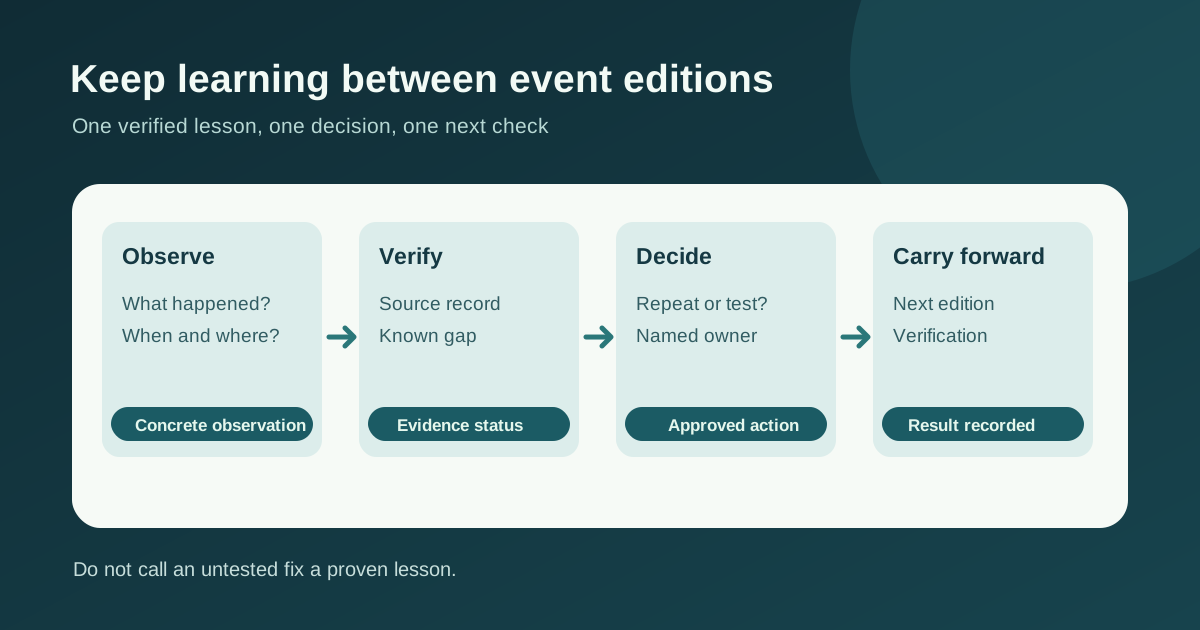
A debrief is a conversation; a lessons learned register is the record you can find and use months later. Download the editable worksheet to capture what happened, what supports the observation, what is still uncertain, and what to carry into the next event edition. Keep successes as well as problems. The register sits between meeting notes and the next edition's action plan.
Boletolibre editorial team
Published
Download the editable lessons register
Download the event lessons learned register (Markdown, English)
Download the Markdown worksheet and copy it for one event edition. It includes an index, a repeatable lesson record and a fictional worked example. Open it in a text editor or paste it into a shared document. Store the working copy where future organizers will look for the next event plan, with a named owner and review date.
The debrief agenda helps people discuss what happened; this register retains individual findings after the meeting. A post-event report summarizes results for stakeholders. Neither should become an unsearchable pile of meeting minutes.
- Event and edition; area; specific observation; evidence location; uncertainty; decision; owner; next review; later verification.
Capture a specific observation and its evidence
Write what was planned and what was observed, with a time, place or affected task. Link the underlying record and note who can access it. Scanner timestamps, attendee feedback, crew notes and published-page versions can support different parts of a finding; none automatically proves a cause.
Do not paste personal attendee details or a sensitive incident narrative into a broadly shared register. Point authorized reviewers to the controlled source record instead. Capture a success worth repeating with the same care as a failure.
- Use an access-controlled link for detailed records.
- Label an unsupported explanation as a question.
- Preserve examples of what worked.
Make a decision without pretending the cause is proven
For each lesson, choose whether to repeat a practice, test a change, investigate a gap or take no action. Name the decision owner, the delivery owner and a next check. A proposed fix is a hypothesis until a later observation supports it.
Separate an observation from an explanation. If a queue formed, do not write 'the scanner was too slow' unless the evidence distinguishes scanner speed from arrival timing, staffing and layout. Mark disputed or missing evidence rather than smoothing it away.
- Repeat a proven practice.
- Test a plausible change.
- Investigate before deciding.
- Close with a reason when no action is needed.
Worked example: a check-in queue
Suppose one of two planned check-in lanes opened at doors and staff saw a queue. Door notes and scan times support the timing, but no complete wait-time sample exists. The register can preserve that limited finding and propose an earlier readiness check for both lanes.
At the next venue walk-through, the operations owner can confirm whether the second lane is ready. At the next event, capture comparable arrival observations. Only then record whether the change helped; the example is fictional and its numbers are not targets.
Bring the lesson into the next edition
Before reusing a venue, supplier or registration setup, review the relevant lesson IDs. Transfer approved changes into the next edition's working plan and keep a link back to the original observation. Record the result after the new event so the register is a learning loop, not a one-time archive.
PMI describes lessons learned as an ongoing process of identifying, documenting, analyzing, storing and retrieving experience. The event-specific worksheet applies that principle without requiring a formal project-management system.[1]
- Review selected lessons at planning kickoff.
- Move approved actions into the live plan.
- Return after the next event to record the result.
Sources and further reading
- Lessons learned: taking it to the next levelProject Management Institute · Accessed