Event debrief template: a 45-minute agenda and question bank
The event is over, but the team still holds details that a dashboard will never capture: where a handoff failed, why a queue formed, which change helped guests, and what needs a closer look. An event debrief turns those observations into a small number of decisions. This free Word worksheet gives you a 45-minute agenda, questions to select from, space for evidence, and a handoff table. It is a meeting tool; the post-event report is the written performance summary for stakeholders.
Boletolibre editorial team
Published
Download the editable debrief worksheet
Download the event debrief agenda template (.docx)
The two-page Word file is ready to print or edit. Fill in the event and meeting details, name the decision to make, select relevant prompts, then record evidence-backed observations and a few assigned changes. It requires no sign-up. The first organic result for this search is a template download page that emphasizes structured reflection, results and what to do differently. Its underlying gated worksheet is not visible, so our agenda and questions are original rather than a reproduction.[1]
Prepare the evidence and the right people
Schedule the conversation while details are still fresh, but allow enough time to collect check-in, payment, support and incident records. Invite representatives from the functions that actually delivered the event: registration, operations, content, marketing, finance, venue and partners as relevant. Circulate a one-page snapshot of original goals, observed results, known data gaps and the two decisions the meeting must inform.
- Ask each participant beforehand for one success, one friction point and one open question.
- Label every figure with its source and cutoff date. Registration, attendance and website visits are different populations.
- Name a facilitator and note taker so discussion and capture do not compete for attention.
- State that the aim is to improve systems and decisions, rather than identify someone to blame.
Goldcast’s debrief guide likewise recommends an agenda, the people who can explain different parts of the event, relevant analytics, and a clear path from discussion to action.[2]
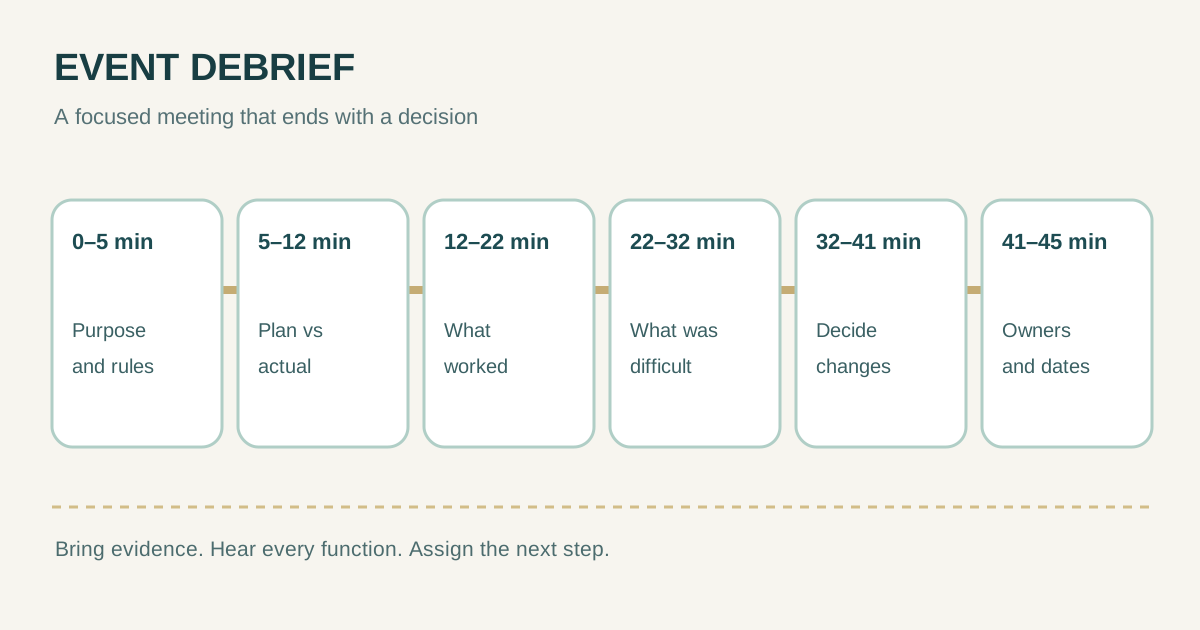
Use a 45-minute agenda, then adapt it
| Time | Conversation | Output |
|---|---|---|
| 0–5 min | Purpose, ground rules, known gaps | The decision and evidence standard are clear |
| 5–12 min | Plan versus actual | Agreed facts and disputed definitions |
| 12–22 min | What worked | Practices to repeat, with evidence |
| 22–32 min | Where the experience broke down | Prioritized issues and unknowns |
| 32–41 min | What to change or test | Up to three decisions or experiments |
| 41–45 min | Read back the handoff | Owners, due dates and follow-up |
The times are a practical starting point, not a rule. For a complex festival, split the debrief by workstream. For a small workshop, combine sections. If a topic consumes the meeting, park it with an owner and a separate follow-up rather than cutting the decision step.
Choose questions that expose useful differences
A long question bank is only useful when you select from it. Start with what was planned and observed; then ask what the team learned. Ask for a record or first-hand observation before adopting an explanation. The Goldcast guide groups prompts around planning, execution, attendee experience and outcomes; our worksheet uses those broad lenses with shorter facilitation questions.[2]
- Audience: Which target mattered most? Were sign-ups, check-ins or feedback measured consistently?
- Registration and marketing: Where did people need help or abandon the flow? What evidence shows why?
- Program: Which sessions met their stated purpose? What did speakers and attendees report directly?
- Operations: Which queue, handoff, venue or technology issue affected guests? What does the incident log show?
- Finances and partners: Which costs, refunds or sponsor deliverables remain open?
- Experience: Which accessibility or support issue recurred, and whose perspective is missing?
Worked example: turn a queue into a testable change
Imagine a fictional workshop where 82 people checked in. Three staff members observed a 15-minute arrival queue, and the scanner log shows most entries during the first 20 minutes. ‘The venue was badly managed’ is too broad. A more useful note is: ‘Arrival queue reached about 15 minutes near the opening; staff observations and scan times support the timing, but we did not count everyone who joined the queue.’
A decision could be to open a second check-in lane for the next workshop and record arrival-to-entry time in five-minute samples. Assign an operations owner and a review date. The proposed fix is a hypothesis until the next measurement confirms it; the meeting should not present it as a proven cause.
Close with decisions, owners and the next check-in
Read the decisions aloud before ending. Each one needs a named owner, a due date, and a measure or observable result. Note questions that still need data and who will obtain it. Keep the task register alive after the meeting; use the separate post-event report to summarize verified performance for stakeholders.
- Keep at most a few priority changes so the team can follow through.
- Separate confirmed findings from suggested causes and experiments.
- Share concise notes with attendees and give absent owners a chance to confirm assignments.
- Set a short follow-up to check progress and update the next event plan.
Sources and further reading
- Event Debrief Template download pageEventsAir · Accessed
- Event Debrief Template: Questions to Assess Your SuccessGoldcast · Accessed