Event supplier cancellation terms checklist: questions before signing
A vendor contract can say “cancellation fee applies” without answering the question that matters on event day: who must do what, by when, and what happens to work and money already committed? The leading event-agreement checklist for this search names cancellation and rescheduling among several contract topics. This focused worksheet helps an organizer find the exact language in each supplier agreement and raise missing or conflicting terms before signing. It is a review log, not a model clause or a promise about legal outcomes.
Boletolibre editorial team
Published
Download the cancellation-terms review worksheet
Copy the editable Markdown worksheet for each supplier. Record the agreement version, exact clause or page, what it says, what remains unclear, business impact, question owner and resolved version. Keep written supplier responses with the proposed agreement. A note in the worksheet does not amend the contract; confirm any agreed change in the agreement or a signed amendment.
Download the event supplier cancellation review worksheet (Markdown)
Separate three different event scenarios
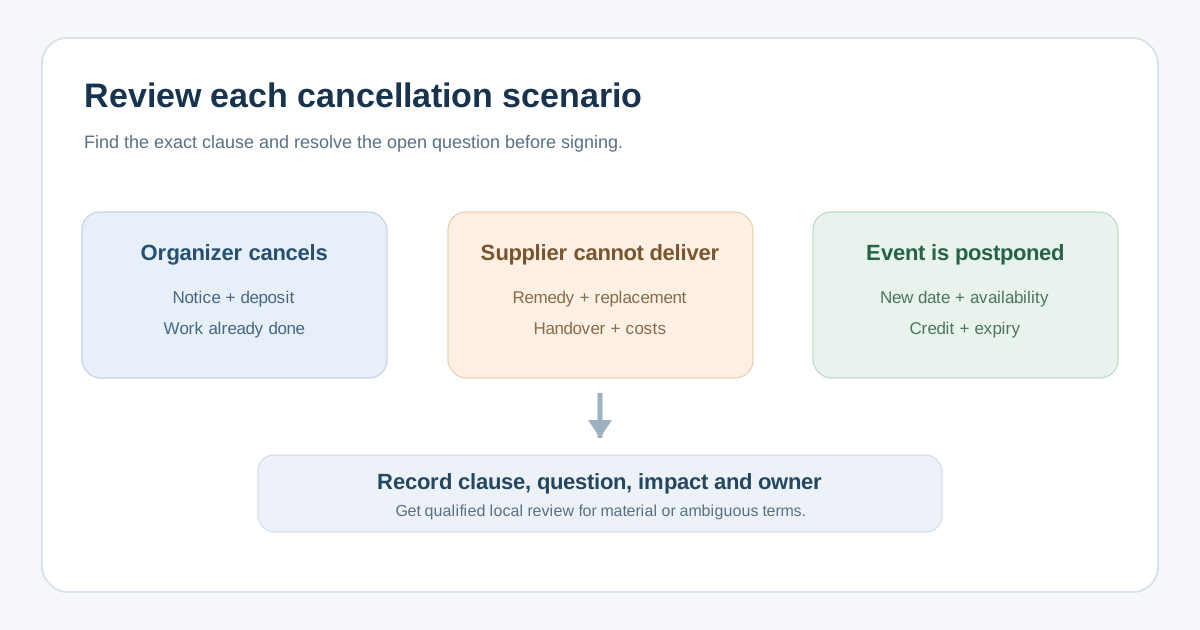
Read the clauses for organizer cancellation, supplier cancellation or non-performance, and postponement separately. Each may trigger different notice, payments, remedies and time limits. Do not assume a postponement credit is a refund or that a replacement supplier may be appointed without approval. Ask who can make the decision and how the other party is notified.
| Scenario | Question to resolve | Operational consequence |
|---|---|---|
| Organizer cancels | How and when is notice effective? | Know deposits, work completed and committed costs |
| Supplier cannot perform | What notice, remedy and fallback are required? | Plan replacement and handover without assuming an automatic refund |
| Event moves date | Who must accept a new date and by when? | Check availability, credit expiry and revised milestones |
The SMVRT Legal checklist raises vendor responsibilities, timelines, payment and cancellation together. A real procurement contract such as DEFRA’s standard goods-and-services terms shows why termination and disruption need their own defined triggers and notice mechanics; its wording and time limits are specific to that contract, not default rules for your event.[1][2]
Map the money without assuming a universal refund
For each scenario, list deposits and installments already paid, work accepted, third-party commitments, any stated cancellation charge, credits for a new date, and payment or repayment timing. Ask what documentation supports a claimed non-recoverable cost and who approves it. Read the price schedule, order form and cancellation section together; a clause may refer to another document or define “cancellation date” differently from the date you send notice. Record the exact answer rather than entering a percentage from a blog post.
Also plan the organizer’s separate attendee and venue obligations. A supplier credit does not itself settle attendee ticket refunds, and an attendee refund policy does not rewrite the supplier agreement. The UK CMA’s fair-term guidance concerns trader-to-consumer contracts; it is not a rule that can simply be applied to an organizer’s business-to-business supplier contract. Identify the governing jurisdiction and get qualified local legal review for a material deposit, penalty, liability or force-majeure question.[3]
Check the notice path and fallback owner
Write down the required notice channel, address, named recipient, time zone, proof of delivery and moment notice takes effect. Ask whether an email to the event contact is sufficient or whether the contract requires a legal address. Then identify who handles guest communications, venue changes, replacement sourcing, equipment retrieval and data or design handover. If the supplier proposes a substitute, check whether the organizer must approve that person or company and whether the price or service standard changes.
- Find the clause for each trigger; do not rely on a heading such as “force majeure” alone.
- Ask the supplier to resolve missing or inconsistent language in writing before commitment.
- Record the organizer approver and the person authorized to send or accept formal notice.
- Escalate ambiguous, high-value or jurisdiction-specific terms to qualified local counsel.
The completed worksheet is an operating record of questions and decisions. The signed contract, not the checklist, controls the parties’ rights and duties. Avoid treating a disruption label as automatic protection; its effect depends on the actual clause, facts and applicable law.
Sources and further reading
- Event Agreement Checklist for Small BusinessesSMVRT Legal · Accessed
- Standard goods and services terms and conditionsUK Department for Environment, Food and Rural Affairs · Accessed
- Writing a fair contract for customersUK Competition and Markets Authority · Accessed