Should your event website use an internationalized domain name?
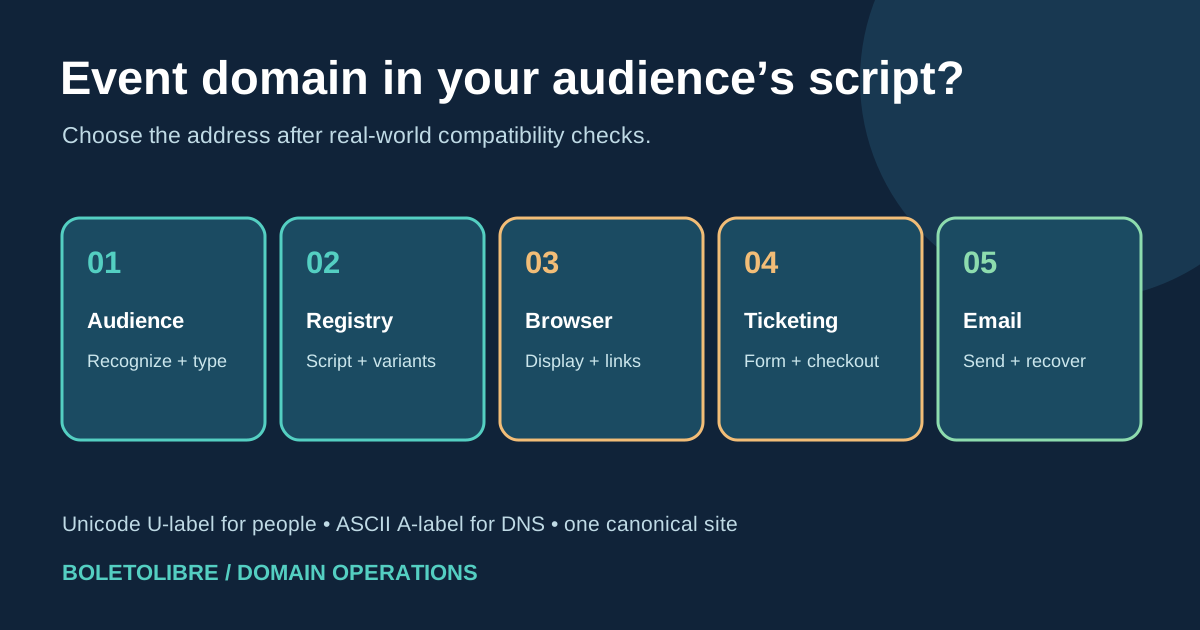
An event name in the audience's own script can be easier to recognize, but an internationalized domain is a practical address decision, not a shortcut to better rankings. Test the exact spelling, TLD and tools that carry attendees from a poster to a ticket and support email. This guide helps you choose between an IDN, an ASCII address or both.
Boletolibre editorial team
Published
Download the IDN decision and compatibility worksheet
Download the event-domain script decision worksheet (Markdown, English)
Use it with the exact candidate spelling, TLD, target audience and real attendee devices. Record observed results rather than marking every language or script as supported by assumption. The document does not contain a domain purchase recommendation.
What an internationalized domain name changes
An internationalized domain name, or IDN, lets a domain label use characters beyond basic ASCII: for example accented Latin letters or a non-Latin script. The form people read is the U-label. The DNS uses an ASCII-compatible A-label, often beginning with xn--. These are two representations of a registered label, not two separate websites to buy. The event pages can still be multilingual on an ordinary ASCII domain; choosing an IDN changes the address attendees must recognize, type and share.[3]
The leading Google page lists possible inclusion and branding benefits, but its revenue, reputation and local-ranking claims are promotional. An IDN may be useful when the event's actual audience naturally writes the brand in that script. Do not promise a search ranking or sales lift from the characters in the domain.[1]
Confirm this exact label is allowed before designing around it
Check the registry and registrar rules for the proposed TLD and script. IDN support is not simply an on/off switch for all Unicode characters: a registry can define allowed scripts, code points and variants. ICANN publishes reference label-generation rules that registries can use; those rules are not a live availability check for your specific name. Confirm the candidate spelling, variant treatment, registration eligibility, renewal price and transfer support directly with the selected provider.[2]
Avoid visually similar alternatives chosen merely to look like a familiar ASCII name. Unicode's security guidance explains that confusable characters depend on script and font, so a human brand review remains necessary. Test the exact rendered address across the typography, ticket emails and browsers your attendees will use; do not assume a browser will always show the same Unicode form.[6]
Test the attendee path and the operations path
| Place to test | Task to perform | Failure to record |
|---|---|---|
| Poster, spoken announcement, search and QR fallback | Ask a local-language reader to copy, type and recognize the address | Hard-to-enter characters or lookalike confusion |
| Mobile and desktop browsers | Open the Unicode form and inspect the displayed address and certificate | Unexpected A-label display, wrong destination or warning |
| Registration, ticketing and payment tools | Enter the domain in settings, checkout return links and webhooks | Rejected or altered host name |
| Email and account recovery | Send and receive branded mail; test support and recovery address acceptance | Delivery, validation or display problem |
| Analytics, redirects and social profiles | Save, share and reopen exact URLs | Broken link or inconsistent canonical address |
ICANN's Universal Acceptance work exists because valid IDNs and internationalized email addresses are not handled consistently by all applications and services. Even ICANN's own EAI-support FAQ still requires an ASCII fallback address for its account system. That is a concrete reason to test your event's registration, ticketing, payment, email and helpdesk stack before promising an all-IDN contact journey.[4][5]
Choose the primary address and fallback deliberately
Choose the IDN as the main public address if the target audience recognizes and types it comfortably, the exact TLD accepts it, the core tools work end to end, and the organization can support it over future editions. A short ASCII primary address may be simpler for a mixed-language audience, printed materials or systems that fail compatibility tests. If both names are registered, decide which is canonical and redirect the other to the corresponding page; do not maintain two competing versions of the same event content.
Document both Unicode and A-label forms, registrar account owner, renewal dates, DNS records, certificates and the address to use when speaking to attendees. Keep support staff aware of which form may appear in logs or browser bars. Re-test after switching providers or ticketing systems. These are operations checks, not a blanket judgment that IDNs are unsafe.
Sources and further reading
- 5 Reasons to Have an Internationalized Domain Name (IDN)Register.Domains · Accessed
- Second-Level Reference Label Generation RulesICANN · Accessed
- Procedure to Develop and Maintain the Label Generation Rules for the Root ZoneICANN · Accessed
- Universal AcceptanceICANN · Accessed
- ICANN Account EAI Support FAQsICANN · Accessed
- Unicode Security Mechanisms (UTS #39)Unicode Consortium · Accessed