Multilingual event website URL structure: language, region and hreflang
An event in Mexico City can attract Spanish, English, French and Dutch readers. Those are language needs, not four different event locations. Before choosing /en/, /en-us/ or a country domain, separate what language the visitor reads from where the event takes place and whether a regional offer really changes.
Boletolibre editorial team
Published
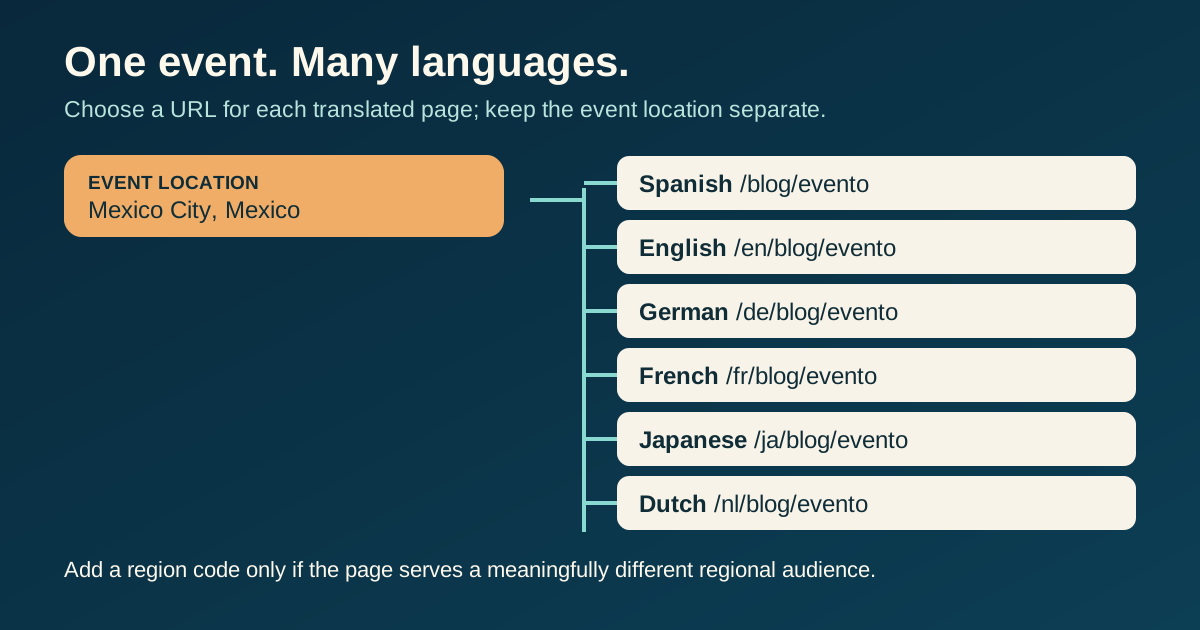
Separate language, audience region and event location
Language is the language of the visible page. Audience region is the country or market for which terms, currency, shipping, ticket availability or contact information differ. Event location and legal jurisdiction describe the actual event and its applicable terms. A Spanish page is not necessarily for Mexico alone, and Dutch copy does not automatically mean Netherlands-only sales. Set a regional URL only when the page makes a meaningful regional promise.
| Question | Example for one Mexico City event | URL implication |
|---|---|---|
| Which language does this visitor read? | Spanish or English | Separate translated URLs |
| Does the offer change by audience country? | Maybe different currency or purchase eligibility | Consider a region-specific version only if the content differs |
| Where is the event held? | Mexico City, Mexico | State this in every language; do not infer it from the URL |
Choose one stable URL pattern
Google recommends distinct URLs for language versions rather than relying on cookies or browser settings. A generic domain with language subdirectories is straightforward to maintain: example.org/evento for the default Spanish page and example.org/en/evento for English. A subdomain such as en.example.org can also work, but creates another property to operate. A country-code domain such as example.mx signals country targeting and adds domain and infrastructure work; it is not needed just because an event happens in Mexico. Avoid query parameters such as ?lang=en as the primary language structure.[1]
| Pattern | When it makes sense | Tradeoff |
|---|---|---|
| One domain + language paths | Same event and brand, several reading languages | Simple shared site; maintain complete translations |
| Language subdomains | Separate publishing systems or teams | More properties and routing to manage |
| Country domains | Distinct country presence and operations | Domain, infrastructure and market upkeep |
| Region-qualified paths | Truly different country-specific offer | More versions and content maintenance |
For this site's existing convention, Spanish is the default unprefixed route: /blog/evento. English, German, French, Japanese and Dutch live at /en/, /de/, /fr/, /ja/ and /nl/. This is a routing example, not a claim that every site should use the same default. Keep a chosen pattern stable and link people to the version they selected.
Connect translated equivalents without mixing their canonicals
Each translated page should contain the actual language in its visible body, not just a translated title or an hreflang tag. Let visitors reach each version through a normal link and an explicit language selector. Avoid forcing a visitor or crawler away from a chosen language URL based solely on location or browser language.[1]
When pages are true equivalents, list the full absolute URLs in reciprocal hreflang annotations, including each page itself. Use language codes for language-wide versions; add a region code such as es-MX only when you really maintain a Mexico-specific Spanish version. Each distinct translated page should have its own preferred canonical URL rather than canonicalizing all languages to Spanish. If a translation does not exist, omit that alternate rather than pointing to an untranslated or unrelated page.[2]
- Check that the translated page, language switch and hreflang destination all resolve to the intended content.
- Keep translated pages in the same event edition; do not link this year's English page to last year's Spanish page.
- State date, time zone, venue and ticket terms in the page itself, even when the URL contains a language code.
Map one event before publishing
Start with one row per page purpose and language. Record the public URL, intended audience region (or “all”), event location, any genuinely regional terms, owner and review date. Compare rows side by side: if only the language changes, a language URL is enough. If currency, legal terms or eligibility changes, review whether a country-specific page is warranted and who will keep it current.
Download the multilingual event URL planning sheet (CSV)
After publication, open every locale URL directly, test its language switch, and inspect its canonical and hreflang destinations. The URL plan is useful only if the live copy and links agree with it.
Sources and further reading
- Managing multi-regional and multilingual sitesGoogle Search Central · Accessed
- Tell Google about localized versions of your pageGoogle Search Central · Accessed