Coordinating a European roadshow: one shared core, a manifest for every city
A repeatable event needs more than the same deck and a list of cities. Keep the audience outcome shared, but give each stop its own venue, people, access, clock and decision record. This proposed planning method uses qualified sources accessed on October 14, 2026. It is not a legal checklist, technical design or confirmation that an event or journey can proceed. Europe is not synonymous with the European Union; the example deliberately includes Berlin and London.
Boletolibre editorial team
Published
Copy a blank record before filling the itinerary
Start the shared record with series/outcome ____, concept owner/version ____, content and technical pack author/revision/date ____, change authority ____ and unresolved questions ____. Then duplicate this city manifest for every stop. For each answer, name a responsible contact, evidence/date, revision and accepted, pending or rejected status.
| City record field | Your entry and evidence |
|---|---|
| Identity and ownership | City/country/exact date: ____; actual venue/address: ____; accountable local owner/contact: ____. |
| Languages | Audience language: ____; crew working language: ____; local copy reviewer: ____. |
| Finance and display | Operating/display currency and proposed amounts/terms: ____; finance reviewer: ____. These are questions, not prescribed currency or tax rules. |
| Clock record | Timezone ID: ____; exact date/local time/UTC/offset: ____; source and check date: ____. |
| Separate access routes | Visitor entrance: ____; crew/loading gate: ____; receiving contact and agreed window, if any: ____. |
| Transport and storage | Proposed availability cues: ____; carrier/route/storage questions: ____; responsible logistics contact: ____. |
| Technical scope | Request pack/revision: ____; local exception: ____; qualified reviewer and acceptance scope: ____. |
| Decision contacts | Venue, local producer, technical, logistics, audience-message and finance contacts/evidence: ____. |
| Change receipt | Affected recipients/next stop: ____; revision sent: ____; acknowledgement and remaining condition: ____. |
Fictional Signal Rooms: two stops, separate local records
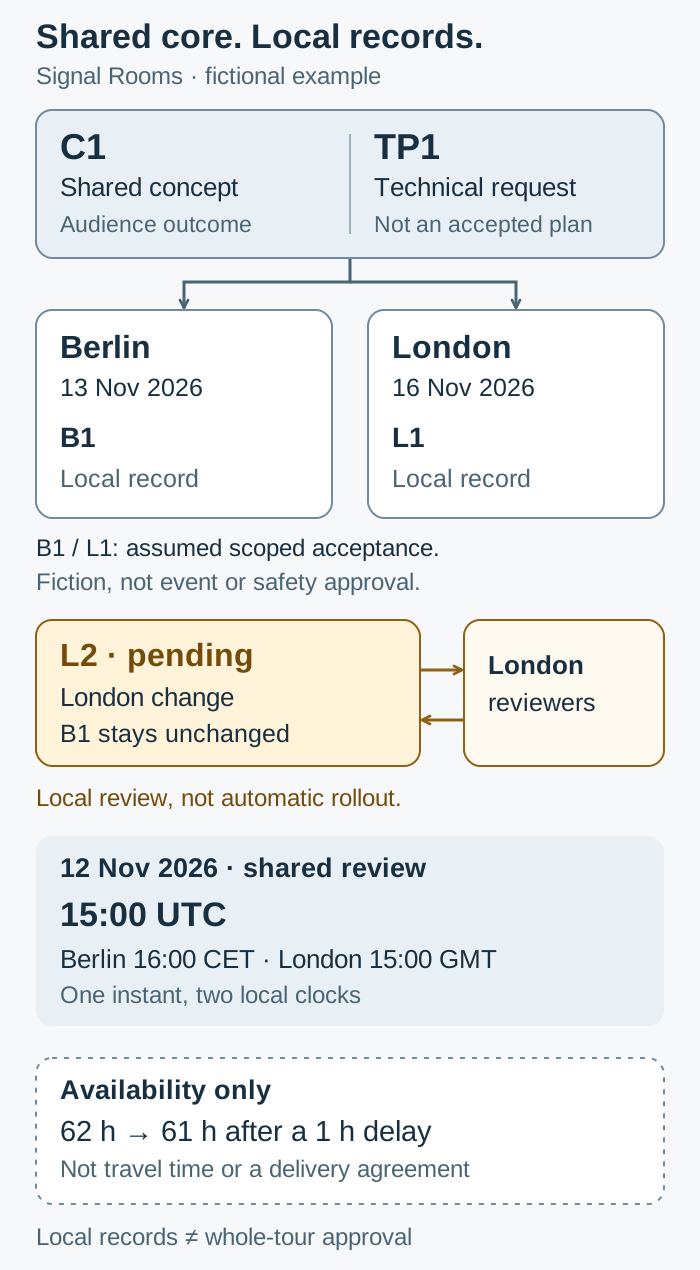
Signal Rooms, Studio B, Hall L, roles, choices, windows and statuses are invented. Neither venue is booked; Hall L is not Excel London. These future dates and proposals demonstrate the record, not actual availability or permission. Shared C1 holds the learning goal and media; TP1 is a technical request. Each city needs its own local producer and venue, technical, logistics, copy and finance contacts.
| Record | Fictional proposals |
|---|---|
| Place/date/owner | Berlin, Germany: Studio B, Friday November 13, 2026, local producer B. London, UK: Hall L, Monday November 16, 2026, local producer L. Actual addresses and contacts are unset. |
| Language and finance | Berlin audience copy German, London English; shared crew pack English. Proposed currencies EUR and GBP respectively; no prices set. Copy/finance reviews pending, not national requirements. |
| Exact-date clocks | Europe/Berlin: CET, UTC+01:00 on November 13. Europe/London: GMT, UTC+00:00 on November 16. |
| Crew and visitor cues | Berlin crew/load-in November 13 at 09:00 CET = 08:00 UTC; show 18:00 CET = 17:00 UTC. London receiving November 16 at 10:00 GMT = 10:00 UTC; show 18:00 GMT = 18:00 UTC. Gates, visitor doors and receiving agreements unconfirmed. |
| Pack and local review | Both receive C1 + TP1; Berlin B1 and London L1 begin pending. An accepted local revision must specify its own scope. |
Use a shared instant, not a copied clock string
GOV.UK’s published 2026 table gives October 25 for clocks going back and explains the return to GMT. Its page was last updated November 24, 2025. PTB’s German guidance gives CET as UTC+1 and CEST as UTC+2, with the described last-Sunday March–October daylight-saving period until further notice. For these November dates, the example uses Berlin CET and London GMT. These sources do not establish one time rule for Europe or a whole statutory audit; PTB’s page update date was not established.[1][2]
The invented shared review on Thursday November 12, 2026 at 15:00 UTC is 16:00 CET in Berlin and 15:00 GMT in London. The separate shows both say 18:00 locally, but Berlin’s November 13 cue is 17:00 UTC and London’s November 16 cue is 18:00 UTC. Include the date, timezone ID and offset in handoffs; a local hour alone leaves room for a wrong assumption.
Keep the availability interval separate from a transport plan
Invented Berlin load-out completion on November 13 at 21:00 CET is 20:00 UTC. Proposed London receiving on November 16 at 10:00 GMT is 10:00 UTC. The interval is 62 hours. A one-hour Berlin delay, to 22:00 CET / 21:00 UTC, leaves 61 hours. Neither figure is a journey duration, feasibility finding, driver-hours or rest calculation, border-clearance estimate or agreed delivery appointment.
Excel London’s operator pages describe local production/logistics coordination and separate storage, delivery and transport services. Use that as a concrete prompt to ask the actual venue and logistics owner who receives, stores and moves each item. It is not a regulator’s instruction, a mandatory supplier rule or proof of capacity, booking, price or duration. A delay reopens the carrier, route, storage and receiving questions; obtain the London owner’s acknowledgement instead of declaring the move safe or harmless.[3][4]
Let local changes travel through a receipt
Suppose the fictional local reviewers subsequently record B1 and L1 as accepted for their specified room arrangements. This assumed acceptance is not event permission or technical safety certification. London then requests a different presentation layout, L2. Record the reason, author, revision and relevant reviewers; until they accept its actual scope, L2 remains pending. It does not overwrite Berlin B1 or turn the whole series approved.
The central owner checks whether L2 changes C1’s audience outcome or shared media. London’s qualified technical and venue reviewers assess its local arrangement. If shared assets or a later stop are affected, send those named recipients the revised request and record their acceptance or unresolved condition. Acknowledgement that a file arrived is not acceptance of its contents. Operational role assignments do not themselves transfer statutory duties.
Recheck the source and close the next open item
The retained exact-date calculations used Node Intl with installed timezone data 2026b, not an updated runtime. IANA’s separately accessed version endpoint served 2026e. Selected London, Berlin and March/October rule entries from the current Europe file agreed for these November examples; the complete file and all European rules were not audited. IANA data is software guidance, not statute, and these separate accesses are not an immutable release-integrity check.[5][6]
Before operational use, recheck the real date and clock rules, actual venue/access agreements and current applicable local or cross-border questions with the responsible competent parties. No universal customs, visa, labour, tax, permit, currency, safety or capacity rule is supplied here. Start with one pending record and obtain scoped evidence and an owner response. Keep the shared core reproducible by making each exception visible—not by assuming all cities work alike.
Sources and further reading
- UK 2026 clock-change table and return to GMT; published guidanceUK Government · Accessed
- German CET/CEST and daylight-saving guidance; not a consolidated statute auditPTB, German National Metrology Institute · Accessed
- Venue-specific organiser team and service coordination exampleExcel London · Accessed
- Venue-specific storage, delivery and transport categories; no booking verifiedExcel London · Accessed
- Separately served timezone-database version identifier, not runtime updateIANA timezone database · Accessed
- Selected London/Berlin and seasonal rule entries; narrow software-data readingIANA timezone database · Accessed