Choose an early-bird ticket deadline or quantity limit
An early-bird price needs a clear end condition before the offer goes public. The choice is operational: a clock, a finite ticket allocation, or both. The right boundary depends on your event budget, approved capacity, sales system and what you can explain to buyers. This guide is about ending a discounted tier accurately; early access to tickets is a separate decision.
Boletolibre editorial team
Published
Decide what the offer must accomplish
Download the editable early-bird boundary worksheet (Markdown, English)
Write down the discounted price, the later price, what each ticket includes, the event date and the minimum revenue you need. Compare the cost of selling a place at each price with your own budget; there is no dependable discount percentage for every event. If the goal is to gather an early planning signal, decide how many discounted admissions you can afford. If the goal is a public planning deadline, choose a date you can state plainly. A discount is not evidence that total revenue will rise.[1][2]
Choose a time limit, quantity limit or first-to-occur rule
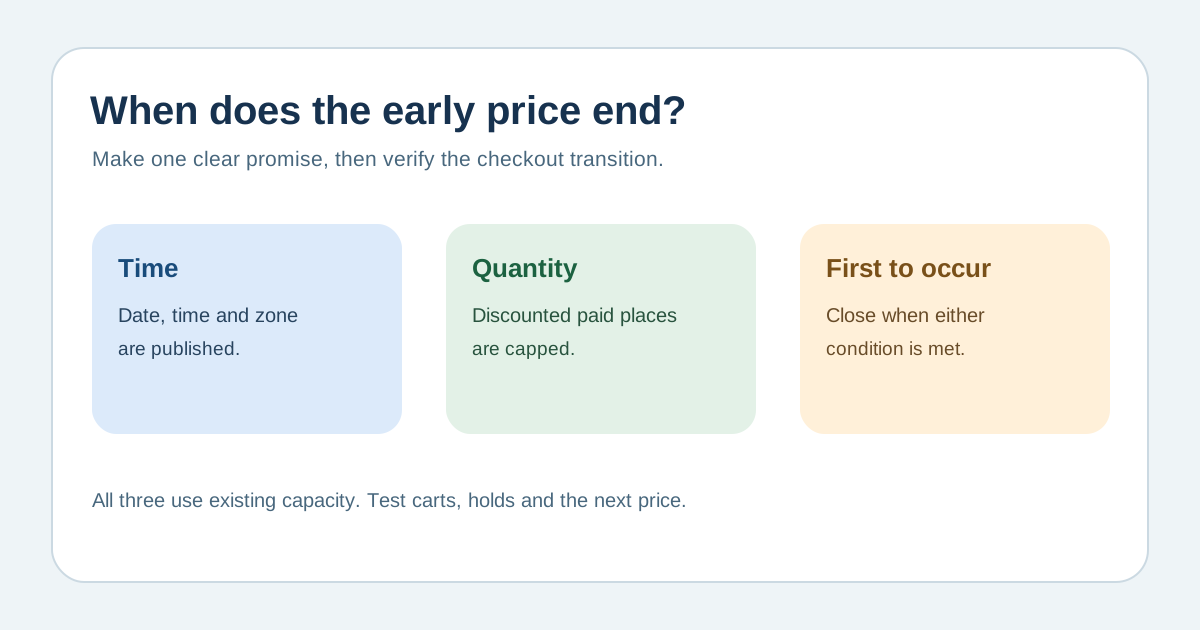
A time limit ends at a published local date and time even if tickets remain. A quantity limit ends when the assigned discounted stock is exhausted, even if that happens early. A combined rule closes at whichever occurs first. State which rule applies, the time zone, the limit and the next price. Set the discounted ticket-type quantity inside the approved event capacity, rather than adding it on top. Eventbrite documents separate controls for a ticket-type quantity, sale dates and total event capacity; confirm your own platform’s controls before promising the same behavior.[2][3][4]
Check carts, holds and the price transition
A ticket held in a buyer’s cart or pending order may temporarily reduce availability. Ask the provider what happens if checkout starts before the deadline but payment finishes after it, or if a pending order fails after the quantity sells out. Test the exact boundary with a private ticket or staging event: before, at and after the closing time, with the correct time zone. Check that the later ticket becomes purchasable when expected and that a hidden or ended tier cannot still be selected through an old link. Do not infer the result from the event page alone.[2][3][4]
Publish a buyer-facing explanation
Show the current total price and what it changes to; include mandatory fees in the comparison according to your checkout display. For a time rule, say “ends 18:00 on 30 April, Mexico City time” rather than “ends soon.” For a quantity rule, say “first 40 paid admissions, subject to availability” only if that count is actually enforced. If both apply, say both. Keep ads, event page, emails and checkout aligned. Distinguish a discounted early-bird from a presale, which can mean earlier access without a lower price.[1][2]
Document changes and review the result
Record who can change the limit or end date, why, and which public messages must be corrected. An extension after a firm promise can mislead buyers who acted on it; if circumstances require a change, make it explicit instead of quietly resetting a countdown. Monitor tickets issued by tier, holds, remaining capacity and support questions. Compare actual gross and net revenue with the original budget, while remembering that observed sales do not prove the discount caused them.[1][2]
Sources and further reading
- Early-Bird Ticket Pricing: The Complete Strategy Guide for OrganizersEventist · Accessed
- Create and edit ticket typesEventbrite Help Centre · Accessed
- Change your event capacityEventbrite Help Center · Accessed
- What to do when tickets are not on saleEventbrite Help Centre · Accessed