Event press kit template: facts, assets and media contact checklist
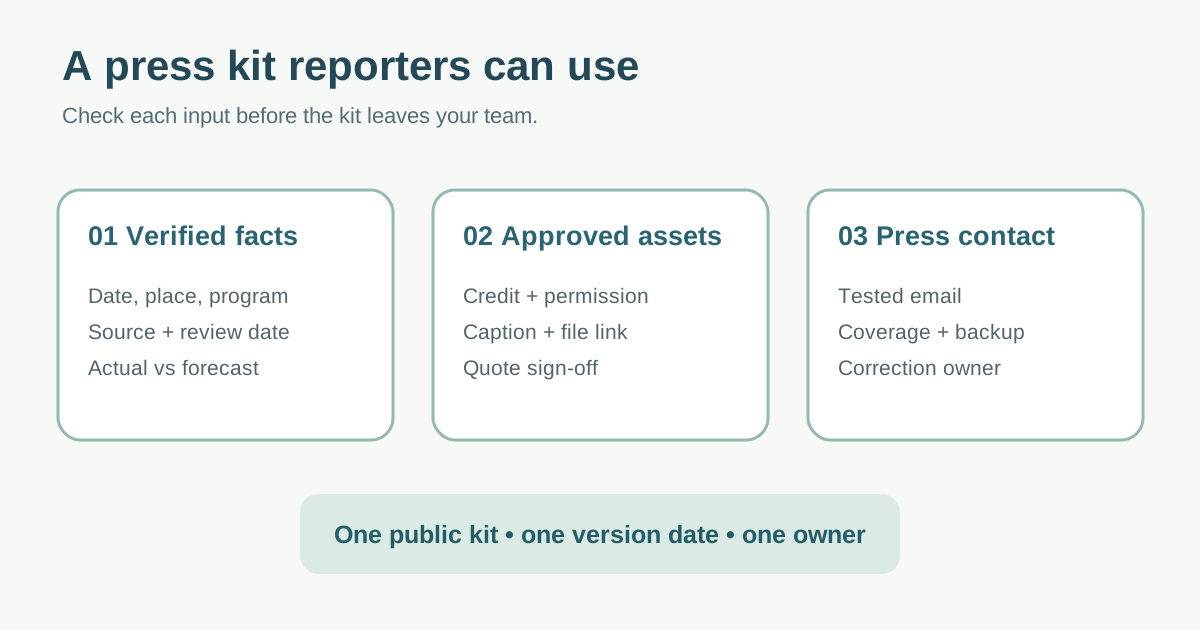
A journalist covering an event needs more than a poster. They need current facts they can check, assets they may actually use and someone who can answer a question on deadline. This event-specific press kit template gives each item a source, approver and update owner. It is a working package, not a promise of coverage: replace every placeholder, verify rights and publish only approved material.
Boletolibre editorial team
Published
Download the editable event press kit
Download the event press kit and asset register (Markdown, English)
The template contains a one-page event fact sheet, short and long descriptions, quote approvals, an asset register and a media-response log. It is intentionally editable rather than a finished promotional claim. Smartsheet’s event press kit template confirms that this search often expects a usable document with event name, venue, date and purpose; the worksheet adds source and permission checks that a graphic layout alone cannot provide.[2]
Put the verified event facts first
Start with the event name, edition or year, organizer, date and time with timezone, venue and address or online format, audience eligibility, ticket or registration link, access information and a direct media contact. Identify which details are confirmed and which are still pending. If a venue or speaker changes, revise the kit and its version date together with the public event page.
Write a short description a reporter can use for orientation, then a longer paragraph explaining what will happen and why it matters. Present past attendance as a dated historical figure, current registrations as registrations and expected turnout as a labeled forecast. Do not invent a “record” crowd or reach figure. The first organic Prezly guide emphasizes a central source for facts, bios, assets and contact details; for an event, the date and live-change owner are especially important.[1]
| Fact | Evidence to check | Update owner |
|---|---|---|
| Date, time, place | Current approved event page and venue agreement | Event producer |
| Program and speakers | Approved agenda and speaker sign-off | Program lead |
| Attendance claim | Dated check-in or registration report; label actual/forecast | Data owner |
| Ticket and access link | Open the live page and check current terms | Ticketing and accessibility leads |
| Press contact | Test inbox and response coverage | Communications lead |
Package images with usable terms
For every image, logo, headshot, poster or video, provide a descriptive filename, caption, credit line, resolution or format, and a link to the downloadable original. Record who supplied it and what uses are approved. A speaker’s headshot, venue photo or sponsor logo is not automatically yours to sublicense to media; check the specific permission, contract and jurisdiction before publishing. The U.S. Copyright Office explains that a photographer generally owns their photograph initially under U.S. law; treat that as a reminder to check rights, not a universal rule for every contract or country.[4]
Separate unrestricted approved assets from items requiring a request or embargo. Remove private attendee images or identifying details unless their use is cleared. Include alt text or a descriptive caption so the asset’s subject is understandable even when it is not displayed. The Festival de Cannes press FAQ illustrates a real event separating posters, photos, press kits, press officers and schedules into media resources.[3]
Approve quotes and biographies before release
Ask the quoted person to approve exact wording, name, title and attribution. Keep the approval date and owner in the internal register. Do the same for speaker bios and sponsor descriptions; a draft from an old event can be factually wrong even when it sounds polished. If the quote is not approved, omit it. Do not write a testimonial on a partner’s behalf.
A press kit is not a press release. You may link a separately approved announcement, but the kit should remain a reusable reference after that announcement becomes old. Give reporters a stable facts page and downloadable assets instead of forcing them to extract details from an image-heavy PDF.
Publish, test and maintain one source of truth
Host the kit at a stable page or shared folder that opens without an unnecessary sign-in for intended media. Test it in a private browser: download links, filenames, contact address, mobile view and any access restrictions. Link to the public event page for attendee-facing facts rather than maintaining contradictory copies. Prezly recommends an online newsroom for updateable assets; a small organizer can achieve the same practical access with a simple maintained page and folder.[1]
Add a visible version date. Name one person who updates the kit when the event is postponed, a speaker withdraws or a photo permission changes. Keep an internal change log and notify recipients who already received a material correction. After the event, label the kit archival and replace live registration or schedule claims with the final status. A media kit can improve accuracy and convenience; it cannot guarantee coverage.
Sources and further reading
- Press Kit: What It Is, Templates & ExamplesPrezly · Accessed
- Free Press Kit Templates — Event Press Kit TemplateSmartsheet · Accessed
- Press FAQ and downloadable materialsFestival de Cannes · Accessed
- What Photographers Should Know about CopyrightU.S. Copyright Office · Accessed