Workshop materials checklist: set capacity by the limiting activity
A list of pens and handouts is only the start. If 24 people register but only 12 can use the required tools, the workshop has 12 usable places until the activity changes. Build the capacity from each activity, the available materials, the room and the support people can actually provide.
Boletolibre editorial team
Published
Start with activities, not a shopping list
Write the outcome and each hands-on activity in order. For every activity, note whether people work alone, in pairs or at stations; how long they need the equipment; and what must be prepared, cleaned or reset between groups. The University of Kansas Community Tool Box treats workshop planning as a sequence of goals, audience, format and practical preparation, including materials and the number of participants. Use that sequence to derive supplies from the learning task rather than buying a generic kit.[2]
Ask the facilitator to name essential items, optional substitutes and the number of people they can support safely during the activity. Do not import a universal participant-to-facilitator ratio: a discussion, a craft table and supervised equipment have different constraints. Confirm the venue-approved room limit and workable table layout separately; a spreadsheet cannot authorize occupancy.
Count usable kits and stations
For each item record stock on hand, items that are usable after inspection, units needed per participant or group, and a spare or replacement plan. Shared equipment needs a station count and an explicit rotation schedule. If every participant must finish an activity, dividing people across stations is only valid when the allotted time and facilitation support allow the rotation.
| Constraint | Question to answer | Example of a decision |
|---|---|---|
| Individual kits | How many complete, usable sets can be assembled? | Cap places or source missing components |
| Shared stations | How many groups can use the equipment within the session? | Add a rotation or split into sessions |
| Facilitator support | Can each group get the guidance its activity needs? | Add qualified support or simplify the activity |
| Room and access | What layout and approved limit work for this activity? | Reduce seats or select another space |
The leading Google result lists participant packages and venue supplies such as aids, paper and AV equipment. Its list is useful as a prompt, but a sealed package, promotional items or a particular lead time is not a requirement for every workshop. Convert each item into a quantity, owner and testable readiness condition.[1]
Use the smallest real constraint as the booking cap
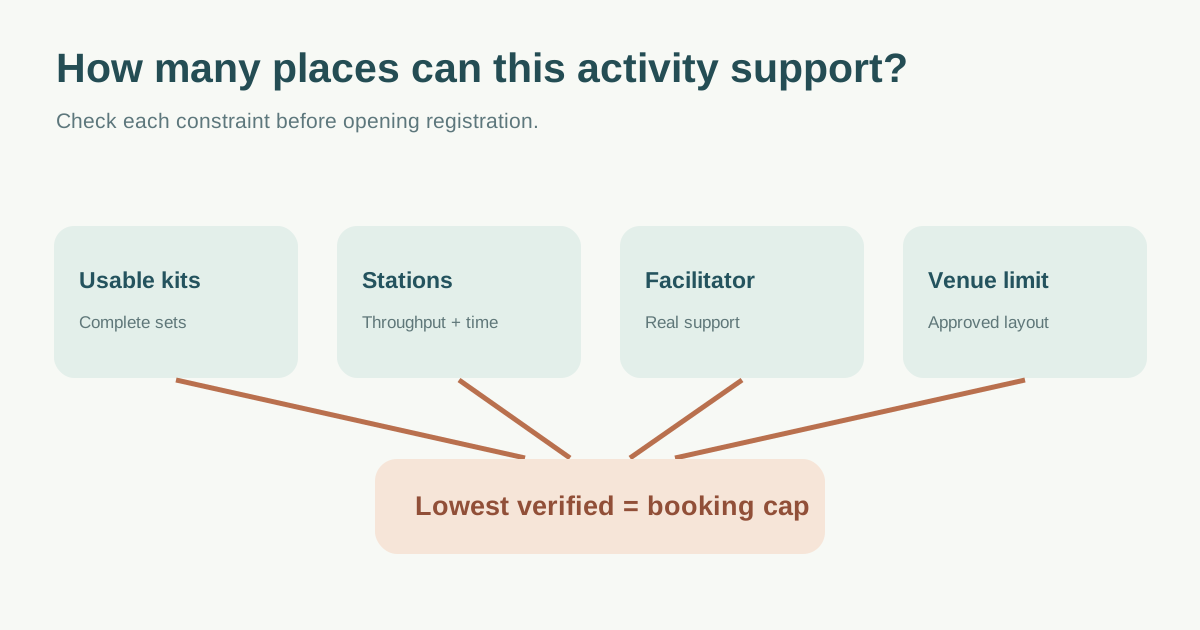
Compare complete kits, supported station throughput, facilitator capacity and the venue’s approved workable limit. The lowest verified number is the practical cap for this format. This is an operational planning rule, not an occupancy calculation or safety approval. If the result is below demand, record one deliberate change: acquire more usable materials, schedule another session, alter the activity with the facilitator, or limit registration.
For example, 18 complete kits, 12 supported station places and a venue limit of 30 still yield only 12 places for a single unrotated session. A second rotation may raise total participation only if time, reset work, accessibility and facilitation have been checked; do not silently count the same station twice.
Pack, test and assign a day-of decision owner
Prepare one clearly labeled kit or station set as the reference. Test the activity with the actual materials and a representative device or surface. Record damaged or missing stock, accessibility alternatives requested by participants, delivery owner, setup location, replenishment and cleanup. The University of Kansas training checklist calls for materials prepared before delivery; translate that into a named readiness check instead of a vague “supplies handled” task.[3]
Update the registration cap when a supplier delay or failed equipment check changes usable inventory. Tell participants about any activity change that affects what they must bring or do. Keep a fallback that preserves the learning outcome where possible, and have the facilitator approve it.
Download the workshop materials and capacity worksheet (Markdown, English)
Sources and further reading
- Workshop Materials and Supplies ChecklistHafla · Accessed
- Conducting a WorkshopUniversity of Kansas Community Tool Box · Accessed
- Delivering a Training Session — ChecklistUniversity of Kansas Community Tool Box · Accessed