Timed-entry ticket capacity planning: slots, dwell time and live counts
Timed entry lets a guest choose when to arrive. It can smooth the queue and simplify a long program, as the first Google result from Weeztix describes. But a cap on arrivals in each window is not automatically a cap on everyone still inside. Build slot inventory from the assessed site and zone limits, expected time on site, entrance flow and staff controls, then monitor what actually happens.
Boletolibre editorial team
Published
Define what a slot ticket allows
Write the event date, arrival-window start and end, last entry rule, whether the guest may stay beyond the window, any session or area entitlement, re-entry rule and late-arrival path. “10:00 ticket” is ambiguous if it could mean arrive at 10:00, enter anytime before 10:30 or leave at 10:30. Put the chosen wording on the product page, checkout, ticket and reminder. The leading Weeztix article uses a real seasonal event with all-day, morning, afternoon and evening products; those are distinct entitlements, not interchangeable names for the same window.[1]
If the ticketing platform supports per-slot inventory, confirm whether it shares stock with all-day passes, comp tickets, walk-ups, groups and offline sales. TicketingHub documents editable time-slot capacities for its product, but integrations and rules vary. Record the actual provider behavior before opening sales.[6]
Separate arrival flow from concurrent occupancy
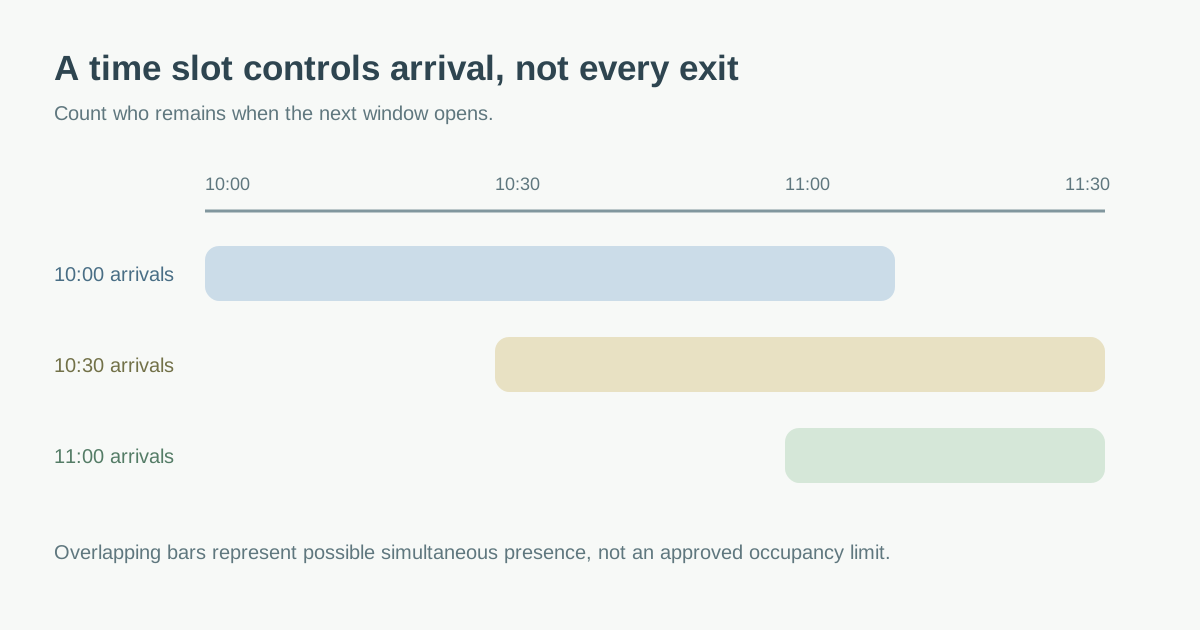
Start with the site-specific safe capacity and local zone limits approved for the actual layout; do not infer them from ticket software. Then map every ticket class into the time periods during which its holder might still be on site. For each period, estimate people present from earlier windows who have not left, plus new arrivals, staff and other counted populations. Use conservative dwell and late-arrival scenarios and ask the competent event safety team to review the assumptions. HSE guidance separates arrival/entry, circulation and leaving, and says safe capacity assessment is a key part of planning.[5][3]
| Question | Plan record | Risk if omitted |
|---|---|---|
| How many may enter in each window? | Slot inventory by product and channel | Queue or entrance surge |
| How long may guests remain? | Dwell scenario and exit observations | Overlap between windows |
| Who else is counted? | Staff, vendors, companions, all-day passes | Occupancy understatement |
| Where can people concentrate? | Zone limit and route check | Local overcrowding despite venue headroom |
A sold-out window can coexist with spare total capacity, and an under-sold window can still add too many people if earlier groups remain. Do not treat the first result’s statement that slot limits control how many are on site as a general guarantee. HSE recommends monitoring overall numbers and crowd distribution, including entrances, exits and bottlenecks.[1][4]
Translate the plan into ticket inventory and messages
Create only the dates, windows and products the operating team can honor. For every window, record the approved inventory ceiling, shared-pool link, sales channel, hold/release rules and owner. Reconcile all-day or multi-window passes and complimentary allocations with the same occupancy assumptions. Hold a test purchase and safe check-in rehearsal for early, on-time, late and duplicate arrivals; test what the scanner displays for a ticket outside its window. Ticketmaster says timed-entry tools can support inventory and session management, but the exact event and provider configuration still needs rehearsal.[2]
Tell guests their arrival window, exact entrance, expected screening steps, accessible arrival route, support contact and any change or transfer options that the actual policy permits. Do not promise a queue-free visit. Publish a clear route if a window must be changed or closed.
Monitor arrivals, occupancy and exceptions on the day
Assign an owner to compare sold inventory, scans and observed entry/exit counts at agreed intervals. HSE describes counting at entry and exit and watching local crowd distribution. If exits are not reliably counted, treat modeled dwell as an uncertainty and use the competent safety plan’s conservative control, not a spreadsheet assumption that everyone leaves on time. Record the threshold and person authorized to pause entry, redirect arrivals or reduce remaining inventory.[4][3]
The worksheet keeps arrival-window inventory, overlap assumptions, access rules, observation method and escalation owner together. It is a planning aid, not a venue occupancy certificate or safety approval. Revisit it when event layout, program duration, transport or ticket mix changes.[5]
Download the timed-entry inventory and occupancy worksheet (Markdown, English)
Sources and further reading
- Timed entry ticketing: how time slots solve capacity managementWeeztix on LinkedIn · Accessed
- Timed-Entry Ticketing Solutions To Help Organizers Reduce Queues and Manage DemandTicketmaster Business · Accessed
- Put crowd controls in placeUK Health and Safety Executive · Accessed
- Monitor the crowdUK Health and Safety Executive · Accessed
- Assess crowd safety risks and identify hazardsUK Health and Safety Executive · Accessed
- How to Set Availability and CapacitiesTicketingHub Help Desk · Accessed